Week 1: Week 1 Content
Grade 5 Science | Rosche | Kairos Academies
The Phenomenon: The Mystery Water Samples
Anchoring Context and Focus Question
Before We Begin: Activate Your Prior Knowledge
Think about what you already know: You have learned that everything around us is called matter. Water, air, rocks - all matter! This week: How can we test water without tasting it to figure out what might be in it? Scientists use properties to identify what is in matter!
The Mystery:
- A scientist gives you 4 cups of water that all look the same
- Only ONE is safe to drink - the others could make you sick!
- You cannot taste them (too dangerous!)
- How can you figure out which water is safe?
What tests could help you solve this mystery?
Vocabulary
| Term | Definition |
|---|---|
| particles | Tiny pieces that make up all matter - too small to see with your eyes |
| matter | Anything that takes up space and has mass (weight) - solids, liquids, and gases |
| property | Something you can observe or measure about matter (like color, smell, or temperature) |
| states of matter | The three forms matter can take: solid, liquid, or gas |
| dissolve | When a substance breaks into tiny pieces and mixes completely into a liquid (becomes invisible) |
St. Louis Connection
The Missouri Department of Natural Resources tests water across our state every day! They measure properties like pH, temperature, and oxygen levels to make sure water in the Mississippi and Missouri Rivers is safe for fish and people. Scientists in St. Louis use the same tests you will learn about today!
Why This Matters to YOU
Every time you drink water from a fountain or faucet, scientists have already tested it to make sure it is safe. Understanding water properties helps protect people, animals, and the environment. Today, YOU will think like a water scientist!
Focus Question: How can we figure out what is in water without tasting it?
By the end of this lesson, you will be able to:
- Explain that all matter is made of tiny particles too small to see
- Describe properties that can be observed and measured
- Identify properties of water that indicate safety (color, odor, pH)
- Design a simple test to compare water samples
Worked Example: Using Properties to Identify Water Samples
Step-by-Step Problem Solving
The Problem
You have two clear water samples. Sample A has no smell. Sample B has a rotten egg smell. Which one is more likely to be safe? How do you know?
Step-by-Step Solution
Step 1: Identify the property being tested
"The property being tested is SMELL (odor). This is something I can observe without tasting."
Step 2: Compare the observations
"Sample A: no smell. Sample B: rotten egg smell. A bad smell often means something harmful is in the water."
Now YOU Complete Steps 3-4:
Step 3: Based on the smell property, which sample is more likely to be safe? Write your answer.
Step 4: What OTHER properties could you test to be even more sure? (Think: color, pH, temperature...)
Hook - The Mystery Water Samples
12 Points | ~8 Minutes
Think about how to solve the mystery!
The Challenge
What You Will Do (~8 minutes)
- Think about how to test water without tasting it (2 min)
- Predict what tests could help identify what is in water (2 min)
- Review what you know about properties of matter (2 min)
- Check your understanding of particles (2 min)
Need help? Click for hints
Sentence starters and key concepts.
Key Concept Reminder:
- Properties are things you can OBSERVE (see, smell, feel) or MEASURE (temperature, pH)
- Matter is made of tiny particles too small to see
Sentence Starters:
- "I can test water by looking at..."
- "A property of matter is..."
- "Particles are..."
Stuck? Click here for step-by-step CER help
Detailed walkthrough when you need more guidance.
Try these steps in order:
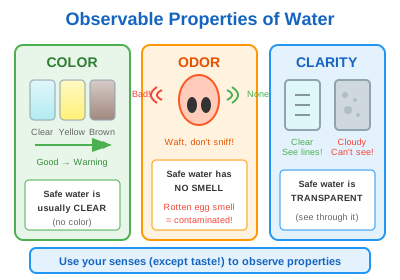
- Think: What can you observe about water? (color, smell, clarity)
- Think: What can you measure about water? (temperature, pH level)
- A property = something you observe or measure about matter
- All matter (including water) is made of tiny particles
- When you dissolve something, the particles are still there - just too small to see!
COMPLETE THE HOOK FORM BELOW
Submit your predictions before moving to Station 1.
[EMBED G5.U5.2.W1 Hook Form Here]
Complete Your Worksheet - Click to Expand
Complete the "MYSTERY" section on your worksheet:
- Write the driving question
- List at least 2 ways to test water without tasting it
Bonus: +2 points for completing this section!
Station 1 - Particles in Matter
20 Points | ~15 Minutes
Explore how particles behave using a simulation.
Your Mission: Discover Particles!
PhET Simulation: States of Matter Basics
Open this link: States of Matter: Basics
- Click on "Water"
- Watch the particles move around
- Try heating and cooling the water
- Notice how particles behave differently!
What to Look For:
- Are particles still or moving?
- What happens when you add heat?
- Can you see individual particles?
Need help? Click for hints
Sentence starters and key concepts.
Key Concept Reminder:
- ALL matter is made of particles - even things you cannot see!
- Particles are always moving, even in solids
- Adding heat makes particles move FASTER
Sentence Starters:
- "In the simulation, I can see that water is made of..."
- "When I add heat, the particles..."
- "This is evidence that matter is made of particles because..."
Stuck? Click here for step-by-step CER help
Detailed walkthrough when you need more guidance.
Try these steps in order:
- Open the simulation and click "Water"
- Look at the container - you see many tiny dots. Those are PARTICLES!
- Watch: Are the dots still or moving? (They should be moving)
- Click the heat button - watch the dots speed up and spread apart
- This shows: Water is made of many tiny particles that are always moving
COMPLETE THE STATION 1 FORM BELOW
[EMBED G5.U5.2.W1 Station 1 Form Here]
Complete Your Worksheet - Click to Expand
Complete the "STATION 1" section on your worksheet:
- Draw particles in solid, liquid, and gas
- Describe how particles move when heated
Bonus: +3 points for detailed drawings!
Station 2 - Analyzing Water Test Data
20 Points | ~13 Minutes
Use data to identify which water sample is safe.
Your Mission: Analyze Water Test Results
Scientists tested 4 water samples:
| Sample | Color | Smell | pH Level | Particles Visible? |
|---|---|---|---|---|
| A | Clear | None | 7 (neutral) | No |
| B | Cloudy | Bad smell | 4 (acidic) | Yes |
| C | Clear | None | 7 (neutral) | No |
| D | Yellow | Chlorine | 7 (neutral) | No |
Look for Warning Signs:
- Bad smell = something harmful might be in the water
- Acidic pH = not healthy for drinking
- Visible particles = something is mixed in
- Strange color = might have contamination
Need help? Click for hints
Sentence Starters:
- "Sample ___ probably has something bad because..."
- "The properties that told me something was wrong were..."
- "To learn more about Sample B, I could test..."
Stuck? Click here for step-by-step CER help
Look at each sample:
- Sample A: Clear, no smell, neutral pH, no particles - looks safe!
- Sample B: Cloudy, bad smell, acidic, visible particles - WARNING SIGNS!
- Sample C: Similar to A - might be safe, but similar to A
- Sample D: Yellow color and chlorine smell - chlorine is used to clean water
- Sample B has the most warning signs
COMPLETE THE STATION 2 FORM BELOW
[EMBED G5.U5.2.W1 Station 2 Form Here]
Complete Your Worksheet - Click to Expand
Complete the "STATION 2" section on your worksheet:
- Write which sample has warning signs
- List the properties that told you something was wrong
Bonus: +3 points for explaining your reasoning!
Station 3 - Design a Water Test
25 Points | ~20 Minutes
Design your own investigation to test fish tank water.
Your Mission: Design a Water Test for Fish
The Scenario:
You want to find out if water is safe for fish to live in. Fish need clean water with the right properties. Design a test to check if water is good for fish!
What Fish Need:
- Temperature: Fish need certain temperatures (not too hot, not too cold)
- pH level: Fish need neutral water (pH around 7)
- Oxygen: Fish breathe oxygen from water
- Clean water: No harmful particles or chemicals
Need help? Click for hints
Sentence Starters:
- "My question about the water is..."
- "I would test ___ because fish need..."
- "The tools I would need are..."
- "It is important to test water before putting fish in because..."
Stuck? Click here for step-by-step CER help
Build your investigation:
- Question: "Does this water have the right temperature for fish?"
- Properties to test: Temperature, pH level, oxygen amount
- Tools needed: Thermometer (temperature), pH strips (acidity), oxygen test kit
- Why it matters: Fish can get sick or die if the water is wrong
COMPLETE THE STATION 3 FORM BELOW
[EMBED G5.U5.2.W1 Station 3 Form Here]
Exit Ticket - Properties and Particles
23 Points | ~15 Minutes
Show what you learned!
Exit Ticket Structure:
- 2 NEW - Questions about particles and properties from this week
- 2 SPIRAL - Review questions about matter and dissolving
- 1 INTEGRATION - Connect particles to what we can and cannot see in water
- 1 REFLECTION - What questions do you still have?
COMPLETE THE EXIT TICKET BELOW
Take your time and show your best thinking!
[EMBED G5.U5.2.W1 Exit Ticket Form Here]
Complete Your Worksheet - Click to Expand
Turn in your completed worksheet to your teacher!
Up to 15 bonus points for complete worksheet!
Enrichment and Extension
Optional deep dives into water science and scientist profiles.
Systems Thinking Reflection
Water connects everything! Think about these connections.
Cause and Effect Chain
Pollution enters river -> Water properties change -> Fish get sick -> People notice -> Scientists test the water -> ?
Your turn: What happens next in this chain?
Hidden Connections
Rain falls on farms -> Fertilizer washes into streams -> Streams flow into rivers -> Rivers flow to the ocean...
Your turn: How does water in St. Louis connect to the ocean?
Scientist Spotlight: Dr. Mae C. Jemison
Dr. Mae C. Jemison became the first Black woman to travel to space in 1992. Before becoming an astronaut, she was a doctor and Peace Corps volunteer. On the Space Shuttle Endeavour, she conducted experiments about how living things behave in space - including how fluids (like water) move differently without gravity!
Her advice to students: "Never be limited by other people's limited imaginations. If you adopt their attitudes, then the possibility won't exist because you'll have already shut it out."
Week 1 Complete!
Great job exploring particles and properties! Next week, you will learn how to separate mixtures and solutions.