Week 2: Week 2 Content
Grade 5 Science | Rosche | Kairos Academies
The Phenomenon: The Muddy Fish Tank
Anchoring Context and Focus Question
Before We Begin: Activate Your Prior Knowledge
Think back to Week 1: You learned that matter is made of tiny particles. Some particles are too small to see - like when sugar dissolves in water. This week: How can we SEPARATE things that are mixed in water? Can we get the dirt OUT? Can we get dissolved minerals BACK?
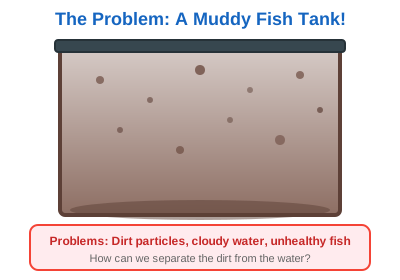

The Problem:
- Someone accidentally put dirt in the fish tank!
- The water is now muddy - the fish cannot see!
- The water also has dissolved minerals that we cannot see
- How can we clean the water so the fish can be healthy?
What methods can separate different things from water?
Vocabulary
| Term | Definition |
|---|---|
| filter | A material with tiny holes that lets small things through but traps big things |
| mixture | Two or more substances combined but not chemically joined (can be separated) |
| dissolve | When a substance breaks into tiny pieces and mixes completely into a liquid (becomes invisible) |
| evaporate | When a liquid turns into a gas (like water becoming water vapor) |
| particle | A tiny piece of matter - can be big enough to see (dirt) or too small to see (dissolved salt) |
| solution | A mixture where something is dissolved (like salt water) - looks clear but has stuff in it |
St. Louis Connection
The Missouri Botanical Garden in St. Louis has special water gardens! Scientists there must keep the water clean for fish, plants, and visitors to enjoy. They use filtration systems similar to what you will learn about today. The Chain of Rocks Water Treatment Plant also uses giant filters to clean water for 2 million people in the St. Louis area!
Why This Matters to YOU
Have you ever used a coffee filter or a pool filter? These are everyday examples of filtration! Understanding how to separate mixtures helps engineers design water treatment plants, recycling systems, and even medical equipment. The skills you learn today could help solve real water problems!
Focus Question: How can we separate things mixed in water to make it healthier?
By the end of this lesson, you will be able to:
- Explain that filtration separates mixtures based on particle SIZE
- Describe how evaporation can recover dissolved substances
- Select appropriate separation methods for different mixture types
- Apply conservation of matter to separation processes
NGSS 3D Standards - Click to View
This Week's Standards
5-PS1-2: Measure and graph quantities to provide evidence that matter is made of particles too small to be seen.
5-PS1-4: Conduct an investigation to determine whether the mixing of two or more substances results in new substances.
Spiral Standards (Review)
- 5-PS1-3 (Week 1): Make observations to identify materials based on their properties
Worked Example: Choosing the Right Separation Method
Step-by-Step Problem Solving
The Problem
You have a cup of water with sand at the bottom AND dissolved salt. How can you separate BOTH the sand AND the salt from the water?
Step-by-Step Solution
Step 1: Identify what needs to be separated
"I need to remove two things: SAND (big particles I can see) and SALT (dissolved - too small to see)."
Step 2: Match each substance to the right method
"Sand = BIG particles, so FILTRATION will catch them. Salt = DISSOLVED (tiny particles), so filtration will not work. I need EVAPORATION to get the salt back."
Now YOU Complete Steps 3-4:
Step 3: In what ORDER should you use these methods? Filter first or evaporate first? Why?
Step 4: After both steps, what will you have? (Hint: You will have separated THREE things!)
Hook - The Muddy Water Mystery
12 Points | ~8 Minutes
How can we clean the fish tank water?
The Challenge
What You Will Do (~8 minutes)
- Think about what happens to dirt in water if you just wait (2 min)
- Predict which method would clean muddy water quickly (2 min)
- Think about WHY removing dirt is important for fish (2 min)
- Make your best prediction about the best cleaning method (2 min)
Need help? Click for hints
Sentence starters and key concepts.
Key Concept Reminder:
- Dirt particles are HEAVY - they can sink to the bottom over time
- A filter has tiny holes that can trap big particles
Sentence Starters:
- "I can separate dirt from water by..."
- "Removing dirt is important because fish need..."
- "I think the best method would be... because..."
Stuck? Click here for step-by-step CER help
Detailed walkthrough when you need more guidance.
Try these steps in order:
- Think: Dirt is heavier than water. If you wait, dirt will SINK to the bottom.
- But waiting takes a long time! Is there a faster way?
- A FILTER can catch dirt particles - like a coffee filter or fish net.
- Fish need clean water to breathe and see their food.
- Filtering is probably the FASTEST way to clean muddy water!
COMPLETE THE HOOK FORM BELOW
Submit your predictions before moving to Station 1.
[EMBED G5.U5.2.W2 Hook Form Here]
Complete Your Worksheet - Click to Expand
Complete the "MYSTERY" section on your worksheet:
- Write the driving question
- Draw a quick picture of your prediction for cleaning muddy water
Bonus: +2 points for completing this section!
Station 1 - Filtration Investigation
20 Points | ~15 Minutes
Learn how filters separate mixtures by SIZE.
Your Mission: Understand How Filters Work
Watch the Filtration Video
Watch this video showing how filters separate mixtures: Water Filtration Demo
As you watch, notice: What goes through the filter? What gets trapped?
The Key Idea: SIZE Matters!
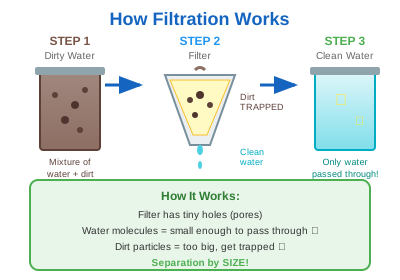
- Filters have tiny HOLES in them
- Particles BIGGER than the holes get TRAPPED
- Particles SMALLER than the holes go THROUGH
- Dissolved particles are SO tiny they go through any filter!
Need help? Click for hints
Sentence starters and key concepts.
Key Concept Reminder:
- Think of a filter like a net - big fish get caught, small fish swim through
- Dirt = big particles = gets trapped
- Dissolved salt = tiny particles = goes through
Sentence Starters:
- "A filter works by..."
- "Dirt gets trapped because..."
- "You cannot filter dissolved salt because..."
Stuck? Click here for step-by-step CER help
Detailed walkthrough when you need more guidance.
Try these steps in order:
- A filter is like a strainer or net with tiny holes
- Water can fit through the tiny holes
- Dirt particles are BIGGER than the holes, so they get STUCK
- But dissolved salt? Those particles are SO tiny they fit right through
- So: Filters work for dirt, but NOT for dissolved stuff!
COMPLETE THE STATION 1 FORM BELOW
[EMBED G5.U5.2.W2 Station 1 Form Here]
Complete Your Worksheet - Click to Expand
Complete the "STATION 1" section on your worksheet:
- Write 2 things: What a filter catches AND what goes through
- Draw a diagram showing how filtration works
Bonus: +3 points for detailed explanation!
Station 2 - Evaporation Investigation
20 Points | ~13 Minutes
Learn how evaporation recovers dissolved substances.
Your Mission: Discover What Evaporation Leaves Behind
PhET Simulation: Sugar and Salt Solutions
Open this link: Sugar and Salt Solutions
- Click the "Evaporation" tab
- Add some salt to the water
- Watch what happens when water evaporates
- Spend 5 minutes exploring!
The Key Idea: Evaporation Separates Solutions!
- Water can turn into a GAS (water vapor) and float away
- Dissolved substances like salt CANNOT turn into gas
- When water evaporates, the salt stays behind as solid crystals!
- Important: The salt is NOT destroyed - same amount, just visible now!
Need help? Click for hints
Sentence Starters:
- "When water evaporates, the salt..."
- "Evaporation works for dissolved substances because..."
- "If I dissolve 10 grams of salt and evaporate the water, I will have..."
Stuck? Click here for step-by-step CER help
Think about it this way:
- When you boil water, it turns into steam (gas) and floats away
- But salt cannot turn into gas - it stays behind!
- In the simulation, watch the water level go down
- See those white crystals appearing? That is the salt that was dissolved!
- The salt was always there - just invisible when dissolved
COMPLETE THE STATION 2 FORM BELOW
[EMBED G5.U5.2.W2 Station 2 Form Here]
Complete Your Worksheet - Click to Expand
Complete the "STATION 2" section on your worksheet:
- Draw a before/after picture: Salt water in a cup BEFORE, and empty cup with salt crystals AFTER
Bonus: +3 points for showing where the water went!
Station 3 - Design a Separation System
25 Points | ~18 Minutes
Choose the right method for different mixtures.
Your Mission: Match Methods to Mixtures
You Know Two Methods:
- FILTRATION - Traps BIG particles (like dirt, sand, leaves)
- EVAPORATION - Removes water, leaves dissolved stuff behind (like salt, sugar)
Quick Reference: Which Method for What?
| What to Separate | Method | Why |
|---|---|---|
| Sand from water | Filtration | Sand particles are big |
| Dissolved salt from water | Evaporation | Salt particles are too small for filters |
| Sand AND salt from water | Both! | Filter first, then evaporate |
Need help? Click for hints
Sentence Starters:
- "I would use ___ to separate ___ because..."
- "To clean dirty pond water, first I would... then I would..."
- "Filtration is fastest because..."
Stuck? Click here for step-by-step CER help
Follow this decision tree:
- Ask: Can I SEE what I want to remove? (Is it big particles?)
- If YES (dirt, sand, leaves) → Use FILTRATION
- If NO (dissolved salt, sugar) → Use EVAPORATION
- If BOTH visible and dissolved stuff → Filter FIRST, then evaporate!
- For fish tank water with mud: Filtration is fastest and safest!
COMPLETE THE STATION 3 FORM BELOW
[EMBED G5.U5.2.W2 Station 3 Form Here]
Complete Your Worksheet - Click to Expand
Complete the "STATION 3" section on your worksheet:
- Draw your water cleaning system design
- Label each step with what it removes
Bonus: +3 points for explaining WHY each step works!
Exit Ticket - Separating Mixtures
23 Points | ~15 Minutes
Show what you learned!
Exit Ticket Structure:
- 2 NEW - Questions about filtration and evaporation from this week
- 2 SPIRAL - Review questions about particles and properties from Week 1
- 1 INTEGRATION + SEP - Connect properties to separation methods
- - Explain why water treatment plants use multiple methods
COMPLETE THE EXIT TICKET BELOW
Take your time and show your best thinking!
[EMBED G5.U5.2.W2 Exit Ticket Form Here]
Complete Your Worksheet - Click to Expand
Turn in your completed worksheet to your teacher!
Up to 15 bonus points for complete worksheet!
Enrichment and Extension
Optional deep dives into water treatment and scientist
profiles.
Systems Thinking Reflection
Water treatment is a SYSTEM with many connected parts!
Cause and Effect Chain
Dirty water enters treatment plant -> Filters remove particles -> Chemicals kill bacteria -> Clean water goes to homes -> ?
Your turn: What happens to the stuff that gets filtered out?
Multiple Methods
Water treatment plants use filtration, chemicals, UV light, AND more. Why do they need so many methods?
Your turn: What would happen if they only used filtration?
Scientist Spotlight: Ellen Swallow Richards
Ellen Swallow Richards (1842-1911) was the first woman admitted to MIT! She became a pioneer in water quality testing and sanitation science. She tested water samples across Massachusetts to help cities understand their water quality - work that helped lead to modern water treatment systems.
Her advice to students: "There is no such thing as luck. It is merely the meeting of preparation with opportunity."
Real World: How Do They Make Ocean Water Drinkable?
In places without freshwater, engineers use a process called desalination to remove salt from ocean water. One method uses the evaporation principle you learned about! Water evaporates, leaving salt behind, then the water vapor is collected and cooled back into liquid fresh water.
Think about it: If 10 grams of salt are dissolved in ocean water and you evaporate all the water, how much salt will be left? (Hint: Remember conservation of matter!)
Week 2 Complete!
Great job learning about separating mixtures and solutions! Next week, you will use these skills to engineer a water filtration system!