Week 3: Week 3 Content
Grade 5 Science | Rosche | Kairos Academies
The Phenomenon: The Dirty Water Crisis
Anchoring Context and Focus Question
Before We Begin: Activate Your Prior Knowledge
Think back to W1 and W2: You learned that matter has different properties (mass, volume, dissolving ability). Some substances dissolve in water, others do not. This week: How can we use what we know about matter properties to separate harmful substances from water? Engineering uses science to solve real problems!
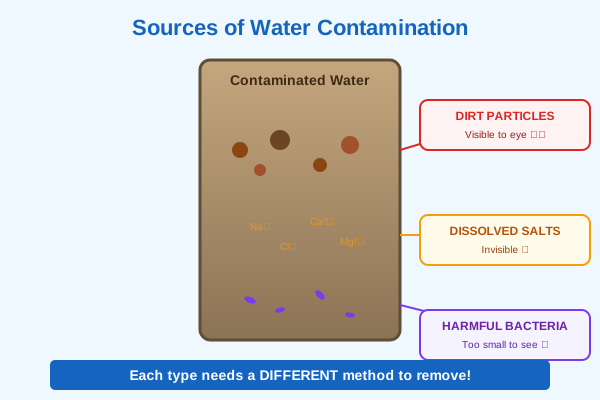
A community faces a serious problem:
- Their only water source has dirt and sand particles (visible particles)
- The water contains dissolved salt and minerals (invisible but harmful in large amounts)
- Harmful bacteria are present (too small to see)
- They need clean water for drinking, cooking, and washing
How can we design a system to make this water safe to drink?
Vocabulary
| Term | Definition |
|---|---|
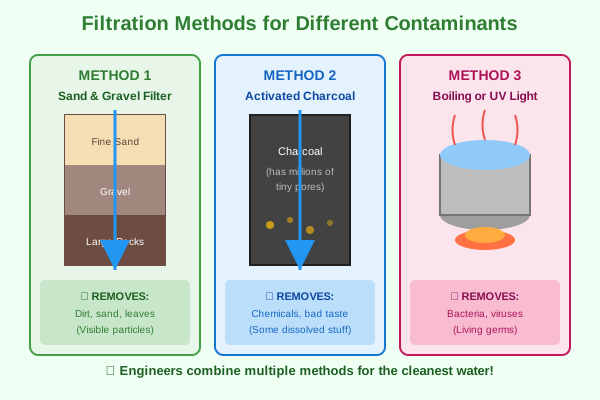
| filtration | Separating solid particles from a liquid by passing it through a material with tiny holes |
| evaporation | When a liquid turns into a gas, leaving dissolved solids behind |
| dissolved | When a substance breaks into tiny pieces and mixes completely into a liquid (invisible) |
| contamination | When harmful substances get into something (like water) |
| prototype | A first model of something used to test if the design works |
| criteria | The requirements that a good solution must meet |
St. Louis Connection
St. Louis gets its drinking water from the Missouri and Mississippi Rivers! The water travels through a treatment plant where engineers use filtration, chemicals, and UV light to remove dirt, bacteria, and harmful substances. The Chain of Rocks Water Treatment Plant processes 140 million gallons per day to keep our water safe!
Why This Matters to YOU
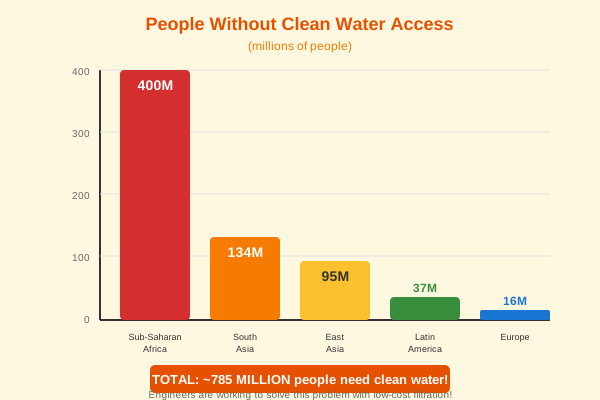
About 785 million people worldwide lack access to clean water. Engineers are working to solve this problem using simple, low-cost solutions. Today, YOU become an engineer designing a water filtration system. The skills you learn could help solve real problems in your community!
Focus Question: How can we design a water filtration system that removes different types of contaminants using simple materials?
By the end of this lesson, you will be able to:
- Identify different types of water contamination (particles, dissolved substances, bacteria)
- Explain how filtration and evaporation separate different substances
- Use the Engineering Design Process to plan a solution
- Design and evaluate a water filtration prototype
▼ NGSS 3D Standards - Click to View ▼
This Week's Standards
5-PS1-4: Conduct an investigation to determine whether the mixing of two or more substances results in new substances.
3-5-ETS1-1: Define a simple design problem reflecting a need or want that includes criteria for success and constraints on materials.
Spiral Standards (Review)
- 5-PS1-1 (Week 1): Matter is made of particles too small to see
- 5-PS1-3 (Week 2): Some substances dissolve, others do not
Worked Example: Choosing the Right
Separation Method
Step-by-Step Problem Solving
The Problem
You have a cup of water that contains: (1) sand at the bottom, (2) dissolved salt you cannot see, and (3) floating leaves. Which method(s) would you use to get clean water?
Step-by-Step Solution
Step 1: Identify what needs to be removed
"First, I will list what is in the water: Sand (solid particles, visible), Leaves (solid, floating), Salt (dissolved, invisible)."
Step 2: Match each contaminant to a removal method
"Sand and leaves are solid particles, so FILTRATION will work. But salt is dissolved, it will pass right through a filter. I need EVAPORATION to remove dissolved salt."
Now YOU Complete Steps 3-4:
Step 3: In what ORDER should you use these methods? (Hint: Can you evaporate water that still has sand in it?)
Step 4: What would happen if you ONLY used filtration? Would the water be safe to drink? Explain.
Hook - Clean Water Challenge
12 Points | ~8 Minutes
Observe the problem and make initial predictions.
The Challenge
What You Will Do (~8 minutes)
- Observe the dirty water sample (or images) - what do you notice? (2 min)
- Identify at least 3 things that make the water unsafe (2 min)
- Predict which materials might help clean the water (2 min)
- Consider the Engineering Design Process steps (2 min)
COMPLETING THIS AT HOME?
Think about these questions:
- What makes water "dirty" or unsafe to drink?
- Have you ever seen a water filter at home (like a Brita)?
- What materials might catch solid particles?
- Can a filter remove things you cannot see?
Need Hints? — CER Scaffold + Sentence Starters
Sentence starters and key concepts.
Key Concept Reminder:
- Water can have visible things (dirt, leaves) AND invisible things (dissolved salt, bacteria)
- Engineers follow steps: Define the problem, Research, Imagine solutions, Plan, Create, Test
Sentence Starters:
- "I notice the water has..."
- "This water is unsafe because..."
- "I think we could use ___ to remove ___..."
Stuck? Click for step-by-step help
Detailed walkthrough when you need more guidance.
Try these steps in order:
- Look at the water - write down everything you SEE (color, particles, floating things)
- Think about things you CANNOT see but might be there (salt? germs?)
- For each contaminant, ask: "Is this a solid particle or something dissolved?"
- Solid particles can be filtered. Dissolved things need a different method.
- Write your initial ideas - they do not have to be perfect!
COMPLETE THE HOOK FORM BELOW
Submit your observations and predictions before moving to Station 1.
Complete Your Worksheet - Click to Expand
Complete the "AFTER HOOK FORM" section on your worksheet:
- Write what you observed about the dirty water
- List at least 2 ideas for cleaning the water
Bonus: +2 points for completing this section!
Station 1 - Engineering Design
Process
20 Points | ~15 Minutes
Learn the steps engineers use to solve problems.
Your Mission: Master the Engineering Design Process
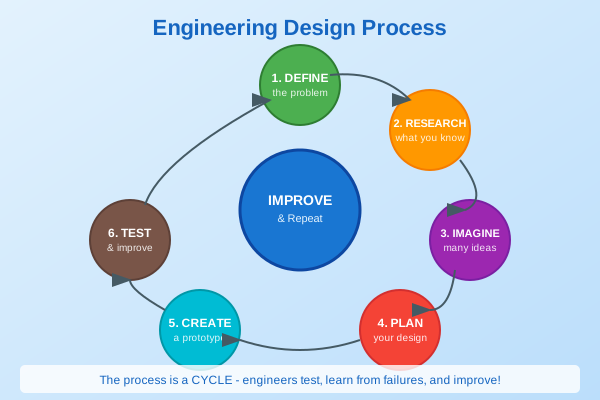
The 6 Steps of Engineering Design:
- DEFINE the problem - What needs to be solved? What are the requirements?
- RESEARCH - What do you already know? What do you need to find out?
- IMAGINE - Brainstorm multiple possible solutions
- PLAN - Choose your best idea and create a detailed plan
- CREATE - Build a prototype (first model)
- TEST and IMPROVE - Does it work? How can you make it better?
Key Terms for Your Design:
- Criteria: What must your solution do? (Example: "Must remove visible dirt")
- Constraints: What limits do you have? (Example: "Only use materials provided")
COMPLETING THIS AT HOME?
Think about how you would apply each step to the water filtration problem:
- DEFINE: "I need to remove dirt, salt, and bacteria from water"
- RESEARCH: "Filters catch solid particles. Evaporation removes dissolved substances."
- IMAGINE: Draw 2-3 different designs
- PLAN: Choose your best idea and list the steps to build it
▼ Need Hints? — CER Scaffold + Sentence Starters ▼
Sentence Starters:
- "The problem I need to solve is..."
- "My design must be able to..."
- "One constraint I have is..."
- "I think my best idea is ___ because..."
▼ Stuck? Click for step-by-step help ▼
Try these steps in order:
- DEFINE: Write "I need to remove ___, ___, and ___ from water"
- RESEARCH: List what you learned - filtration removes solids, evaporation removes dissolved substances
- IMAGINE: Draw at least 2 different designs - they do not need to be perfect
- PLAN: Pick your best design and list the materials you would need
- Ask yourself: Does my design address ALL three types of contamination?
COMPLETE THE STATION 1 FORM BELOW
Complete Your Worksheet - Click to Expand
Complete the "STATION 1" section on your worksheet:
- Write your criteria (what your filter must do)
- Write your constraints (what limits you have)
- Sketch at least 2 possible designs
Bonus: +3 points for detailed sketches!
Station 2 - Design Your Solution
20 Points | ~13 Minutes
Plan and create your water filtration design.
Your Mission: Design a Multi-Stage Water Filter
Design Requirements:
- Must remove dirt and sand (large visible particles)
- Should remove dissolved minerals (like salt) if possible
- Can be built with simple materials (sand, gravel, cotton, charcoal, etc.)
- Should work without electricity
Material Properties - Which to Use?
| Material | What It Removes | Why |
|---|---|---|
| Gravel | Large debris (leaves, sticks) | Big gaps catch big particles |
| Sand | Medium particles (dirt) | Smaller gaps than gravel |
| Cotton/Cloth | Fine particles | Very small gaps between fibers |
| Charcoal | Some chemicals, odors | Chemicals stick to charcoal surface |
Need Hints? — CER Scaffold + Sentence Starters
Design Tip:
Layer materials from LARGEST gaps to SMALLEST gaps. This way, big particles get caught first and do not clog the fine filter.
Sentence Starters:
- "My first layer will be ___ because..."
- "I chose this order because..."
- "To remove dissolved salt, I would need to..."
Stuck? Click for step-by-step help
Example Design (you can modify this):
- Top layer: Gravel (catches leaves, large debris)
- Middle layer: Sand (catches dirt particles)
- Bottom layer: Cotton or cloth (catches fine particles)
- Optional: Charcoal layer for chemicals/odors
Remember: This removes PARTICLES but not dissolved substances or bacteria!
COMPLETE THE STATION 2 FORM BELOW
Complete Your Worksheet - Click to Expand
Complete the "STATION 2" section on your worksheet:
- Draw your final design with labeled layers
- Explain what each layer removes and why
Bonus: +3 points for explaining the science!
Station 3 - Unit Synthesis
25 Points | ~18 Minutes
Connect all the big ideas from the unit.
Your Mission: Putting It All Together
Unit Big Ideas - Connect Them!
- Week 1: Matter is made of tiny particles. Some particles are too small to see.
- Week 2: Substances can dissolve in water OR remain as separate particles.
- Week 3: We can use these properties to separate substances and solve problems.
Focus Question: "How can we make water healthy for all living things?"
Answer the Focus Question:
Use evidence from all three weeks to explain how understanding matter properties helps us design solutions for clean water.
Need Hints? — CER Scaffold + Sentence Starters
Sentence Starters for Your Response:
- "To make water healthy, we need to remove..."
- "Understanding that matter is made of particles helps because..."
- "Dissolved substances are different from particles because..."
- "The Engineering Design Process helped us by..."
▼ Stuck? Click for step-by-step help ▼
Build your response step by step:
- Start with the problem: "Dirty water contains particles, dissolved substances, and bacteria."
- Connect to Week 1: "I learned that matter is made of tiny particles. Some particles are too small to see."
- Connect to Week 2: "Some substances dissolve in water and cannot be seen. Others stay as separate particles."
- Connect to Week 3: "Filtration removes solid particles. Evaporation removes dissolved substances."
- Conclude: "Engineers use these properties to design water treatment systems with multiple stages."
Example response structure: Problem → W1 connection → W2 connection → W3 solution → Conclusion
COMPLETE THE STATION 3 FORM BELOW
Exit Ticket - Unit Synthesis
Assessment
23 Points | ~15 Minutes
Show what you learned!
Exit Ticket Structure:
- 2 NEW - Engineering design questions from this week
- 2 SPIRAL - Review questions from Week 1 (particles) and Week 2 (dissolving)
- 1 INTEGRATION - Connect ideas across all three weeks
- 1 SEP-6 - Constructing explanations (explain your reasoning)
COMPLETE THE EXIT TICKET BELOW
Take your time and show your best thinking!
Complete Your Worksheet - Click to Expand
Turn in your completed worksheet to your teacher!
Up to 15 bonus points for complete worksheet!
▼ Enrichment & Extension ▼
Optional deep dives into systems thinking, scientist profiles, and
environmental justice.
Systems Thinking Reflection
Water connects everything! Use these questions to see the hidden connections.
Cause → Effect Chain
Factory dumps chemicals → River gets contaminated → Fish get sick → People who eat fish get sick → ?
Your turn: How does dirty water in one place affect people far away?
Trade-Off Thinking
Farmers need fertilizer to grow food, but fertilizer runoff contaminates water...
Your turn: How can we grow enough food AND keep water clean?
Feedback Loop
Dirty water → Plants can't grow → Less filtration → Water gets dirtier → Even fewer plants...
Your turn: How could you break this cycle and make it positive instead?
Unit Connection: W1 (particles), W2 (dissolving), and W3 (filtration) all connect to one big idea. What is it?
Scientist Spotlight: Dr. Marian Croak
Dr. Marian Croak is a Black American engineer and inventor who holds over 200 patents! While she's most famous for inventing VoIP (voice-over-internet-protocol, the technology behind FaceTime and Zoom), she also developed systems to help communities access clean water information.
Growing up in New York City, Dr. Croak was fascinated by how things worked. She took apart every toy she could find! This curiosity led her to earn a PhD in social psychology and quantitative analysis, then join AT&T Bell Labs where she became a Vice President of Engineering.
Her advice to students: "Don't be afraid to be different. The best solutions come from people who think in new ways. If everyone tells you your idea won't work, that might mean you're onto something big!"
Environmental Justice: Who Gets Clean Water in St. Louis?
Not everyone in St. Louis has the same access to clean, safe water. Neighborhoods with more money often have newer pipes and better water treatment, while lower-income communities—often communities of color—sometimes have older infrastructure that can allow lead and other contaminants into the water.
Remember the Flint, Michigan water crisis? For years, residents—mostly Black families—were told their brown, smelly water was safe to drink. It wasn't. Lead in the water caused serious health problems, especially for children. This happened because city officials chose to save money instead of protecting people.
Organizations like Missouri Coalition for the Environment work to make sure every family in St. Louis has clean water, regardless of their zip code or income. Understanding water filtration means understanding that clean water is a right, not a privilege.
Week 3 Complete!
You finished the Matter Properties unit! Great job using the Engineering Design Process to solve a real-world problem!