Week 1: Week 1 Content
Grade 6 Science | Rosche | Kairos Academies
The Phenomenon: The Disappearing Puddle
Anchoring Context and Focus Question
Before We Begin: Activate Your Prior Knowledge
Think back to what you know about matter: You learned that matter can change states between solid, liquid, and gas. This week: What makes water change from liquid to gas? Where does the water "go" when a puddle disappears? The Sun's energy and particle motion are the keys!
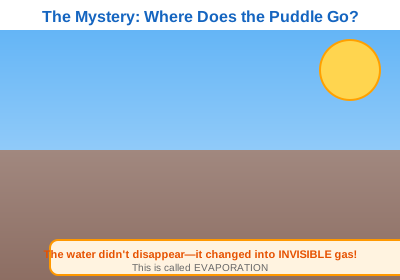
Scientists observing a puddle noticed something puzzling:
- After a rainstorm, a puddle forms on the sidewalk
- An hour later, the puddle is smaller
- By afternoon, the puddle is completely gone
- It didn't sink in. It didn't flow away. It just... disappeared.
Where did the water go? Thermal energy and particle motion hold the answer!
Vocabulary
| Term | Definition |
|---|---|
| evaporation | The process of liquid water changing into water vapor (gas) |
| thermal energy | Energy from heat that causes particles to move |
| particle motion | The movement of tiny particles (molecules) that make up matter |
| phase change | When matter changes from one state to another (solid, liquid, gas) |
| water vapor | Water in its gas form; invisible in the air |
| condensation | The process of water vapor cooling and changing back into liquid |
St. Louis Connection
St. Louis summers are known for being hot and humid. The humidity comes from water evaporating from the Mississippi River, local lakes, and the Gulf of Mexico. When all that water vapor is in the air, it makes those summer days feel even hotter! Understanding evaporation helps explain why St. Louis weather feels so different from dry places like Arizona.
Why This Matters to YOU
Ever wonder why your wet hair dries faster on a hot day? Or why sweating cools you down? Evaporation is everywhere! It's the first step in the water cycle that brings us rain, fills our rivers, and creates the weather we experience every day.
Focus Question: How does water "disappear" into thin air?
By the end of this lesson, you will be able to:
- Explain how thermal energy causes water molecules to evaporate
- Model particle behavior during liquid to gas phase changes
- Connect evaporation rate to environmental conditions (temperature, surface area)
- Design an investigation to test evaporation from different environments
NGSS 3D Standards - Click to View
This Week's Standards
MS-ESS2-4: Develop a model to describe the cycling of water through Earth's systems driven by energy from the sun and the force of gravity.
MS-ESS2-5: Collect data to provide evidence for how the motions and complex interactions of air masses result in changes in weather conditions.
3-Dimensional Learning
- SEP-2: Developing and Using Models - Model particle motion during phase changes
- SEP-3: Planning Investigations - Design humidity investigation
- DCI ESS2.C: The Role of Water in Earth's Surface Processes
- CCC-5: Energy and Matter - Energy transfer drives phase changes
Worked Example: Explaining Evaporation
Step-by-Step Problem Solving
The Problem
Two identical puddles form on the playground. One is in direct sunlight, the other is in the shade. After 2 hours, the sunny puddle is almost gone, but the shaded puddle is still large. Explain why using what you know about particle motion.
Step-by-Step Solution
Step 1: Identify the energy source
"The Sun provides thermal energy. The sunny puddle receives more thermal energy than the shaded puddle."
Step 2: Connect energy to particle motion
"More thermal energy means water molecules move FASTER. Faster-moving molecules have more kinetic energy."
Now YOU Complete Steps 3-4:
Step 3: What happens to fast-moving water molecules at the surface of the puddle?
Step 4: Why does the sunny puddle evaporate faster than the shaded puddle?
Hook - The Disappearing Puddle
12 Points | ~10 Minutes
Observe the phenomenon and make predictions about evaporation.
The Disappearing Puddle Mystery
What You Will Do (~10 minutes)
- Observe the phenomenon: A puddle disappears without sinking or flowing away (2 min)
- Make predictions: What happened to the water? (3 min)
- Connect to prior knowledge: What makes water change states? (3 min)
- Identify the energy source: Where does the energy come from? (2 min)
COMPLETING THIS AT HOME?
Think about these concepts:
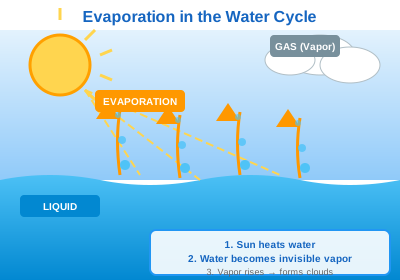
- Evaporation is when liquid water becomes water vapor (gas)
- Thermal energy makes particles move faster
- Fast-moving particles can escape from the liquid surface
- The Sun is the main energy source for evaporation
Need Hints? — CER Scaffold + Sentence Starters
Sentence starters and key concepts.
Sentence Starters:
- "The water in the puddle went into the air by..."
- "The Sun provides energy that causes..."
- "When water molecules gain thermal energy, they..."
Stuck? Click for step-by-step help
Detailed walkthrough when you need more guidance.
Think about it this way:
- Water is made of tiny particles called molecules
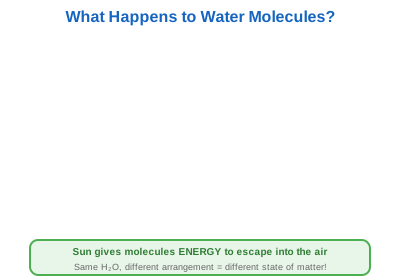
- The Sun heats the water, giving molecules more energy
- Molecules with enough energy can "jump" off the surface
- These fast molecules become invisible water vapor in the air
- This is evaporation - the water didn't disappear, it changed form!
COMPLETE THE HOOK FORM BELOW
Submit your predictions before moving to Station 1.
[EMBED G6.U6.3.W1 Hook Form Here]
Station 1 - PhET States of Matter
20 Points | ~18 Minutes
Investigate particle motion during phase changes using a simulation.
Your Mission: Explore Particle Behavior
Open the Simulation:
PhET States of Matter SimulationInstructions:
- Select "Water" from the dropdown menu
- Start with the temperature slider in the middle
- Observe how particles behave as you INCREASE temperature
- Watch what happens when water changes from liquid to gas
- Notice: How fast are the particles moving? How far apart are they?
Key Observations to Make:
- Low temperature: Particles move slowly, stay close together (liquid)
- High temperature: Particles move fast, spread far apart (gas)
- During evaporation: Fast particles "escape" from the surface
Need Hints? — CER Scaffold + Sentence Starters
Sentence Starters:
- "When I increased the temperature, the particles..."
- "Evaporation happens when particles have enough energy to..."
- "The simulation shows that adding thermal energy causes..."
COMPLETE THE STATION 1 FORM BELOW
[EMBED G6.U6.3.W1 Station 1 Form Here]
Station 2 - Water Droplet Collision Video
20 Points | ~15 Minutes
Analyze slow-motion video to understand condensation.
Your Mission: Understand Condensation
Watch the Video:
Slow-Motion Water Droplet CollisionKey Concept - The Magnetic Marble Model:
- Think of water molecules like magnetic marbles
- Fast-moving marbles: They bounce off each other (like gas molecules)
- Slow-moving marbles: They stick together (like liquid molecules)
- Cooling = slowing down = sticking together = condensation
Spiral Connection - Lessons 1-6:
Remember: Air high in the atmosphere is COLDER than air near the ground. This is why clouds form HIGH UP - water vapor rises, cools down, slows down, and condenses into droplets!
Need Hints? — CER Scaffold + Sentence Starters
Sentence Starters:
- "When water droplets collide in the video, they..."
- "Slow-moving molecules stick together because..."
- "Clouds form high up because the air is..."
COMPLETE THE STATION 2 FORM BELOW
[EMBED G6.U6.3.W1 Station 2 Form Here]
Station 3 - Design Humidity Investigation
25 Points | ~20 Minutes
Plan an investigation comparing evaporation from different environments.
Your Mission: Design a Fair Test
The Research Question:
"Does water evaporate at the same rate from different Earth environments (ocean, lake, wet soil, plants)?"
Design an investigation that could answer this question. Think about what variables you would control and measure.
Investigation Design Checklist:
- Independent variable: What do you CHANGE? (type of environment)
- Dependent variable: What do you MEASURE? (evaporation amount)
- Controlled variables: What stays the SAME? (temperature, time, container size)
- Prediction: Which environment will evaporate fastest and why?
Need Hints? — CER Scaffold + Sentence Starters
Sentence Starters:
- "My research question is: How does ___ affect ___?"
- "I predict that ___ will evaporate fastest because..."
- "To make this a fair test, I need to keep ___ the same."
Stuck? Click for step-by-step help
Example investigation design:
- Put equal amounts of water in 4 identical containers
- Add different "environments": plain water, salt water, wet soil, plant leaves
- Place all containers in the same location (same temperature, same light)
- After 24 hours, measure how much water is left in each
- The container with LESS water left had MORE evaporation
COMPLETE THE STATION 3 FORM BELOW
[EMBED G6.U6.3.W1 Station 3 Form Here]
Exit Ticket - Evaporation & Particle Motion
23 Points | ~15 Minutes
Show what you learned!
Exit Ticket Structure:
- 2 NEW - Evaporation and particle motion questions from this week
- 2 SPIRAL - Review questions from previous lessons (air temperature, conduction)
- 1 INTEGRATION - Connect evaporation to cloud formation
- 1 POST-REFLECTION - Add a question to our Focus Question Board
COMPLETE THE EXIT TICKET BELOW
Take your time and show your best thinking!
[EMBED G6.U6.3.W1 Exit Ticket Form Here]
Complete Your Worksheet - Click to Expand
Turn in your completed worksheet to your teacher!
Up to 15 bonus points for complete worksheet!
Enrichment & Extension
Optional deep dives into systems thinking, scientist profiles, and
environmental justice.
Systems Thinking Reflection
Evaporation connects everything in the water cycle! Use these questions to see the hidden connections.
Cause to Effect Chain
Sun heats ocean, Water evaporates, Vapor rises, Air cools, Condensation, Clouds form, Precipitation...
Your turn: Where does the water go after it falls as rain?
Real-World Application
Farmers use evaporation knowledge to water crops at the right time of day...
Your turn: When is the best time to water plants - morning or noon? Why?
Scientist Spotlight: Eunice Newton Foote
Eunice Newton Foote was an American scientist who, in 1856, was the first person to discover that carbon dioxide and water vapor in the atmosphere trap heat from the Sun. She conducted experiments showing that air with more water vapor got hotter in sunlight.
Her work was presented at a scientific conference, but because she was a woman, a man had to read her paper for her. Today, she is recognized as a pioneer in climate science - three years before John Tyndall's more famous experiments!
Environmental Justice: Urban Heat Islands
In cities like St. Louis, some neighborhoods are much hotter than others. Areas with lots of concrete and few trees can be 10-15 degrees F hotter than areas with parks and green spaces. This is called the "urban heat island effect."
Evaporation from plants and trees cools the air naturally. Neighborhoods with fewer trees - often lower-income areas - experience more extreme heat, which can cause health problems. Understanding evaporation helps us see why tree-planting programs are a matter of environmental justice!
Week 1 Complete!
Next Week: Cloud Formation & Storm Development - How do clouds form and create storms?