Week 2: Week 2 Content
Grade 6 Science | Rosche | Kairos Academies
The Phenomenon: The Frost Formation Mystery
Anchoring Context and Focus Question
Before We Begin: Activate Your Prior Knowledge
Think back to Week 1: You learned that water evaporates when thermal energy makes molecules move fast enough to escape into the air as water vapor. This week: What happens when that water vapor COOLS DOWN? How do clouds form, and what creates thunderstorms? Rising air, cooling, and condensation are the keys!
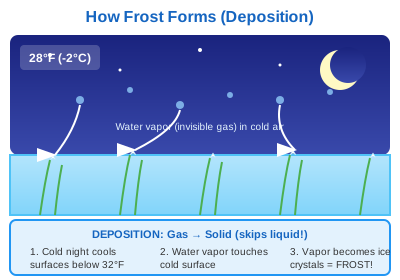
On cold mornings, you might notice something strange:
- Frost covers car windows and grass
- There was no rain overnight
- No sprinklers were running
- So where did this ice come from?
The answer connects frost on the ground to clouds in the sky - both form through condensation!
Vocabulary
| Term | Definition |
|---|---|
| condensation | Water vapor (gas) cooling and changing back into liquid droplets |
| condensation nuclei | Tiny particles (dust, pollen, salt) that water vapor condenses onto |
| updraft | A column of warm air rising rapidly upward |
| cumulus | Puffy, cotton-ball clouds that form from rising air; can grow into storms |
| stratus | Flat, layered clouds that cover the sky like a blanket |
| cirrus | Thin, wispy clouds made of ice crystals high in the atmosphere |
| cumulonimbus | Tall thunderstorm clouds that produce heavy rain, hail, and lightning |
St. Louis Connection
St. Louis is famous for dramatic afternoon thunderstorms in summer! The hot, humid air from the Gulf of Mexico rises rapidly when heated by the afternoon sun, creating powerful updrafts. These updrafts build massive cumulonimbus clouds that can produce heavy rain, hail, and even tornadoes. Understanding cloud formation helps you predict when these storms might develop!
Why This Matters to YOU
Can you look at the sky and predict if it will rain? Cloud types are nature's weather forecast! Puffy cumulus clouds on a hot day might mean afternoon thunderstorms. Knowing the science helps you plan your outdoor activities and stay safe during severe weather.
Focus Question: How do clouds form, and what creates thunderstorms?
By the end of this lesson, you will be able to:
- Explain that clouds form when rising air cools and water vapor condenses
- Identify the role of condensation nuclei in cloud formation
- Describe how updrafts lead to thunderstorm development
- Connect evaporation and condensation in the water cycle
NGSS 3D Standards - Click to View
This Week's Standards
MS-ESS2-4: Develop a model to describe the cycling of water through Earth's systems driven by energy from the sun and the force of gravity.
MS-ESS2-5: Collect data to provide evidence for how the motions and complex interactions of air masses result in changes in weather conditions.
Spiral Standards (Review from Week 1)
- MS-ESS2-4 (Week 1): Evaporation driven by Sun's energy
- Particle Motion: Temperature affects molecular speed
Worked Example: Cloud Formation Process
Step-by-Step Problem Solving
The Problem
On a hot summer afternoon, you see small puffy clouds forming over the city. Two hours later, a thunderstorm develops. Explain the sequence of events that led from sunny morning to thunderstorm using what you know about clouds and condensation.
Step-by-Step Solution
Step 1: Identify the energy source
"The Sun heats the ground. The hot ground heats the air above it through conduction."
Step 2: Explain what happens to warm air
"Warm air is less dense than cold air, so it RISES. This rising warm air is called an updraft."
Now YOU Complete Steps 3-4:
Step 3: What happens to the temperature of rising air as it goes higher in the atmosphere? What does this cause?
Step 4: How does a small cumulus cloud grow into a thunderstorm-producing cumulonimbus cloud?
Hook - Frost Formation Mystery
12 Points | ~10 Minutes
Observe the phenomenon and connect frost to clouds.
The Frost Mystery
What You Will Do (~10 minutes)
- Observe the phenomenon: Frost appears on cold mornings without rain (2 min)
- Connect to evaporation: Where did the water in frost come from? (2 min)
- Make the connection: How are frost and clouds similar? (3 min)
- Predict: What conditions cause clouds to form? (3 min)
COMPLETING THIS AT HOME?
Think about these concepts:
- Water vapor is always in the air (from evaporation)
- When water vapor touches something cold, it condenses
- If the cold surface is below freezing, you get frost (ice crystals)
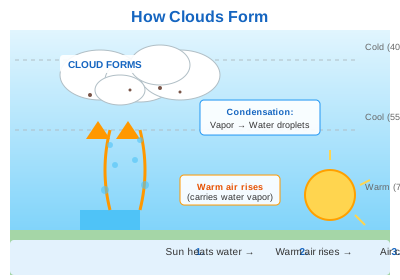
- Clouds form when water vapor rises to cold air high up and condenses
Need Hints? — CER Scaffold + Sentence Starters
Sentence starters and key concepts.
Sentence Starters:
- "Frost forms when water vapor in the air..."
- "Both frost and clouds form through the process of..."
- "Clouds form high up because the air there is..."
COMPLETE THE HOOK FORM BELOW
Submit your predictions before moving to Station 1.
[EMBED G6.U6.3.W2 Hook Form Here]
Station 1 - Cloud Formation Simulation
20 Points | ~18 Minutes
Investigate how cooling causes condensation using a simulation.
Your Mission: Explore Condensation
Open the Simulation:
PhET States of Matter: BasicsInstructions:
- Select "Water" from the dropdown menu
- Start with the temperature HIGH (gas/vapor state)
- SLOWLY decrease the temperature and observe the particles
- Watch what happens when water changes from gas to liquid
- Notice: How does particle motion change? How do particles interact?
Key Observations:
- Hot (gas): Particles move fast, spread far apart, bounce off each other
- Cooling: Particles slow down, start to come closer together
- Cold (liquid): Particles move slowly, stick together as liquid
- This is condensation: Gas to liquid when cooled!
Need Hints? — CER Scaffold + Sentence Starters
Sentence Starters:
- "When I cooled the water vapor, the particles..."
- "Condensation happens because cooling causes..."
- "This relates to cloud formation because air high up is..."
COMPLETE THE STATION 1 FORM BELOW
[EMBED G6.U6.3.W2 Station 1 Form Here]
Station 2 - Storm Development Reading
20 Points | ~15 Minutes
Learn about cloud types and thunderstorm formation.
Your Mission: Understand Cloud Types and Storms
Cloud Types and What They Tell Us:
| Cloud Type | Appearance | Weather It Brings |
|---|---|---|
| Cumulus | Puffy, cotton-ball | Fair weather, but can grow into storms |
| Stratus | Flat, layered blanket | Overcast skies, light rain or drizzle |
| Cirrus | Thin, wispy streaks | Fair weather (made of ice crystals) |
| Cumulonimbus | Tall, anvil-shaped | Thunderstorms, heavy rain, hail, lightning |
How Thunderstorms Form:
- Heating: The Sun heats the ground, warming the air above it
- Updraft: Warm, humid air rises rapidly (this is an updraft)
- Cooling: Rising air cools as it goes higher
- Condensation: Water vapor condenses into cloud droplets
- Growth: Continuous updraft builds cloud higher and higher
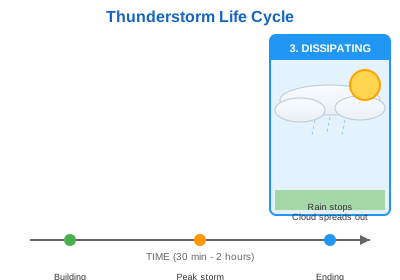
- Storm: Tall cumulonimbus forms with ice, hail, and lightning!
Need Hints? — CER Scaffold + Sentence Starters
Sentence Starters:
- "Thunderstorms form from ___ clouds because..."
- "An updraft is created when..."
- "More moisture and faster rising air make storms..."
COMPLETE THE STATION 2 FORM BELOW
[EMBED G6.U6.3.W2 Station 2 Form Here]
Station 3 - Thunderstorm Video Analysis
25 Points | ~20 Minutes
Analyze a video showing how thunderstorms develop.
Your Mission: Analyze Thunderstorm Formation
Watch the Video:
How Thunderstorms Form (4 min)While watching, look for:
- What causes the initial updraft?
- How does the cloud grow taller?
- Where do rain and hail form in the cloud?
- What creates lightning?
Hail Formation - A Special Process:
- Strong updrafts keep ice particles suspended in the cloud
- Each time ice cycles through the cloud, it collects another layer
- Like adding layers to a snowball!
- When hail gets too heavy for the updraft, it falls
- The strongest storms make the biggest hail!
Need Hints? — CER Scaffold + Sentence Starters
Sentence Starters:
- "The updraft is caused by..."
- "At the top of the cloud, water droplets..."
- "Hail forms when..."
COMPLETE THE STATION 3 FORM BELOW
[EMBED G6.U6.3.W2 Station 3 Form Here]
Exit Ticket - Clouds & Storms
23 Points | ~15 Minutes
Show what you learned!
Exit Ticket Structure:
- 2 NEW - Cloud formation and storm development from this week
- 2 SPIRAL - Review questions from Week 1 (evaporation, particle motion)
- 1 INTEGRATION - Connect evaporation to cloud and storm formation
- 1 SEP-2 - Developing and using models
COMPLETE THE EXIT TICKET BELOW
Take your time and show your best thinking!
[EMBED G6.U6.3.W2 Exit Ticket Form Here]
Complete Your Worksheet - Click to Expand
Turn in your completed worksheet to your teacher!
Up to 15 bonus points for complete worksheet!
Enrichment & Extension
Optional deep dives into systems thinking, scientist profiles, and
environmental justice.
Systems Thinking Reflection
Clouds and storms are part of a larger system! Use these questions to see the hidden connections.
Cause to Effect Chain
Sun heats ocean, Water evaporates, Vapor rises, Air cools, Condensation, Cloud forms, Rain falls, Rivers fill, Water returns to ocean...
Your turn: What would happen if the Sun's energy output decreased?
Feedback Loop
Warmer temperatures, More evaporation, More water vapor, More greenhouse effect, Even warmer temperatures...
Your turn: Is this a positive or negative feedback loop? What does it mean for climate?
Scientist Spotlight: Dr. Ted Fujita
Dr. Tetsuya "Ted" Fujita, a Japanese-American meteorologist, revolutionized our understanding of severe storms. He developed the Fujita Scale (F-Scale) for rating tornado intensity, which is still used today (now the Enhanced Fujita Scale).
Dr. Fujita also discovered microbursts - powerful downdrafts from thunderstorms that can cause plane crashes. His research has saved countless lives by improving aviation safety and tornado warnings. He earned the nickname "Mr. Tornado" for his dedication to understanding severe weather.
Environmental Justice: Storm Shelter Access
When severe thunderstorms or tornadoes threaten, having access to a safe shelter can mean the difference between life and death. But not everyone has equal access to protection.
Mobile home residents are especially vulnerable - mobile homes offer almost no protection from tornadoes, yet many mobile home parks don't have community storm shelters. Studies show that lower-income communities often have fewer public storm shelters. Understanding storm science helps us advocate for equal protection for everyone, regardless of where they live or how much money they have.
Week 2 Complete!
Next Week: Forces & Precipitation - Why do clouds float and what determines rain vs. snow?