Week 3: Week 3 Content
Grade 6 Science | Rosche | Kairos Academies
The Phenomenon: The Floating Cloud Mystery
Anchoring Context and Focus Question
Before We Begin: Activate Your Prior Knowledge
Think back to W1 and W2: You learned that the water cycle is driven by the Sun's energy. Evaporation carries water vapor into the atmosphere. This week: What keeps cloud droplets floating in the sky? And what makes them finally fall as rain, snow, or sleet? Forces and temperature are the keys!
Scientists observing clouds noticed something puzzling:
- Clouds are made of water droplets and ice crystals
- Water is heavier than air (denser)
- So why do clouds float instead of falling to the ground?
- And what finally makes the water fall as rain, snow, or sleet?
The answer involves forces, air pressure, and temperature layers!
Vocabulary
| Term | Definition |
|---|---|
| balanced forces | Equal forces in opposite directions; no change in motion (droplet floats) |
| unbalanced forces | Unequal forces; causes change in motion (droplet falls or rises) |
| gravity | Force that pulls objects toward Earth's center |
| updraft | Rising column of warm air that pushes objects upward |
| air pressure | The weight of air molecules pushing on a surface |
| convection | Circular motion of warm air rising and cool air sinking |
| precipitation | Water falling from clouds (rain, snow, sleet, hail) |
| freezing point | Temperature at which water turns to ice (0 degrees C / 32 degrees F) |
St. Louis Connection
St. Louis gets all four types of precipitation! Our location where warm Gulf air meets cold Canadian air creates ice storms (freezing rain) that have knocked out power to thousands of homes. The famous January 2017 ice storm coated everything in 0.5 inches of ice. Understanding temperature layers in the atmosphere helps meteorologists predict these dangerous events!
Why This Matters to YOU
Will tomorrow bring rain, snow, or ice? Understanding the forces and temperature patterns that create different precipitation types helps you make smart decisions. Should you wear boots? Will school be canceled? Meteorologists use these same concepts to forecast weather that affects millions of people every day!
Focus Question: Why do clouds float, and what determines whether precipitation falls as rain, snow, sleet, or freezing rain?
By the end of this lesson, you will be able to:
- Explain how balanced and unbalanced forces affect cloud droplets
- Describe how convection creates weather patterns
- Predict precipitation type based on temperature profiles
- Connect air pressure to weather conditions
▼ NGSS 3D Standards - Click to View ▼
This Week's Standards
MS-ESS2-4: Develop a model to describe the cycling of water through Earth's systems driven by energy from the sun and the force of gravity.
MS-ESS2-5: Collect data to provide evidence for how the motions and complex interactions of air masses result in changes in weather conditions.
MS-PS2-2: Plan an investigation to provide evidence that the change in an object's motion depends on the sum of the forces on the object.
Spiral Standards (Review)
- MS-ESS2-4 (Week 1): Water cycle driven by Sun's energy
- MS-ESS2-6 (Week 2): Uneven heating creates air circulation
Worked Example: Predicting
Precipitation Type
Step-by-Step Problem Solving
The Problem
A weather balloon measures these temperatures as it rises: Ground level = 35 degrees F (2 degrees C), 500m altitude = 28 degrees F (-2 degrees C), 1000m altitude = 25 degrees F (-4 degrees C), Cloud level = 20 degrees F (-7 degrees C). What type of precipitation will fall?
Step-by-Step Solution
Step 1: Identify the freezing point
"Water freezes at 32 degrees F (0 degrees C). I will compare each layer to this temperature."
Step 2: Map the temperature profile
"Cloud level: 20 degrees F - BELOW freezing (ice crystals form). Middle layers: All below freezing. Ground level: 35 degrees F - ABOVE freezing."
Now YOU Complete Steps 3-4:
Step 3: What happens to ice crystals as they fall through mostly-freezing air and then hit the above-freezing layer near the ground?
Step 4: Will this be rain, snow, sleet, or freezing rain? Use the precipitation type chart to justify your answer.
Hook - Why Do Clouds Float?
12 Points | ~10 Minutes
Observe the phenomenon and make predictions about forces.
The Cloud Puzzle
What You Will Do (~10 minutes)
- Observe clouds - they are made of water but do not fall. Why? (2 min)
- Consider the forces: What pushes down? What might push up? (3 min)
- Predict: When do cloud droplets finally fall? (3 min)
- Connect to weather: What forces create rain versus snow? (2 min)
COMPLETING THIS AT HOME?
Think about these concepts:
- Gravity pulls everything DOWN (including water droplets)
- Updrafts (rising warm air) push UP on light objects
- When forces are EQUAL = balanced = no change in motion
- When forces are UNEQUAL = unbalanced = motion changes
Need Hints? — CER Scaffold + Sentence Starters
Sentence starters and key concepts.
Key Concept Reminder:
- Balanced forces = object stays still or moves at constant speed
- Unbalanced forces = object speeds up, slows down, or changes direction
Sentence Starters:
- "Gravity pulls cloud droplets ___, but..."
- "The forces are balanced when..."
- "Droplets fall when the forces become..."
Stuck? Click for step-by-step help
Detailed walkthrough when you need more guidance.
Try these steps in order:
- Draw a cloud droplet. Add an arrow pointing DOWN and label it "gravity"
- Add an arrow pointing UP and label it "updraft" (rising warm air)
- If arrows are the same size = balanced = droplet floats
- If down arrow is bigger = unbalanced = droplet falls (precipitation!)
- This happens when droplets grow big or updrafts weaken
COMPLETE THE HOOK FORM BELOW
Submit your predictions before moving to Station 1.
Complete Your Worksheet - Click to Expand
Complete the "AFTER HOOK FORM" section on your worksheet:
- Draw a force diagram for a floating cloud droplet
- Label the forces (gravity down, updraft up)
Bonus: +2 points for completing this section!
Station 1 - Balanced & Unbalanced
Forces
20 Points | ~18 Minutes
Investigate how forces determine whether droplets float or fall.
Your Mission: Analyze Forces on Cloud Droplets
Key Concepts - Forces on Cloud Droplets:
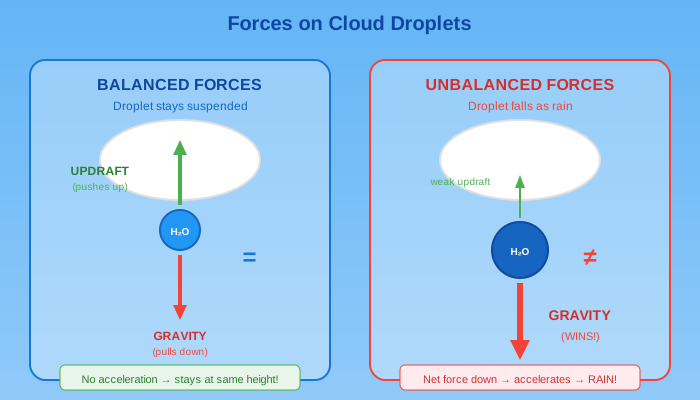
- Gravity (down): Pulls all objects toward Earth. Stronger on heavier/bigger droplets.
- Updraft (up): Rising warm air pushes droplets upward. Stronger in storms!
- Balanced: When gravity = updraft, droplets float (no acceleration)
- Unbalanced: When gravity > updraft, droplets fall as precipitation
Why Do Droplets Eventually Fall?
- Droplets collide and combine with other droplets, getting bigger and heavier
- Bigger droplets = more gravitational force
- When gravity exceeds updraft force = unbalanced = precipitation!
- This is why rain droplets are much bigger than cloud droplets
COMPLETING THIS AT HOME?
Try this thought experiment:
- Imagine holding a tiny styrofoam ball over a fan blowing up
- The ball floats! (fan force up = gravity down)
- Now imagine the ball gets wet and heavier...
- It falls! (gravity > fan force = unbalanced)
Need Hints? — CER Scaffold + Sentence Starters
Sentence Starters:
- "The droplet floats because the forces are..."
- "When the droplet gets bigger, gravity becomes..."
- "Precipitation occurs when the forces are..."
- "Updrafts are created by..."
COMPLETE THE STATION 1 FORM BELOW
Complete Your Worksheet - Click to Expand
Complete the "STATION 1" section on your worksheet:
- Draw force diagrams for floating vs. falling droplets
- Explain why rain droplets are bigger than cloud droplets
Bonus: +3 points for correct force diagrams!
Station 2 - Air Pressure & Convection
20 Points | ~15 Minutes
Explore how air pressure and convection create weather patterns.
Your Mission: Connect Pressure to Weather
Key Concepts - Pressure and Convection:
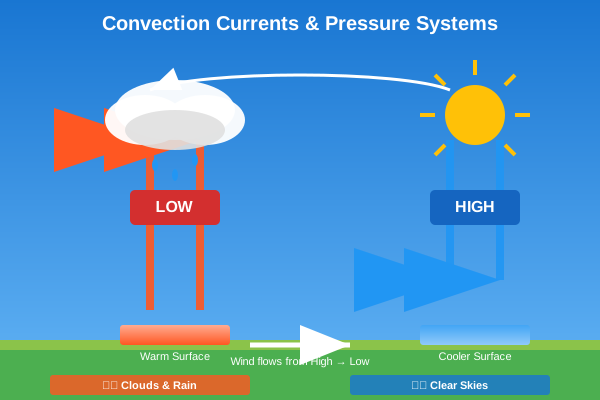
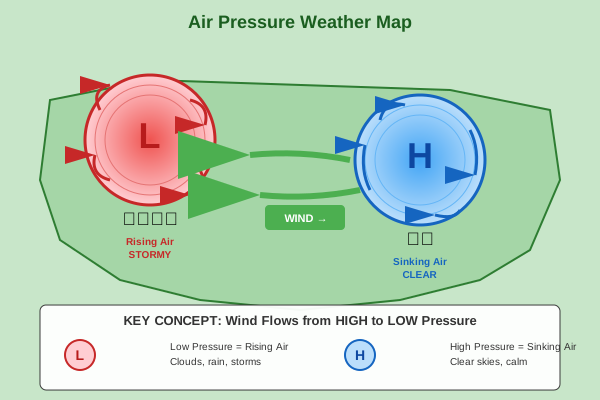
- Low pressure: Rising warm air. Air cools as it rises. Clouds form. Storms!
- High pressure: Sinking cool air. Air warms as it sinks. Clear skies!
- Convection: Circular motion - warm air rises, cools, sinks, warms, rises again
- Wind: Air flows from high pressure to low pressure areas
Pressure-Weather Connection:
| Pressure | Air Movement | Weather |
|---|---|---|
| LOW (L) | Rising air | Clouds, rain, storms |
| HIGH (H) | Sinking air | Clear, sunny skies |
Need Hints? — CER Scaffold + Sentence Starters
Memory Trick:
Low pressure = Lousy weather (clouds, rain). High pressure = Happy weather (sunny)!
Sentence Starters:
- "In a low pressure area, air rises because..."
- "Clouds form in low pressure because..."
- "Wind blows from ___ pressure to ___ pressure."
Stuck? Click for step-by-step help
Think of it like a pot of water:
- Heat the bottom = water rises (warm air rises in low pressure)
- Water cools at the top and sinks back down (cool air sinks)
- This creates a circular convection current
- Same thing happens in the atmosphere!
COMPLETE THE STATION 2 FORM BELOW
Complete Your Worksheet - Click to Expand
Complete the "STATION 2" section on your worksheet:
- Draw a convection cell with arrows showing air movement
- Label high and low pressure areas
Bonus: +3 points for correctly labeling weather in each zone!
Station 3 - Precipitation Types
25 Points | ~20 Minutes
Predict precipitation type based on temperature profiles.
Your Mission: Predict Precipitation Type
Precipitation depends on temperature layers:
| Type | Temperature Profile | What Happens |
|---|---|---|
| Rain | Above freezing entire way down | Falls as liquid water |
| Snow | Below freezing entire way down | Falls as ice crystals |
| Sleet | Freezing, warm layer, freezing at surface | Melts, then refreezes into ice pellets |
| Freezing Rain | Freezing, thick warm layer, freezing surface | Stays liquid, freezes on contact with cold surfaces |
The Key Difference: Sleet vs. Freezing Rain
- Sleet: Has time to refreeze while falling. Bounces when it lands.
- Freezing Rain: Stays liquid while falling, then freezes ON CONTACT with cold surfaces. Coats everything in ice!
Freezing rain is more dangerous because ice coats roads, trees, and power lines!
Need Hints? — CER Scaffold + Sentence Starters
Step-by-Step for Predicting Precipitation:
- Check the cloud temperature - is it below or above freezing?
- Check the middle atmosphere - any warm layers?
- Check the ground temperature - below or above freezing?
- Match the pattern to the chart above!
COMPLETE THE STATION 3 FORM BELOW
Exit Ticket - Forces & Precipitation
23 Points | ~15 Minutes
Show what you learned!
Exit Ticket Structure:
- 2 NEW - Forces and precipitation questions from this week
- 2 SPIRAL - Review questions from Week 1 (water cycle) and Week 2 (air circulation)
- 1 INTEGRATION - Connect forces, pressure, and precipitation
- 1 SEP-2 - Developing and using models
COMPLETE THE EXIT TICKET BELOW
Take your time and show your best thinking!
Complete Your Worksheet - Click to Expand
Turn in your completed worksheet to your teacher!
Up to 15 bonus points for complete worksheet!
▼ Enrichment & Extension ▼
Optional deep dives into systems thinking, scientist profiles, and
environmental justice.
Systems Thinking Reflection
Weather connects everything! Use these questions to see the hidden connections.
Cause → Effect Chain
Sun heats land → Warm air rises → Low pressure zone forms → Surrounding air rushes in → ?
Your turn: How does uneven heating of land and water create coastal winds?
Trade-Off Thinking
Cloud seeding can trigger rain in drought areas, but it might steal rain from neighboring regions...
Your turn: Should humans try to control weather? What could go wrong?
Feedback Loop
↑ Temperature → ↑ Evaporation → ↑ Water vapor → ↑ Greenhouse effect → ↑ Temperature more...
Your turn: How does this positive feedback loop affect extreme weather events?
Unit Connection: W1 (water cycle), W2 (air circulation), and W3 (forces & precipitation) all connect to one system. What drives it all?
Scientist Spotlight: Dr. Joanne Simpson
Dr. Joanne Simpson was the first woman in the United States to earn a PhD in meteorology (1949). Her professors told her women "couldn't do math" and tried to prevent her from studying atmospheric science. She proved them wrong by becoming one of the most influential meteorologists in history!
Dr. Simpson discovered how tropical storms form and strengthen — the exact forces and convection patterns you studied today. She also led the science team for NASA's TRMM satellite, which measures precipitation from space. Her research has saved countless lives by improving hurricane forecasting.
Her advice to students: "If you're told something is impossible or that 'girls can't do science,' let that fuel your determination. The best discoveries come from people who refuse to accept limits that others put on them."
Environmental Justice: Who Gets Warned About Severe Weather?
When severe weather hits St. Louis, not everyone gets the same warning time or has the same ability to respond. Some neighborhoods have outdoor warning sirens, weather apps on smartphones, and basements to shelter in. Others — often lower-income communities — may lack these resources.
During the devastating 2011 Joplin, Missouri tornado (160+ deaths), many people in low-income mobile home parks had no basements and received warnings too late. Studies show that Black and Latino communities are more likely to live in tornado-prone areas with fewer storm shelters.
Organizations like the National Weather Service and local groups are working to improve weather warning systems in underserved areas. Understanding weather science means understanding that equal protection from severe weather should be a right, not a privilege based on where you can afford to live.
Week 3 Complete!
Next Week: Climate Patterns — How do ocean currents affect weather?