Week 4: Week 4 Content
Grade 6 Science | Rosche | Kairos Academies
The Phenomenon: Dramatic Weather Changes
Anchoring Context and Focus Question
Before We Begin: Activate Your Prior Knowledge
Think back to Weeks 1-3: You learned that water evaporates, rises, cools, and condenses into clouds. Forces determine when precipitation falls. This week: Why do some days have completely different weather than the day before? What causes weather to change so dramatically? Air masses and fronts are the keys!
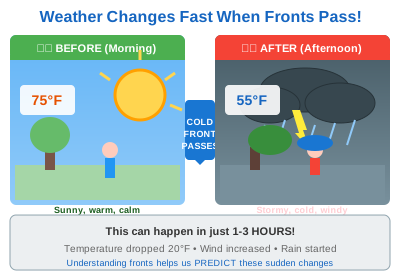
Have you ever noticed weather changing dramatically?
- Monday morning: 75 degrees F and sunny
- Monday evening: Temperature drops 30 degrees
- Thunderstorms roll through in the afternoon
- Tuesday: Cold, clear, and dry
What causes these dramatic changes? Large bodies of air with different properties are colliding!
Vocabulary
| Term | Definition |
|---|---|
| air mass | A large body of air with similar temperature and humidity throughout |
| front | The boundary where two different air masses meet |
| cold front | When cold air pushes under warm air; brings intense but brief storms |
| warm front | When warm air slides up over cold air; brings steady, light precipitation |
| continental | Air mass that forms over land (dry) |
| maritime | Air mass that forms over ocean (wet/humid) |
| polar | Air mass that forms near the poles (cold) |
| tropical | Air mass that forms near the equator (warm) |
St. Louis Connection
St. Louis sits right where air masses from Canada (cold, dry) and the Gulf of Mexico (warm, humid) frequently collide. This is why St. Louis has such variable weather - one day can be completely different from the next! Our location makes us a "battleground" for weather systems, which is why meteorologists here always have exciting forecasts to share.
Why This Matters to YOU
Want to know if you should bring an umbrella tomorrow? Understanding fronts helps you read weather forecasts like a meteorologist! When you hear "a cold front will move through tonight," you will know exactly what weather to expect.
Focus Question: How do air masses and fronts cause weather changes?
By the end of this lesson, you will be able to:
- Classify air masses by temperature and humidity based on source region
- Explain how fronts form where air masses meet
- Predict weather associated with cold and warm fronts
- Read weather maps to forecast conditions
NGSS 3D Standards - Click to View
This Week's Standards
MS-ESS2-5: Collect data to provide evidence for how the motions and complex interactions of air masses result in changes in weather conditions.
MS-ESS2-6: Develop and use a model to describe how unequal heating and rotation of the Earth cause patterns of atmospheric and oceanic circulation.
Spiral Standards (Review from W1-W3)
- MS-ESS2-4 (W1-W2): Water cycle driven by Sun's energy
- MS-PS2-2 (W3): Forces on cloud droplets
Worked Example: Predicting Weather from a Front
Step-by-Step Problem Solving
The Problem
A weather map shows a cold front 100 miles west of St. Louis, moving east at 25 mph. It is currently 78 degrees F and humid. What weather should St. Louis expect over the next 8 hours?
Step-by-Step Solution
Step 1: Calculate when the front will arrive
"100 miles divided by 25 mph = 4 hours. The cold front will arrive in about 4 hours."
Step 2: Identify what type of weather cold fronts bring
"Cold fronts bring intense but brief storms. Cold air pushes rapidly under warm air, forcing it up quickly. This creates tall clouds and thunderstorms."
Now YOU Complete Steps 3-4:
Step 3: Describe the weather BEFORE the front arrives (next 4 hours).
Step 4: Describe the weather AFTER the front passes (hours 4-8).
Hook - Weather Forecast Analysis
12 Points | ~10 Minutes
Analyze a real weather forecast to understand fronts.
Real Weather Forecast
Watch the Weather Report:
Weather Report 1/19/19While watching, pay attention to:
- Temperature differences across different regions
- Where precipitation is occurring
- Terms like "front" and "air mass"
- How weather is predicted to change
Need Hints? — CER Scaffold + Sentence Starters
Sentence starters and key concepts.
Sentence Starters:
- "Different regions have different temperatures because..."
- "A front is the boundary where..."
- "Weather changes at fronts because..."
COMPLETE THE HOOK FORM BELOW
Submit your observations before moving to Station 1.
[EMBED G6.U6.3.W4 Hook Form Here]
Station 1 - Air Mass Classification
20 Points | ~18 Minutes
Learn to classify air masses by their source regions.
Your Mission: Classify Air Masses
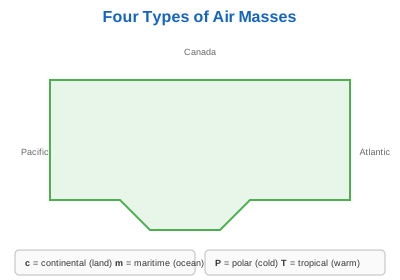
Air Mass Classification System:
Air masses get their properties from where they form (source region):
| Type | Where It Forms | Properties |
|---|---|---|
| mT (maritime tropical) | Gulf of Mexico, Caribbean | Warm and humid |
| cP (continental polar) | Canada, northern land | Cold and dry |
| mP (maritime polar) | North Pacific/Atlantic | Cold and wet |
| cT (continental tropical) | Southwest desert | Hot and dry |
How to Remember:
- c = continental = land = DRY
- m = maritime = ocean = WET
- P = polar = near poles = COLD
- T = tropical = near equator = WARM
Need Hints? — CER Scaffold + Sentence Starters
Sentence Starters:
- "An air mass from the Gulf of Mexico would be ___ because..."
- "An air mass from Canada would be ___ because..."
- "St. Louis weather is variable because..."
COMPLETE THE STATION 1 FORM BELOW
[EMBED G6.U6.3.W4 Station 1 Form Here]
Station 2 - Weather Fronts
20 Points | ~15 Minutes
Learn what happens when air masses collide.
Your Mission: Understand Front Types
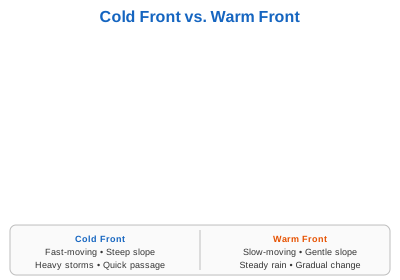
Types of Fronts:
| Front Type | What Happens | Weather |
|---|---|---|
|
Cold Front (blue triangles) |
Cold air pushes UNDER warm air rapidly | Intense but brief storms, then clearing |
|
Warm Front (red semicircles) |
Warm air slides UP and OVER cold air slowly | Steady rain/drizzle over large area |
|
Stationary Front (alternating symbols) |
Neither air mass is moving | Weather can persist for days |
Why Cold Fronts Cause Thunderstorms:
- Cold air is DENSER (heavier) than warm air
- Cold air wedges UNDER warm air like a plow
- Warm air is FORCED UP rapidly
- Rapid lifting = rapid cooling = tall clouds = intense storms
- But it passes quickly, then it's clear and cooler!
Need Hints? — CER Scaffold + Sentence Starters
Sentence Starters:
- "At a cold front, cold air pushes under warm air because..."
- "Thunderstorms are more common with cold fronts because..."
- "Warm fronts bring steady rain because..."
COMPLETE THE STATION 2 FORM BELOW
[EMBED G6.U6.3.W4 Station 2 Form Here]
Station 3 - Weather Map Reading
25 Points | ~20 Minutes
Read weather maps to predict conditions.
Your Mission: Forecast Weather from Maps
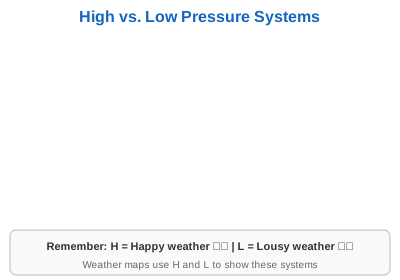
Weather Map Symbols:
| Symbol | Meaning | Associated Weather |
|---|---|---|
| H | High pressure | Clear skies, sinking air |
| L | Low pressure | Clouds, storms, rising air |
| Blue triangles | Cold front | Intense storms, then clearing |
| Red semicircles | Warm front | Steady rain/drizzle |
Weather Movement Rules:
- Weather generally moves west to east across the US
- Storms form around low pressure (L)
- Clear weather occurs with high pressure (H)
- Fronts bring precipitation where air masses meet
- You can calculate arrival time: distance divided by speed!
Need Hints? — CER Scaffold + Sentence Starters
Sentence Starters:
- "If I see an L on the map, I expect..."
- "A cold front 200 miles away moving at 25 mph will arrive in..."
- "After the front passes, the weather will..."
COMPLETE THE STATION 3 FORM BELOW
[EMBED G6.U6.3.W4 Station 3 Form Here]
Exit Ticket - Air Masses & Fronts
23 Points | ~15 Minutes
Show what you learned!
Exit Ticket Structure:
- 2 NEW - Air masses and fronts from this week
- 2 SPIRAL - Review from W1-W3 (pressure systems, precipitation types)
- 1 INTEGRATION - Connect fronts to the complete weather system
- 1 SEP-4 - Analyzing data from weather maps
COMPLETE THE EXIT TICKET BELOW
Take your time and show your best thinking!
[EMBED G6.U6.3.W4 Exit Ticket Form Here]
Complete Your Worksheet - Click to Expand
Turn in your completed worksheet to your teacher!
Up to 15 bonus points for complete worksheet!
Enrichment & Extension
Optional deep dives into systems thinking, scientist profiles, and
environmental justice.
Systems Thinking Reflection
Air masses and fronts are part of global atmospheric circulation! Use these questions to see the hidden connections.
Cause to Effect Chain
Gulf heats up, mT air mass forms, Moves north, Meets cP from Canada, Cold front forms, Thunderstorms develop, Rain falls...
Your turn: What would happen if the Gulf of Mexico were colder?
Geographic Pattern
St. Louis is in "Tornado Alley" where cold Canadian air meets warm Gulf air regularly...
Your turn: Why might coastal cities have fewer dramatic weather changes?
Scientist Spotlight: Vilhelm Bjerknes
Vilhelm Bjerknes was a Norwegian physicist who developed the theory of weather fronts in the early 1900s. His "Bergen School of Meteorology" in Norway created the modern system of weather analysis that we still use today.
Bjerknes and his team named fronts after military "fronts" in World War I - where opposing armies met in battle. They saw that weather works the same way: different air masses "fight" at their boundaries, creating storms. This breakthrough made weather forecasting much more accurate!
Environmental Justice: Weather Forecasting Access
Not everyone has equal access to weather forecasts and warnings. People without smartphones, internet access, or TV may not receive severe weather alerts. This is especially dangerous during rapidly-approaching cold fronts that bring tornadoes.
Studies show that rural communities and low-income urban areas often receive warnings later or have fewer ways to receive them. Organizations like the National Weather Service are working to improve warning systems for all communities, including outdoor sirens, NOAA Weather Radio, and Wireless Emergency Alerts that work on all cell phones.
Week 4 Complete!
Next Week: Climate Patterns & Unit Synthesis - Why are some places wetter than others?