Week 5: Week 5 Content
Grade 6 Science | Rosche | Kairos Academies
UNIT FINALE!
This week you will bring together everything you learned in W1-W4 to answer our driving question!
The Phenomenon: Seattle vs. Phoenix
Anchoring Context and Focus Question
Before We Begin: Activate Your Prior Knowledge
Think back to W1-W4: You learned about evaporation, cloud formation, forces on droplets, precipitation types, air masses, and fronts. This week: Why do some places consistently get more rain than others? What is the difference between weather and climate? Global patterns and geography are the keys!
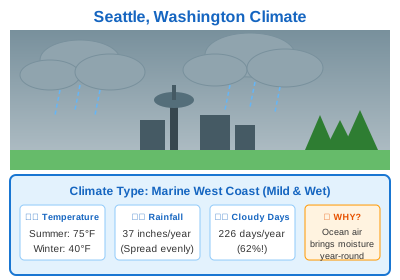
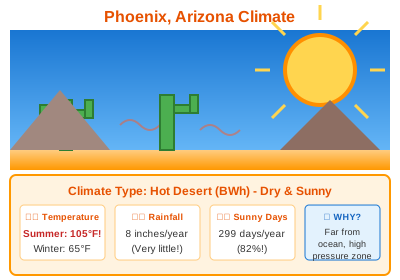
A tale of two cities at similar latitudes:
- Seattle, Washington: ~37 inches of rain per year
- Phoenix, Arizona: ~8 inches of rain per year
- Both cities are at about the same latitude (similar distance from equator)
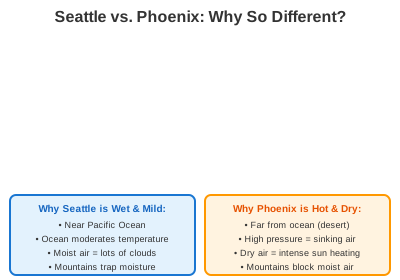
- Why is Seattle nearly 5 times wetter than Phoenix?
The answer involves wind patterns, ocean proximity, and mountains!
Vocabulary
| Term | Definition |
|---|---|
| climate | Average weather patterns over long periods (30+ years) |
| weather | Atmospheric conditions at a specific time and place |
| prevailing winds | Consistent wind patterns caused by Earth's rotation and uneven heating |
| westerlies | Prevailing winds that blow from west to east at mid-latitudes (like the US) |
| rain shadow | A dry area on the side of a mountain away from wind; moisture lost climbing up |
| orographic lift | Air rising when forced up and over a mountain |
St. Louis Connection
St. Louis has a humid continental climate with hot, humid summers and cold winters. We get about 42 inches of rain per year - more than Seattle! Why? We have no mountains to block moisture from the Gulf of Mexico (mT air masses), and we are in the path of weather systems that bring precipitation year-round.
Why This Matters to YOU
Understanding climate helps you make decisions about the future. Where would you want to live? What careers depend on climate? How will climate change affect different regions? This unit gave you the tools to understand the science behind these important questions.
Unit Focus Question: Why does a lot of hail, rain, or snow fall at some times and not others?
By the end of this lesson, you will be able to:
- Explain how global wind patterns and geography create regional climates
- Distinguish between weather (short-term) and climate (long-term)
- Synthesize ALL unit concepts to fully answer the driving question
- Apply your understanding to real-world scenarios
NGSS 3D Standards - Click to View
This Week's Standards
MS-ESS2-5: Collect data to provide evidence for how the motions and complex interactions of air masses result in changes in weather conditions.
MS-ESS2-6: Develop and use a model to describe how unequal heating and rotation of the Earth cause patterns of atmospheric and oceanic circulation.
MS-ESS3-2: Analyze and interpret data on natural hazards to forecast future catastrophic events.
Unit Synthesis: All Previous Standards
- MS-ESS2-4 (W1-W2): Water cycle driven by Sun's energy and gravity
- MS-PS2-2 (W3): Forces on cloud droplets (balanced/unbalanced)
- MS-ESS2-5 (W4): Air mass interactions and weather changes
Worked Example: Unit Synthesis
Answering the Focus Question Step-by-Step
The Focus Question
"Why does a lot of hail, rain, or snow fall at some times and not others?"
A complete answer uses concepts from ALL 5 weeks!
Building the Complete Answer
Week 1: Where does the water come from?
"Water evaporates from oceans, lakes, and land surfaces when the Sun provides thermal energy. Water vapor enters the atmosphere."
Week 2: How do clouds form?
"Warm, moist air rises. As it goes higher, it cools. Water vapor condenses on condensation nuclei to form cloud droplets."
Week 3: When does precipitation fall?
"Droplets fall when forces become unbalanced - when gravity exceeds updraft force. Temperature layers determine if it falls as rain, snow, sleet, or freezing rain."
Now YOU Complete with W4-W5:
Week 4: How do air masses and fronts create the conditions for precipitation?
Week 5: How does climate (long-term patterns) determine WHEN and WHERE these conditions are likely?
Hook - Regional Climate Patterns
12 Points | ~10 Minutes
Explore why Seattle is wetter than Phoenix.
The Seattle vs. Phoenix Mystery
Compare these cities:
| City | Annual Rainfall | Location |
|---|---|---|
| Seattle, WA | 37 inches | Near Pacific Ocean |
| Phoenix, AZ | 8 inches | Desert, inland |
Hint: Think about...
- Where does Seattle's moisture come from?
- What direction do prevailing winds blow in the US?
- What happens when air hits mountains?
- Why might Phoenix be in a "rain shadow"?
Need Hints? — CER Scaffold + Sentence Starters
Sentence starters and key concepts.
Sentence Starters:
- "Seattle is near the ___ Ocean, which provides..."
- "Westerlies bring moist air from the ___ to the ___."
- "Phoenix is dry because mountains block..."
COMPLETE THE HOOK FORM BELOW
Submit your predictions before moving to Station 1.
[EMBED G6.U6.3.W5 Hook Form Here]
Station 1 - Global Wind Patterns
20 Points | ~18 Minutes
Learn how global wind patterns affect regional climates.
Your Mission: Understand Global Climate Drivers
Prevailing Winds:
- Near equator: Trade winds blow from EAST
- Mid-latitudes (like US): Westerlies blow from WEST to EAST
- Near poles: Polar easterlies
- This is why weather moves west-to-east across the US!
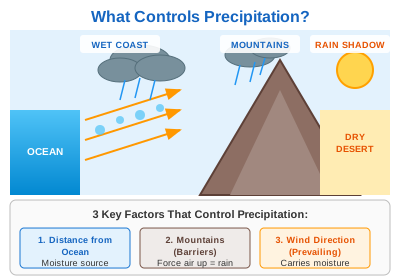
The Rain Shadow Effect:
- Moist air blows in from the Pacific Ocean (westerlies)
- Air hits the Cascade Mountains and is forced UP (orographic lift)
- Rising air COOLS and water vapor CONDENSES = RAIN on windward side
- By the time air goes OVER the mountain, it's DRY
- Air descends on the other side (leeward) = DRY desert (rain shadow)
This is why Phoenix is so dry - it's in the rain shadow of mountains!
Need Hints? — CER Scaffold + Sentence Starters
Sentence Starters:
- "Seattle is wet because westerlies bring..."
- "When air rises over mountains, it..."
- "A rain shadow forms because..."
COMPLETE THE STATION 1 FORM BELOW
[EMBED G6.U6.3.W5 Station 1 Form Here]
Station 2 - Weather vs. Climate
20 Points | ~15 Minutes
Distinguish between short-term weather and long-term climate.
Your Mission: Understand the Difference
Weather vs. Climate:
| Weather | Climate |
|---|---|
| What's happening NOW | Average over 30+ years |
| "It's 85 degrees F today" | "Miami is warm year-round" |
| Can change quickly | Changes slowly |
| What you GET | What you EXPECT |
Example:
A tourist visits Seattle for a week and says: "I visited Seattle and it didn't rain at all! Seattle isn't really that rainy."
Problem: One week of WEATHER doesn't change Seattle's CLIMATE. Seattle's climate is rainy ON AVERAGE (37 inches/year), but any specific week could be sunny!
Need Hints? — CER Scaffold + Sentence Starters
Sentence Starters:
- "Weather describes ___ while climate describes ___."
- "One cold week doesn't change climate because..."
- "Scientists study climate by..."
COMPLETE THE STATION 2 FORM BELOW
[EMBED G6.U6.3.W5 Station 2 Form Here]
Station 3 - Unit Synthesis
25 Points | ~20 Minutes
Answer the driving question using everything you learned!
Your Mission: Answer the Focus Question
"Why does a lot of hail, rain, or snow fall at some times and not others?"
Your Complete Answer Must Include:
| Week | Concept to Include |
|---|---|
| W1 | Evaporation - where water vapor comes from |
| W2 | Cloud formation - rising air, cooling, condensation |
| W3 | Forces - when droplets fall; temperature and precip type |
| W4 | Air masses and fronts - what creates rising air and storms |
| W5 | Climate - long-term patterns that determine when/where |
Need Hints? — CER Scaffold + Sentence Starters
Start your answer with:
- "Precipitation happens at certain times because multiple factors must align..."
- "First, water must evaporate from... Then, air must rise because..."
- "Climate patterns determine WHERE and WHEN these conditions are likely."
Stuck? Click for step-by-step help
Build your answer step by step:
- Start with water: "Water evaporates from oceans and land..."
- Add rising air: "When warm, moist air rises, it cools..."
- Explain clouds: "Cooling causes water vapor to condense..."
- Add forces: "Droplets fall when gravity exceeds updraft..."
- Include temperature: "Temperature layers determine rain vs. snow..."
- Add weather systems: "Fronts and pressure systems create conditions..."
- Finish with climate: "Climate patterns determine when and where..."
COMPLETE THE STATION 3 FORM BELOW
[EMBED G6.U6.3.W5 Station 3 Form Here]
Exit Ticket - Unit Synthesis
23 Points | ~15 Minutes
Final assessment for the unit!
Exit Ticket Structure:
- 2 NEW - Climate patterns and weather vs. climate from this week
- 2 SPIRAL - Review from W1-W4 (fronts, clouds, forces, evaporation)
- 1 INTEGRATION - Apply all concepts to a new scenario
- 1 SEP-7 - Engaging in argument from evidence
COMPLETE THE EXIT TICKET BELOW
Take your time and show your best thinking!
[EMBED G6.U6.3.W5 Exit Ticket Form Here]
Complete Your Worksheet - Click to Expand
Turn in your completed worksheet to your teacher!
Up to 15 bonus points for complete worksheet!
Enrichment & Extension
Optional deep dives into systems thinking, scientist profiles, and
environmental justice.
Systems Thinking Reflection - Unit Complete!
You've now seen how weather and climate are connected systems! Use these questions to see the big picture.
Complete Cause-Effect Chain
Sun heats ocean, Water evaporates, Vapor rises, Cools and condenses, Cloud forms, Droplets grow, Forces unbalance, Precipitation falls, Water returns to ocean...
Your turn: How would climate change (warmer oceans) affect this cycle?
Feedback Loop
Warmer temperatures, More evaporation, More water vapor (greenhouse gas), More warming, Even more evaporation...
Your turn: Is this a positive feedback loop that amplifies change, or a negative feedback that stabilizes?
Scientist Spotlight: Wladimir Koppen
Wladimir Koppen (1846-1940) was a German-Russian climatologist who created the climate classification system still used today. The "Koppen Climate Classification" divides Earth into climate zones based on temperature and precipitation patterns.
Koppen noticed that plants are excellent indicators of climate - certain plants only grow in certain conditions. He used vegetation patterns to help define climate zones. His work helps us understand why different parts of the world have different ecosystems, from tropical rainforests to deserts to tundra.
Environmental Justice: Climate Vulnerability
Climate affects everyone, but not equally. Low-income communities and communities of color are often more vulnerable to climate impacts:
- Less access to air conditioning during heat waves
- Higher rates of flooding in underserved neighborhoods
- Less ability to evacuate during severe weather
- Less political power to demand infrastructure improvements
Understanding climate science empowers you to advocate for climate justice - ensuring that everyone has the resources to adapt to changing conditions and that the burdens of climate change aren't placed unfairly on those least responsible for causing it.
Congratulations! Unit 6.3 Complete!
You've mastered Weather, Climate & Water Cycling!
You can now explain evaporation, cloud formation, precipitation types, air masses, fronts, and climate patterns. You are a weather scientist!