Week 1: Ocean Acidification Investigation
Grade 7 Science | Rosche | Kairos Academies
The Phenomenon: The Dissolving Shells Mystery
Anchoring Context & Focus Question
Before We Begin: Activate Your Prior Knowledge
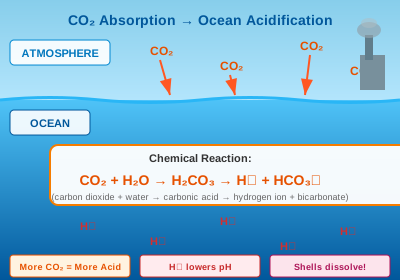
Think back to Cycle 3: You learned that CO₂ is a greenhouse gas that traps heat. You also learned that carbon cycles through Earth's systems. This week: CO₂ → dissolves in ocean → carbonic acid → pH drop → shells dissolve. The same CO₂ causing climate change is also changing ocean chemistry!
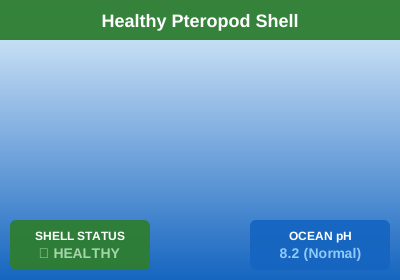
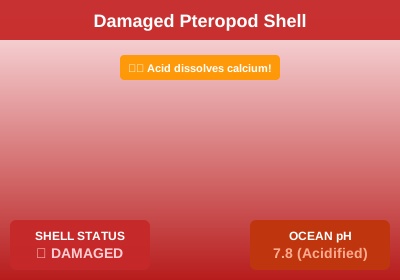
Scientists studying pteropods ("sea butterflies") discovered something alarming:
- Shells collected TODAY are thinner and more fragile than shells from 50 years ago
- Some shells are literally dissolving while the animals are still alive
- This is happening in oceans around the world
- The creatures haven't changed. The water has.
Vocabulary
| Term | Definition |
|---|---|
| acidification | When something becomes more acidic (pH decreases) |
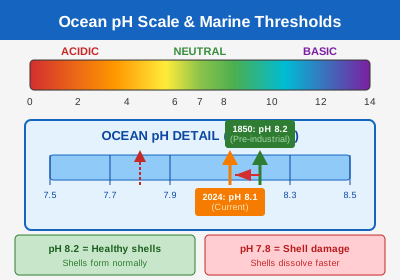
| pH scale | A scale from 0-14 measuring how acidic or basic something is |
| carbon dioxide (CO₂) | A gas that dissolves in water and makes it more acidic |
| carbonic acid | Weak acid (H₂CO₃) formed when CO₂ dissolves in water |
| calcium carbonate | Chemical (CaCO₃) that makes shells and skeletons |
| marine organism | Any living thing that lives in the ocean |
| concentration | How much of something is in a certain amount of space |
St. Louis Connection
St. Louis sits where the Mississippi and Missouri Rivers meet. Our industrial CO₂ emissions contribute to global ocean acidification. Local freshwater mussels face similar threats as ocean pH changes affect river chemistry. Scientists at UMSL and Washington University are monitoring these changes now.
Why This Matters to YOU
Ocean acidification threatens seafood you might eat (oysters, mussels, clams). The same CO₂ causing climate change is dissolving shells. Understanding this chemistry helps protect food sources for millions.
Focus Question: Why is the ocean dissolving shells now when it didn't 50 years ago? What has changed in ocean chemistry?
By the end of this lesson, you will be able to:
- Explain how atmospheric CO₂ affects ocean pH through carbonic acid formation
- Interpret pH data and predict effects on marine organisms at different thresholds
- Apply mass balance to calculate ocean-atmosphere carbon exchange
- Design a monitoring system to track ocean acidification changes
▼ NGSS 3D Standards — Click to View ▼
This Week's Standards
MS-ESS3-3: Apply scientific principles to design a method for monitoring and minimizing human impact on the environment.
▼ Worked Example: Tracing the Ocean
Acidification Cascade ▼
Step-by-Step Problem Solving
[██████████] FULL SUPPORT - Week 1
The Problem
Ocean pH dropped from 8.25 in 1800 to 8.10 in 2020. If this trend continues, pH could reach 7.95 by 2100. Calculate the change in acidity and predict which marine organisms will be affected at each pH threshold.
Step-by-Step Solution (All 5 Steps Shown)
Step 1: Identify what you know
"Let me write down the givens: Starting pH = 8.25 (1800), Current pH = 8.10 (2020), Projected pH = 7.95 (2100). The pH scale is logarithmic."
Step 2: Recall the pH-acidity relationship
"Key fact: pH is logarithmic. Every 0.1 pH decrease = 26% increase in acidity. The total change from 1800 to 2020 is 8.25 - 8.10 = 0.15 units."
Step 3: Calculate the acidity change
"0.15 pH change ≈ 0.1 + 0.05 ≈ 26% + 13% ≈ 40% more acidic since 1800. That's significant! By 2100 (pH 7.95), it could be 50%+ more acidic."
Step 4: Compare to organism thresholds
"Thresholds: Coral (8.0) → Oysters (7.9) → Pteropods (7.8). At current pH 8.10, all organisms are OK but stressed. At pH 7.95 (2100), CORAL fails. At 7.85, OYSTERS fail. At 7.75, PTEROPODS fail."
Step 5: State the answer and check
"Answer: Ocean is ~40% more acidic now than in 1800. By 2100, corals will struggle first (below pH 8.0). This makes sense because lower pH = harder to build shells/skeletons."
Fading Support: This week shows all 5 steps. By Week 2, steps 4-5 will be YOUR turn. By Week 3, you'll do most steps independently! This builds your problem-solving stamina.
▼ Hook – The Dissolving Shells
Mystery ▼
12 Points | ~10 Minutes
Connect Cycle 3 CO₂ concepts to ocean chemistry changes.
The Challenge
What You'll Do (~10 minutes)
- Observe the phenomenon: shells dissolving in modern oceans (2 min)
- Connect to Cycle 3: What does CO₂ do in water? (3 min)
- Make predictions about ocean chemistry changes (3 min)
- Answer diagnostic questions (2 min)
COMPLETING THIS AT HOME?
Think about: What gas is increasing in the atmosphere? (Cycle 3) What happens when gases dissolve in water? What do acids do to calcium carbonate (shells)?
▼ Need extra support? Click for hints ▼
Key Concept Reminder:
- CO₂ + H₂O → H₂CO₃ (carbonic acid)
- More acid = lower pH = shells dissolve faster
- This is the same CO₂ from Cycle 3 greenhouse effect!
▼ 🆘 Stuck? Click here for step-by-step CER help ▼
Try these steps in order:
- Review Cycle 3: CO₂ is a greenhouse gas that traps heat
- CO₂ also dissolves in ocean water
- When CO₂ dissolves, it forms carbonic acid (H₂CO₃)
- Acid attacks shells made of calcium carbonate (CaCO₃)
- Result: Shells dissolve while animals are still alive!
COMPLETE THE HOOK FORM BELOW
Submit your predictions before moving to Station 1.
Complete Your Worksheet — Click to Expand
Complete the "AFTER HOOK FORM" section on your worksheet:
- Write what you learned in the "I learned that..." box
- Review your initial thinking about dissolving shells
Bonus: +2 points for completing this section!
Station 1 – pH and Marine Life
20 Points | ~18 Minutes
Your Mission: Investigate pH Changes
The pH Scale (CRITICAL: It's Logarithmic!)
- pH 7 = neutral (pure water)
- Below 7 = acidic (more H⁺ ions)
- Above 7 = basic (fewer H⁺ ions)
- 0.1 pH change = 26% change in acidity!
Discuss with Your Partner:
"Why do you think a small pH change (like 0.1) can have such a big effect on marine life?" Share your thinking with evidence from the simulation or data tables.
COMPLETING THIS AT HOME? (No lab materials needed)
Use this historical ocean pH data for your answers:
| Year | Ocean pH | Change from 1800 |
|---|---|---|
| 1800 | 8.25 | baseline |
| 1900 | 8.21 | -0.04 |
| 1950 | 8.18 | -0.07 |
| 2000 | 8.12 | -0.13 |
| 2020 | 8.10 | -0.15 |
| 2100 (projected) | 7.95 | -0.30 |
Organism pH Thresholds:
- Pteropods: Shells dissolve below pH 7.8
- Oysters: Larvae fail below pH 7.9
- Coral: Calcification slows below pH 8.0
Interactive Simulation: PhET pH Scale
Use this simulation to compare the pH of different liquids, including carbonated drinks!
▶ Launch PhET pH Scale SimulationInstructions: Select "Macro" tab → Click "Molecules" to see H₃O⁺ ions → Compare "Soda Pop" (pH ~2.5, carbonated with CO₂) to "Milk" (pH ~6.5) → Notice how many more H₃O⁺ molecules appear in the acidic soda!
Key Insight: Soda Pop is acidic (pH 2.5) because CO₂ dissolved in water forms carbonic acid (H₂CO₃). This is the same chemistry that makes oceans more acidic when they absorb atmospheric CO₂!
Can't access the simulation? Use the pH data tables above to answer all questions.
Worked Example: How to Analyze pH Data
Full ScaffoldingExample Question: If ocean pH was 8.20 in 1950 and is 8.10 in 2020, how many times more acidic is the ocean now?
Expert Thinking Process (5 Steps):
Step 1: Identify what you know
"Let me write down the givens: Starting pH = 8.20, Ending pH = 8.10, Change = 8.20 - 8.10 = 0.10 units"
Step 2: Recall the pH formula/relationship
"I remember that pH is logarithmic. The key fact: 0.1 pH change = 26% change in acidity. Since pH went DOWN, acidity went UP."
Step 3: Apply the relationship
"Change is exactly 0.1 units, so 26% more acidic = acidity increased by factor of 1.26"
Step 4: State the answer clearly
"Answer: The ocean is 26% more acidic now than in 1950 (1.26 times as acidic)."
Step 5: Check if it makes sense
"pH decreased (8.20 → 8.10), so acidity should increase. 26% is significant but not extreme. "
Self-Explanation Prompt:
Why does pH decrease when CO₂ increases? Explain in your own words before continuing.
Need extra support? Click here for hints and sentence starters
Key Concept Reminder:
- pH going DOWN = becoming MORE acidic
- Logarithmic means small changes in pH = BIG changes in acidity
- 0.1 pH change = 26% more acidic
Sentence Starters:
- "Even though 0.1 seems small, it actually means..."
- "For marine organisms, this is significant because..."
- "At pH 7.95, all three organisms would be affected because..."
Word Bank:
acidification • pH • carbonic acid • logarithmic • threshold • calcifying • dissolve • absorb
🆘 Stuck? Click here for step-by-step help
Try these steps in order:
- Look at the data table: Are the pH numbers getting bigger or smaller over time?
- Smaller pH = more acidic
- Compare 7.95 (predicted 2100) to each organism's threshold
- Is 7.95 above or below 7.8 (pteropods)? Above or below 7.9 (oysters)? Above or below 8.0 (coral)?
- Watch: Search "Ocean Acidification Explained"
- Still stuck? Email Mr. Rosche with your specific question
Choose Your Analysis Pathway
All three routes reach the same NGSS standards - pick what works for your brain!
- ● Visual: Create graphs and diagrams showing pH changes
- ● Quantitative: Calculate pH impacts and shell dissolution rates
- ● Comparative: Compare healthy vs. acidified ocean conditions
Your form questions adapt to show data in your chosen format.
COMPLETE THE STATION 1 FORM BELOW
Analyze the pH data and predict effects on marine life.