Week 2: Eutrophication & Dead Zones
Grade 7 Science | Rosche | Kairos Academies
Step-by-Step Solution
Step 1: Calculate the nitrogen runoff
"200 kg fertilizer × 15% runoff = 30 kg of nitrogen entering the stream"
Step 2: Trace the pathway
"Farm field → Rain washes
nutrients → Local stream → Mississippi River → Gulf of
Mexico
The journey takes weeks to months, but the nitrogen doesn't
disappear—it accumulates!"
Step 3: Explain the cascade effect in the Gulf
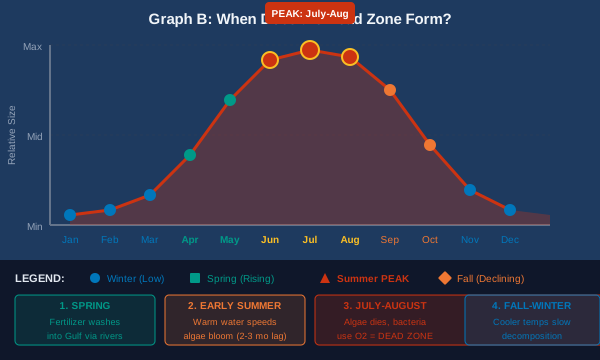
"Nitrogen arrives → Algae
population EXPLODES (nutrients = food for algae)
Algae blocks sunlight → Algae dies → Bacteria decompose dead
algae → Bacteria USE OXYGEN
Oxygen drops below 2 mg/L → Fish suffocate or flee =
DEAD ZONE"
Now YOU Complete Steps 4-5:
Step 4: If thousands of farms across the Midwest each contribute 30 kg of nitrogen, what happens to the total amount reaching the Gulf? Why does this make the problem so hard to solve?
Step 5: Compare this cascade to Week 1's ocean acidification cascade (CO₂ → carbonic acid → pH drop → shell damage). What do both cascades have in common?
Fading Support: Week 1 showed all 5 steps. This week, steps 4-5 are YOUR turn. By Week 3, you'll do most steps independently! This builds your problem-solving stamina.
▼ Station 1 – Nutrient Cycle
Modeling ▼
20 Points | ~18 Minutes
Trace nitrogen and phosphorus from farms through rivers to dead
zones.
Your Mission: Trace N and P Through Ecosystems
The Nutrient Pathway
- Sources: Fertilizers, sewage, animal waste
- Pathway: Farm → Rain → Stream → River → Ocean/Lake
- Effect: Nutrients → Algae Bloom → Death → Decomposition → O₂ Depletion
COMPLETING THIS AT HOME?
Use this reference to understand the eutrophication cascade:
| Stage | What Happens | Result |
|---|---|---|
| 1. Nutrient Input | Fertilizer runs off farms | N and P enter water |
| 2. Algae Bloom | Algae grows explosively | Water turns green |
| 3. Die-Off | Algae blocks light, dies | Massive dead algae |
| 4. Decomposition | Bacteria eat dead algae | Oxygen consumed |
| 5. Dead Zone | O₂ drops below 2 mg/L | Fish die or flee |
Interactive Simulation
▼ Need extra support? Click for hints ▼
Key Concept Reminder:
- Nitrogen (N) and Phosphorus (P) are essential nutrients for plants
- Sources: fertilizers, sewage, animal waste
- Cycle: Source → Runoff → Water → Algae Growth → Death → Decomposition
Sentence Starters:
- "Nitrogen enters the ecosystem when..."
- "The nutrient travels from ___ to ___ by..."
- "This causes oxygen to decrease because..."
▼ 🆘 Stuck? Click here for step-by-step CER help ▼
Try these steps in order:
- Identify where nutrients COME FROM (farms, sewage)
- Trace how they GET TO water (rain washes them)
- Explain what GROWS when nutrients arrive (algae)
- Describe what happens when algae DIES (decomposition)
- Explain why decomposition USES OXYGEN
- Review the 5-stage eutrophication cascade table in the Home Alternative section above
COMPLETE THE STATION 1 FORM BELOW
Model how nutrients move through ecosystems.
▼ Station 2 – Dead Zone Data
Analysis ▼
20 Points | ~15 Minutes
Analyze Gulf of Mexico dead zone data and identify trends over
time.
Your Mission: Analyze Gulf of Mexico Data
Dead Zone Facts
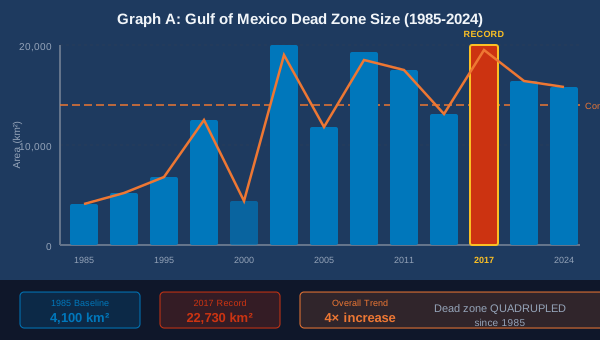
- Dead zone size is measured in square kilometers (km²)
- Reference: Connecticut is ~14,000 km²
- The Gulf of Mexico dead zone can reach 22,000+ km²!
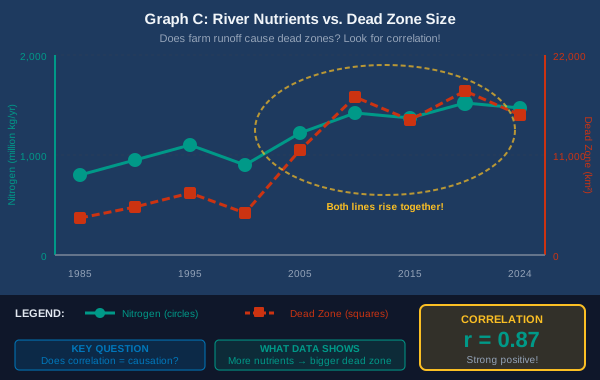
- It's caused by nutrients from the Mississippi River watershed
Data Analysis: Examine These Three Graphs

▼ Graph A: Dead Zone Size (1985-2024) — Click to expand/collapse ▼
▼ Graph B: Seasonal Pattern — Click to expand/collapse ▼
▼ Graph C: River Nutrients vs Dead Zone Size — Click to expand/collapse ▼
▼ Need extra support? Click for data tips ▼
Data Reading Tips:
- Look for TRENDS: Is the zone getting bigger or smaller over time?
- Compare to reference: Connecticut is ~14,000 km²
- Identify the LARGEST and SMALLEST years
Sentence Starters:
- "The data shows that the dead zone has [increased/decreased] because..."
- "The largest dead zone occurred in ___ and was ___ km²..."
- "This correlates with nutrient levels because..."
COMPLETE THE STATION 2 FORM BELOW
Analyze dead zone data and identify trends.
▼ Exit Ticket – Biogeochemical
Systems ▼
23 Points | ~15 Minutes
Demonstrate mastery by integrating Week 1 ocean acidification with
Week 2 eutrophication.
Show What You Learned
Question Types:
- 2 NEW - Eutrophication content (this week)
- 2 SPIRAL - Week 1 review (ocean acidification, pH)
- 1 INTEGRATION - Compare both human impact problems
- 1 SEP-2 - Develop a model explaining the cascade
▼ Autonomy Support: How to Ace
the Exit Ticket (23 pts) ▼
Quick review of Week 1 and Week 2 concepts you'll need to
integrate.
The Exit Ticket tests INTEGRATION - connecting ideas across weeks. Here's how to prepare:
Quick Review Before You Start:
- Week 1 (Ocean Acidification): CO₂ → carbonic acid → pH drop → shell damage to marine organisms
- Week 2 (Eutrophication): Nutrients → algae bloom → decomposition → oxygen depletion → dead zone
- BOTH ARE: Human-caused chemical cascades that harm aquatic ecosystems
- SEP-2 (Develop a Model): Use arrows to show cause → effect chains, label each step
Integration question tip: The best answers connect BOTH problems. Example: "Both ocean acidification and eutrophication are caused by human activities that add excess chemicals to water, creating cascade effects that kill marine life."
COMPLETE THE EXIT TICKET BELOW
This is your final assessment for Week 2. Take your time!
▼ Enrichment & Extension ▼
Optional deep dives into systems thinking, scientist profiles, and
environmental justice.
Systems Thinking Reflection
Dead zones don't appear overnight. Use these questions to trace the connections.
Cause → Effect Chain
Fertilizer on Iowa farms → Rain washes it into streams → Mississippi River → Gulf of Mexico → ?
Your turn: How can a farmer 1,000 miles away affect Gulf shrimp populations?
Trade-Off Thinking
Fertilizers help grow food for millions of people, but they also create dead zones...
Your turn: Should we ban fertilizers? What would happen if we did?
Feedback Loop
Dead zone kills fish → Fishing industry struggles → Less income for coastal communities...
Your turn: How might economic pressure create pressure to change farming practices?
Week 1 + Week 2 Connection: Both ocean acidification AND dead zones are caused by human activities. How are they similar? How are they different?
Scientist Spotlight: Dr. Nancy Rabalais
Dr. Nancy Rabalais is the world's leading expert on hypoxic dead zones in river and ocean systems—the very problem you're studying this week! Since the 1980s, she has spent over 200 research cruises mapping oxygen-depleted waters. Her work transformed our understanding of how fertilizer from farms hundreds of miles upstream ends up killing aquatic life downstream.
Dr. Rabalais received a MacArthur Fellowship ("genius grant") in 2012 for her groundbreaking work. She grew up in inland Missouri but fell in love with water systems during a college field trip. Her advice to students: "Science isn't just about discovering problems—it's about staying committed long enough to find solutions."
Environmental Justice: Who Bears the Burden?
River eutrophication reveals a stark environmental injustice: Industrial agriculture profits from heavy fertilizer use, but Mississippi River communities—disproportionately Black, Latino, and low-income families—bear the consequences. When nutrient pollution degrades water quality, these families lose access to safe fishing, swimming, and drinking water.
Environmental justice advocates argue that nutrient pollution regulation must prioritize protecting vulnerable communities. Understanding eutrophication means understanding whose health and livelihoods are sacrificed for industrial profit.
Week 2 Complete!
Next Week: Synthesis & Assessment – Connecting Ocean Acidification and Eutrophication