Week 3: Carbon Cycle & Sequestration
Grade 7 Science | Rosche | Kairos Academies
The Phenomenon: The Disappearing Carbon Mystery
Anchoring Context & Focus Question
Before We Begin: Activate Your Prior Knowledge
Think back to W1 & W2: CO₂ → carbonic acid → pH drop (ocean acidification). Nutrients → algae → dead zones (eutrophication). This week: Where does carbon GO when forests are cut down? All three weeks connect human activities to chemical changes in Earth's systems!
Scientists studying deforestation discovered something puzzling:
- Every year, about 10 million hectares of forest are cut down (area larger than Portugal!)
- A single large tree can store hundreds of kilograms of carbon in its wood
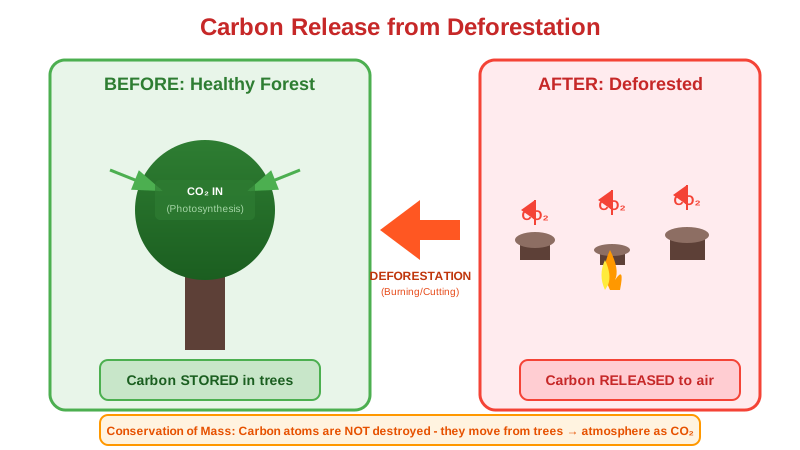
- When the forest is cleared, where does all that carbon GO?
- Atmospheric CO₂ is rising - is there a connection?
The trees didn't just "disappear." The carbon had to go somewhere.
Vocabulary
| Term | Definition |
|---|---|
| carbon cycle | Movement of carbon through Earth's systems: atmosphere, biosphere, oceans, and soil |
| sequestration | Long-term capture and storage of carbon in forests, soil, or oceans to reduce atmospheric CO₂ |
| photosynthesis | Process where plants use CO₂, water, and sunlight to create glucose and oxygen |
| respiration | Process where organisms break down glucose using oxygen and release CO₂ |
| reservoir | Storage location for carbon (e.g., forests, oceans, soil, atmosphere) |
| combustion | Burning of organic material, releasing stored carbon as CO₂ |
| decomposition | Breakdown of dead organisms by bacteria/fungi, releasing carbon back to environment |
St. Louis Connection
St. Louis' industrial corridor releases millions of tonnes of CO₂ annually. Meanwhile, Mississippi River floodplain wetlands store MORE carbon per acre than upland forests—but they're being destroyed by development. Restoring these wetlands is climate action!
Why This Matters to YOU
When forests are cut down (10 million hectares per year!), stored carbon is released as CO₂. Understanding the carbon cycle helps you evaluate which climate solutions actually work.
Focus Question: Where does all the carbon go when forests are cut down? How does this affect Earth's carbon cycle?
By the end of this lesson, you will be able to:
- Trace carbon through Earth's major reservoirs (atmosphere, biosphere, hydrosphere, lithosphere)
- Compare carbon sequestration in different ecosystems using data
- Design a carbon reduction strategy using the Engineering Design Process
- Connect deforestation to ocean acidification (Week 1 spiral)
▼ NGSS 3D Standards — Click to View ▼
This Week's Standards
MS-ESS3-4: Construct an argument supported by evidence for how increases in human population and per-capita consumption of natural resources impact Earth's systems.
MS-PS1-5: Develop and use a model to describe how the total number of atoms does not change in a chemical reaction (conservation of mass).
▼ Worked Example: Calculate Carbon
Storage ▼
Step-by-Step Problem Solving
[██░░░░░░] MINIMAL SUPPORT - Week 3
The Problem
A forest has 100 hectares. Each hectare stores 250 tonnes of carbon in trees. If 20% of the forest is cut down and burned, how much carbon is released to the atmosphere?
Step-by-Step Solution
Step 1: Identify what you know
"First, I'll identify what I know: Total area = 100 ha, Storage per hectare = 250 tonnes C/ha, Percent cut down = 20%"
Now YOU Complete Steps 2-5:
Step 2: Calculate the area cut down (hint: 20% of 100 ha = ?)
Step 3: Calculate total carbon in the cut area (area × storage per hectare)
Step 4: State your answer with correct units
Step 5: Check if it makes sense—is this answer reasonable?
Fading Support: Week 1 showed all 5 steps. Week 2 showed steps 1-3. This week, only Step 1 is provided—YOU do steps 2-5. This builds your independent problem-solving skills!
▼ Hook – The Disappearing Carbon
Mystery ▼
12 Points | ~10 Minutes
Observe deforestation, apply conservation of mass, and predict where
carbon goes.
The Challenge
What You'll Do (~10 minutes)
- Observe the phenomenon: Deforestation before/after images (2 min)
- Apply conservation of mass: Where does carbon go? (3 min)
- Connect to Week 1: How does deforestation affect ocean acidification? (3 min)
- Identify misconceptions about carbon "disappearing" (2 min)
COMPLETING THIS AT HOME?
Use this key concept to guide your thinking:
- Conservation of mass: Carbon atoms cannot be created or destroyed
- When wood burns: C (solid) + O₂ (gas) → CO₂ (gas) — carbon becomes gas!
- The connection: More atmospheric CO₂ → More dissolves in ocean → Ocean acidification (W1)
▼ Need extra support? Click for hints ▼
Key Concept Reminder:
- Carbon is stored in living things (biosphere)
- When things burn or decompose, carbon is released as CO₂
- CO₂ is a greenhouse gas that also dissolves in oceans
Sentence Starters:
- "When forests are cut down, the carbon stored in trees..."
- "This connects to ocean acidification because..."
- "The law of conservation of mass tells us that..."
▼ 🆘 Stuck? Click here for step-by-step CER help ▼
Try these steps in order:
- Look at the before/after images — what changed?
- Trees are made of CARBON — where is that carbon now?
- If trees burned: Carbon + Oxygen → CO₂ (a gas in the atmosphere)
- If trees decomposed: Bacteria release CO₂ slowly as they break down wood
- More CO₂ in atmosphere → More dissolves in ocean → Ocean becomes more acidic
COMPLETE THE HOOK FORM BELOW
Submit your predictions before moving to Station 1.
▼ Complete Your Worksheet — Click to Expand ▼
Complete the "AFTER HOOK FORM" section on your worksheet:
- Write what you learned in the "I learned that..." box
- Review your initial thinking about where carbon goes
Bonus: +2 points for completing this section!
▼ Station 1 – Carbon Cycle Investigation
▼
20 Points | ~18 Minutes
Trace carbon through Earth's reservoirs using an interactive simulation.
Your Mission: Trace Carbon Through Earth's Systems
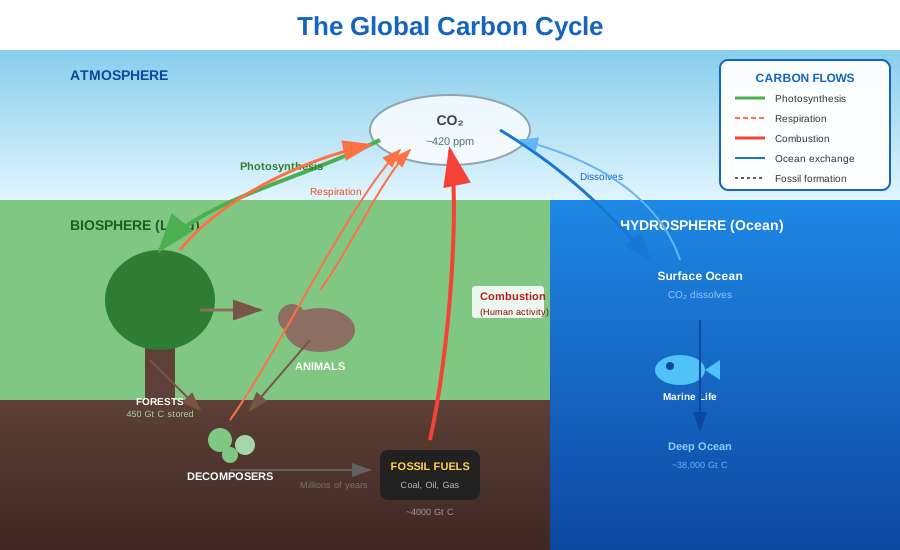
The Carbon Cycle - Major Reservoirs
- Atmosphere: CO₂ gas
- Biosphere: Carbon in living organisms (plants, animals)
- Hydrosphere: Dissolved CO₂ in oceans (Week 1 connection!)
- Lithosphere: Fossil fuels, carbonate rocks, soil
- Key Insight: Carbon moves BETWEEN these reservoirs but total stays constant (conservation of mass!)
Interactive Simulation: Carbon Cycle Tracer
Tip: Click on different reservoirs to see how carbon moves between them. Track the arrows to understand each process!
Alternative Simulation: PhET Greenhouse Effect (Click to expand)
Tip: Use the "Layer Model" to see how CO₂ affects temperature. Toggle between present day and ice age!
COMPLETING THIS AT HOME?
Use this reference to understand carbon pathways:
| Process | What Happens to Carbon | Direction |
|---|---|---|
| Photosynthesis | Plants absorb CO₂, build glucose | Atmosphere → Biosphere |
| Respiration | Organisms release CO₂ | Biosphere → Atmosphere |
| Combustion | Burning releases stored carbon | Biosphere/Lithosphere → Atmosphere |
| Ocean absorption | CO₂ dissolves in seawater | Atmosphere → Hydrosphere |
| Decomposition | Dead matter broken down, CO₂ released | Biosphere → Atmosphere/Lithosphere |
▼ Need extra support? Click for hints ▼
Key Concept Reminder:
- Photosynthesis: CO₂ + H₂O + sunlight → glucose (removes CO₂ from atmosphere)
- Respiration: glucose + O₂ → CO₂ + H₂O (returns CO₂ to atmosphere)
- Combustion: burning wood/fossil fuels → CO₂ released
- Ocean absorption: CO₂ dissolves in seawater (Week 1 connection!)
Sentence Starters:
- "When atmospheric CO₂ increases from deforestation, the ocean absorbs more CO₂ because..."
- "A carbon atom can move from the atmosphere into a plant through..."
- "The carbon cycle shows that matter is conserved because..."
Word Bank:
photosynthesis • respiration • combustion • decomposition • reservoir • atmosphere • biosphere • hydrosphere • lithosphere • sequestration
▼ 🆘 Stuck? Click here for step-by-step CER help ▼
Try these steps in order:
- Identify the 4 main reservoirs: atmosphere, biosphere, hydrosphere, lithosphere
- For each question, ask: "Where is carbon STARTING and where is it GOING?"
- Match the process to the transfer (photosynthesis removes CO₂, respiration adds CO₂)
- Remember: Carbon is NEVER created or destroyed, only moved!
- Use the table in the Home Alternative section as your reference
COMPLETE THE STATION 1 FORM BELOW
Trace carbon pathways and analyze simulation data.
▼ Station 2 – Carbon Sequestration
Analysis ▼
20 Points | ~15 Minutes
Compare carbon storage in different ecosystems and recommend
sequestration strategies.
Your Mission: Compare Natural Carbon Sinks
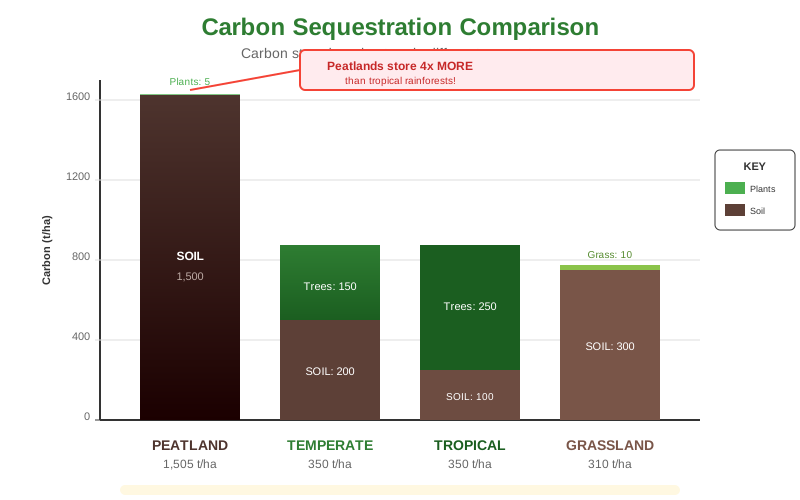
Carbon Sequestration Data (tonnes C/hectare)
| Ecosystem Type | Trees (above ground) | Soil (below ground) | Total Storage |
|---|---|---|---|
| Tropical Rainforest | 250 | 100 | 350 |
| Temperate Forest | 150 | 200 | 350 |
| Grassland | 10 | 300 | 310 |
| Peatland | 5 | 1500 | 1505 |
Key Insight: Don't just look at trees! Soil stores MORE carbon in many ecosystems. Peatlands store 4x more than rainforests!
COMPLETING THIS AT HOME?
Use this calculation method:
- Total carbon = storage per hectare × number of hectares
- Example: 1000 ha of peatland = 1505 tonnes/ha × 1000 ha = 1,505,000 tonnes C
- Compare options by calculating total carbon for each ecosystem type
- The option with the HIGHEST total is the best for carbon storage
▼ Need extra support? Click for data tips ▼
Data Analysis Tips:
- Look at BOTH columns: trees + soil = total storage
- Peatlands surprise people—most carbon is UNDERGROUND
- To calculate total: storage per hectare × number of hectares
- Don't forget units: tonnes C/ha × ha = tonnes C
Sentence Starters:
- "Based on the data, peatland stores ____ times more carbon than..."
- "The most effective strategy would be ____ because the data shows..."
- "Even though trees are visible, soil carbon is important because..."
▼ 🆘 Stuck? Click here for step-by-step CER help ▼
Try these steps in order:
- Read the "Total Storage" column to compare ecosystems
- Notice: Peatland (1505) > Temperate Forest (350) = Tropical Rainforest (350) > Grassland (310)
- For calculations: Multiply storage per hectare by area
- Example: 100 ha of peatland = 1505 × 100 = 150,500 tonnes C
- Compare your totals to determine which option stores more
COMPLETE THE STATION 2 FORM BELOW
Analyze carbon sequestration data and recommend strategies.
▼ Exit Ticket – Carbon Cycle
Integration ▼
23 Points | ~15 Minutes
Demonstrate mastery by integrating Week 1 ocean acidification with Week
3 carbon cycle.
Show What You Learned
Question Types:
- 2 NEW - Carbon cycle content (this week)
- 2 SPIRAL - Week 1 review (ocean acidification, pH)
- 1 INTEGRATION - Connect carbon cycle to ocean acidification AND eutrophication
- 1 POST-REFLECTION - Metacognitive reflection on learning (diagnostic only)
▼ Autonomy Support: How to Ace the
Exit Ticket (23 pts) ▼
Quick review of Week 1-3 concepts you'll need to integrate.
The Exit Ticket tests INTEGRATION — connecting ideas across weeks. Here's how to prepare:
Quick Review Before You Start:
- Week 1 (Ocean Acidification): CO₂ → carbonic acid → pH drop → shell damage
- Week 2 (Eutrophication): Nutrients → algae bloom → decomposition → oxygen depletion
- Week 3 (Carbon Cycle): Carbon moves between reservoirs but total is conserved
- THE CONNECTION: Deforestation → More CO₂ in atmosphere → More CO₂ dissolves in ocean → Ocean acidification!
Integration question tip: The best answers trace carbon through multiple weeks. Example: "Cutting down forests releases stored carbon as CO₂. This increases atmospheric CO₂, which dissolves in oceans, causing the ocean acidification we studied in Week 1."
COMPLETE THE EXIT TICKET BELOW
This is your final assessment for Week 3. Take your time and connect everything you learned!
▼
Science Circle Protocol ▼
Structured discourse for deeper understanding (~5-7 min)
✍️ PRE-WRITE (2 minutes - Silent)
Before any discussion, complete these two prompts silently on your worksheet:
1. My "Aha Moment" from today:
What concept clicked for you? What surprised you about the carbon cycle?
2. My remaining question:
What are you still wondering about? What would you like to explore further?
This silent thinking time ensures everyone has ideas ready to share.
🗣️ TURN & TALK (3 minutes - Partner Discussion)
Face your partner and take turns sharing. Use this sentence stem:
"My aha moment was _______ because _______."
📝 LISTEN & RECORD:
While your partner shares, write down their key idea on your worksheet. You will need this!
Active listening tip: Nod, make eye contact, and ask a follow-up question like "Can you tell me more about...?"
⚠️ COLD CALL ALERT: Be Ready!
Mr. Rosche may call on you to share your PARTNER's thinking - not your own!
You might be asked:
- "What was your partner's aha moment?"
- "What question is your partner still wondering about?"
- "How did your partner connect the carbon cycle to ocean acidification?"
This builds accountability AND active listening skills!
▼ Enrichment & Extension ▼
Optional deep dives into systems thinking, scientist profiles, and
environmental justice.
Optional content if you finish early or want to go deeper.
Systems Thinking Reflection
Forests do more than just look pretty. Use these questions to see the hidden connections.
Cause → Effect Chain
Cut down rainforest → Soil releases CO₂ → More CO₂ in atmosphere → Ocean absorbs more → ?
Your turn: How does cutting a tree in Brazil affect shells in the Pacific Ocean?
Trade-Off Thinking
Peatlands store 4x more carbon than rainforests, but people drain them to build on...
Your turn: Which ecosystems should be protected first: rainforests or peatlands? Why?
Feedback Loop
↑ CO₂ → ↑ Temperature → Forest fires → More CO₂ released → ↑ Temperature even more...
Your turn: Is this a positive or negative feedback loop? Why is it dangerous?
All Weeks Connection: W1 (ocean acidification), W2 (dead zones), and W3 (deforestation) all have the same root cause. What is it?
Scientist Spotlight: Dr. Warren Washington
Dr. Warren Washington is one of the pioneering climate scientists who developed the first computer models showing how CO₂ affects Earth's temperature—models that power climate predictions today. Growing up in Portland, Oregon in the 1940s, he faced racism that nearly derailed his scientific career. One high school counselor told him he "wasn't college material." Instead, he earned a PhD in meteorology and spent 50+ years at the National Center for Atmospheric Research.
Dr. Washington's breakthrough was creating computer models that track carbon through Earth's systems—the atmosphere, oceans, ice, and forests—exactly what you're studying this week! As one of the first Black climate scientists, he received the National Medal of Science in 2010.
His advice to students: "Science isn't just for people who look like the scientists you see in textbooks. We need minds from every background—especially those who've been told they don't belong—to solve problems this big."
Environmental Justice: Who Breathes St. Louis' Carbon Emissions?
St. Louis' chemical plants and industrial facilities don't just release CO₂ that destabilizes the carbon cycle—they also emit toxic pollutants that sicken the people living nearby. And those people are overwhelmingly Black and Latino. Neighborhoods in North St. Louis City (over 90% Black) and near the South City chemical corridor sit in the shadow of facilities releasing millions of tons of carbon annually. Children in these communities have asthma rates 3-4 times higher than children in wealthier, whiter West County suburbs.
Here's the carbon cycle injustice: When extreme weather events intensified by climate change (caused by excess atmospheric carbon) hit St. Louis—like the catastrophic 2022 flooding—these same low-income communities of color flood first and worst.
Community organizations like Missouri Coalition for the Environment and Metropolitan Congregations United, led by people of color from affected neighborhoods, are fighting back. Understanding the carbon cycle means understanding who profits from disrupting it—and who pays the price.
Week 3 Complete!
Next Week: Nitrogen Cycle & Agriculture — Why does corn need fertilizer but prairie grass doesn't?