Week 4: Nitrogen Cycle & Agriculture
Grade 7 Science | Rosche | Kairos Academies
The Phenomenon: The Fertilizer Mystery
Anchoring Context & Focus Question
Before We Begin: Activate Your Prior Knowledge
Think back to Week 2: Excess nutrients caused eutrophication and dead zones. Week 3: You traced carbon through the carbon cycle. This week: Discover that NITROGEN is the key nutrient causing eutrophication - and learn why some plants can get nitrogen naturally while others need fertilizer!
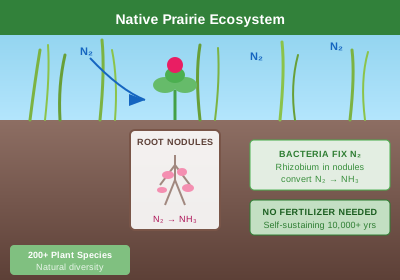
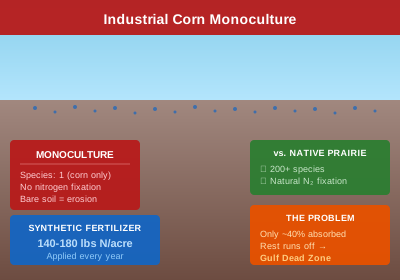
A farmer plants corn in a field where native prairie grass once grew:
- Prairie grass thrived for 10,000+ years without any fertilizer
- Corn requires 100-200 lbs/acre of nitrogen fertilizer annually
- The atmosphere is 78% nitrogen gas - yet plants can't use it directly
- Some plants partner with bacteria to "fix" nitrogen - others cannot
Vocabulary
| Term | Definition |
|---|---|
| nitrogen cycle | Movement of nitrogen through atmosphere, soil, organisms, and back |
| ⭐ nitrogen fixation | Bacteria convert N2 gas into ammonia (NH3) plants can use |
| ⭐ legume | Plants (beans, peas, clover) with root nodules hosting nitrogen-fixing bacteria |
| nitrification | Bacteria convert ammonia into nitrates plants can absorb |
| ⭐ denitrification | Bacteria convert nitrates back to N2 gas, returning it to atmosphere |
| fertilizer | Substance added to soil providing nutrients (especially nitrogen) |
| monoculture | Growing only one crop species in a field (lacks diversity) |
St. Louis & The Mississippi: Agriculture Meets River
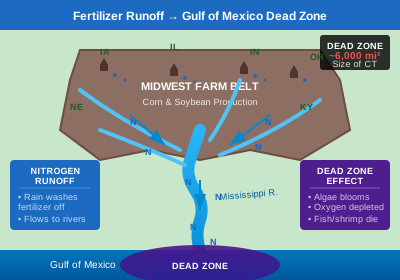
St. Louis sits at the convergence point for agricultural runoff from Iowa, Illinois, and Missouri farms. Every spring, nitrogen fertilizer from millions of acres washes into streams, flows past St. Louis, and travels 1,000 miles downstream - creating dead zones in the Gulf of Mexico.
Why This Matters to YOU
Fertilizer helps farms grow food, but causes dead zones in the ocean. Can we have both? Today you'll investigate the nitrogen cycle and design solutions for sustainable agriculture.
Focus Question: Why does corn need fertilizer but prairie grass doesn't?
By the end of this lesson, you will be able to:
- Trace nitrogen through atmosphere, soil, plants, and back
- Explain why legumes don't need nitrogen fertilizer but corn does
- Analyze fertilizer runoff data and identify environmental impacts
- Design sustainable farming practices that reduce nitrogen pollution
▼ NGSS 3D Standards — Click to View ▼
This Week's Standards
MS-ESS3-3: Apply scientific principles to design a method for monitoring and minimizing human impact on the environment.
MS-LS2-3: Develop a model to describe the cycling of matter and flow of energy among living and nonliving parts of an ecosystem.
Spiral Standards (Review)
- Week 3: Carbon cycle and conservation of matter
- Week 2: Nutrient runoff and eutrophication (dead zones)
- Week 1: Ocean acidification from CO2
▼ Worked Example: Nitrogen Cycle
Integration Analysis ▼
Step-by-Step Problem Solving
[FULL INDEPENDENCE] Week 4 - You Complete All Steps
YOUR TURN - Complete All 5 Steps (Week 4 Full Independence)
You Complete Steps 1-5:
Step 1 - Farm Ecosystem: Trace nitrogen pathway from fertilizer application through the nitrogen cycle (use W4 knowledge: fixation, nitrification, assimilation)
Step 2 - River Ecosystem: Apply W2 knowledge about nutrient runoff - what happens when excess nitrogen enters the river?
Step 3 - Gulf Ecosystem: Integrate W2 eutrophication + W3 carbon cycle - how does nitrogen runoff trigger algae blooms, decomposition, and oxygen depletion?
Step 4 - Carbon-Nitrogen Connection: Use W3 knowledge to explain how the carbon cycle interacts with the nitrogen cycle during decomposition
Step 5 - Systems Thinking: Predict what happens if the farmer switches to crop rotation with legumes - trace effects through all 3 ecosystems
Challenge: Compare the nitrogen pathway in this scenario to a natural prairie ecosystem. What would be different at EACH step?
Fading Support: Week 1 showed all 5 steps. Week 2 had you complete steps 4-5. Week 3 had you complete steps 3-5. This week, you complete ALL steps independently! This builds your problem-solving mastery.
▼ Hook – The Fertilizer Mystery ▼
12 Points | ~10 Minutes
Investigate why prairie grass thrives without fertilizer while corn
cannot.
The Mystery
Consider This:
- The atmosphere is 78% nitrogen gas (N2) - more than 3x as much as oxygen!
- Yet plants can't use this nitrogen directly
- Prairie ecosystems have thrived for 10,000+ years without humans adding fertilizer
- Modern corn requires 100-200 lbs of nitrogen fertilizer per acre every year
What's the difference?
Key Questions to Consider:
- If nitrogen is everywhere in the air, why can't all plants just use it?
- How did prairie grass get nitrogen without human help?
- What organisms might help convert nitrogen into usable forms?
COMPLETING THIS AT HOME?
Watch this 2-minute video introduction before starting: Crash Course: Nitrogen & Phosphorus Cycles (start at 0:00-2:00)
▼ Need extra support? Click for hints ▼
Key Vocabulary:
- Nitrogen fixation: Converting N2 gas into forms plants can absorb
- Legumes: Plants like beans, peas, clover that partner with bacteria
- Nodules: Bumps on plant roots where bacteria live
▼ 🆘 Stuck? Click here for step-by-step CER help ▼
Try these steps in order:
- Think about what prairies have that corn fields don't (hint: plant diversity)
- Prairies include legumes (clover, wild beans) - corn fields don't
- Legumes host bacteria in root nodules that can "fix" nitrogen
- Without legumes, there's no natural nitrogen fixation
- That's why corn fields need synthetic nitrogen fertilizer!
COMPLETE THE HOOK FORM BELOW
Submit your predictions before moving to Station 1.
Complete Your Worksheet — Click to Expand
Complete the "AFTER HOOK FORM" section on your worksheet:
- Write what you learned in the "I learned that..." box
- Record your initial prediction about why corn needs fertilizer
Bonus: +2 points for completing this section!
▼ Station 1 – Nitrogen Cycle
Investigation ▼
20 Points | ~18 Minutes
Map how nitrogen cycles through ecosystems and compare prairie vs. farm
systems.
Your Mission: Map the Nitrogen Cycle
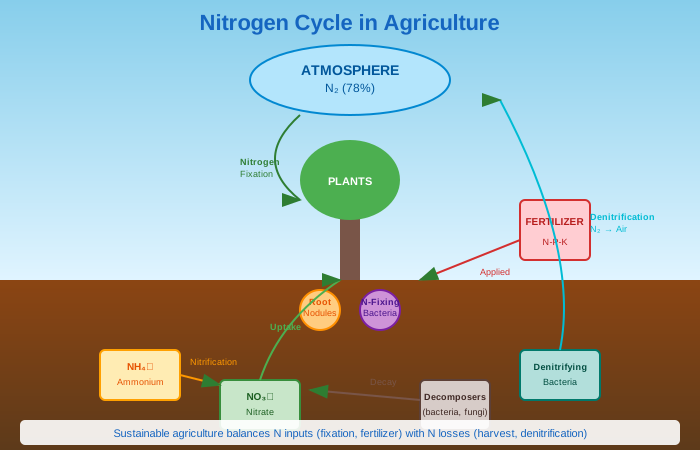
The Nitrogen Cycle - Key Processes:
| Process | What Happens | Who Does It |
|---|---|---|
| Nitrogen Fixation | N2 gas --> Ammonia (NH3) | Bacteria (some in legume roots) |
| Nitrification | Ammonia --> Nitrates (NO3-) | Soil bacteria |
| Assimilation | Plants absorb nitrates | Plant roots |
| Decomposition | Dead organisms --> Ammonia | Decomposer bacteria |
| Denitrification | Nitrates --> N2 gas | Bacteria (returns N to air) |
Prairie vs. Corn Field Comparison:
| Feature | Native Prairie | Corn Field |
|---|---|---|
| Plant diversity | 100+ species | 1 species (monoculture) |
| Legumes present? | Yes (clover, wild beans) | No |
| Nitrogen fixation | Natural (bacteria in legume roots) | None |
| Nitrogen source | Bacteria + decomposition | Synthetic fertilizer |
| Harvest removes N? | No (plants decompose in place) | Yes (grain shipped away) |
COMPLETING THIS AT HOME?
Watch this video on the nitrogen cycle: Crash Course: Nitrogen & Phosphorus Cycles (9:19)
Focus on: (1) Why plants can't use N2 directly, (2) What nitrogen fixation is, (3) How legumes are special
▼ Need extra support? Click for hints ▼
Key Insight:
The atmosphere is 78% nitrogen, but it's in a form (N2) that plants can't use. Only certain bacteria can "fix" (convert) this nitrogen into forms plants can absorb.
Sentence Starters:
- "Prairie grass gets nitrogen from _____ because..."
- "Corn needs fertilizer because it lacks..."
- "Nitrogen-fixing bacteria convert _____ into _____..."
▼ 🆘 Stuck? Click here for step-by-step CER help ▼
Try these steps in order:
- Look at the prairie column - what provides natural nitrogen fixation?
- Now look at the corn field - why is this process missing?
- When corn is harvested, nitrogen leaves the field. Where does replacement nitrogen come from?
- In a prairie, plants die and decompose in place. What happens to their nitrogen?
- Use the process table to trace nitrogen through both systems
COMPLETE THE STATION 1 FORM BELOW
Map how nitrogen cycles through ecosystems.
▼ Station 2 – Agricultural Impact
Analysis ▼
20 Points | ~18 Minutes
Analyze fertilizer runoff data and identify the environmental cost of
modern agriculture.
Your Mission: Analyze the Environmental Cost
The Problem: Fertilizer Runoff
When farmers apply more fertilizer than crops can absorb, the excess washes into waterways. This connects to Week 2's lesson on eutrophication - excess nitrogen and phosphorus cause algae blooms and "dead zones" where fish can't survive.
Data: US Fertilizer Use & Gulf Dead Zone
| Year | US Nitrogen Fertilizer (million tons) | Gulf Dead Zone Size (sq mi) |
|---|---|---|
| 1960 | 2.7 | ~40 |
| 1980 | 11.4 | ~3,000 |
| 2000 | 12.2 | ~4,400 |
| 2020 | 13.1 | ~6,334 |
The Gulf of Mexico dead zone is now larger than Connecticut! Most nitrogen comes from farms in the Mississippi River watershed.
Connection to Week 2 (Eutrophication):
- Excess nitrogen runs off farm fields into rivers
- Rivers carry nitrogen to the Gulf of Mexico
- Algae populations explode (algae bloom)
- Algae die and decompose, using up oxygen
- Low oxygen kills fish and other marine life = "dead zone"
COMPLETING THIS AT HOME?
Use the data table above to answer the form questions. Focus on: (1) How much fertilizer use increased, (2) How dead zone size changed, (3) The correlation between them.
▼ Need extra support? Click for hints ▼
Analyzing the Data:
- Compare 1960 to 2020 - how much did fertilizer use increase?
- How did the dead zone size change over the same period?
- Is there a correlation (relationship) between these two variables?
Sentence Starters:
- "The data shows that fertilizer use [increased/decreased] by..."
- "During the same period, the dead zone..."
- "This suggests a correlation because..."
▼ 🆘 Stuck? Click here for step-by-step CER help ▼
Try these steps in order:
- Find the 1960 and 2020 fertilizer values: 2.7 vs 13.1 million tons
- Calculate the change: 13.1 - 2.7 = 10.4 million tons increase
- Find the dead zone change: ~40 vs ~6,334 sq mi = 158x larger!
- Both increased together = positive correlation
- Connect to W2: More fertilizer = more runoff = bigger dead zone
COMPLETE THE STATION 2 FORM BELOW
Analyze fertilizer runoff data and identify trends.
▼ Exit Ticket – Nitrogen Cycle
Integration ▼
23 Points | ~15 Minutes
Demonstrate mastery by integrating nitrogen cycle knowledge with Weeks
1-3 content.
Show What You Learned
Question Types:
- 2 NEW - Nitrogen cycle processes, prairie vs. monoculture (this week)
- 2 SPIRAL - Week 2-3 review (eutrophication, carbon cycle)
- 1 INTEGRATION - Comparing carbon and nitrogen cycles
- 1 SEP - Designing solutions to environmental problems
Autonomy Support: How to Ace the Exit Ticket (23 pts)
Quick review of Weeks 1-4 concepts you'll need to integrate.
The Exit Ticket tests INTEGRATION - connecting ideas across all 4 weeks. Here's how to prepare:
Quick Review Before You Start:
- Week 1 (Ocean Acidification): CO2 dissolves in ocean --> carbonic acid --> pH drop --> shell damage
- Week 2 (Eutrophication): Excess nutrients --> algae bloom --> decomposition --> oxygen depletion
- Week 3 (Carbon Cycle): Photosynthesis, respiration, decomposition, combustion
- Week 4 (Nitrogen Cycle): Fixation, nitrification, assimilation, denitrification
Integration question tip: Compare carbon and nitrogen cycles - both cycle through atmosphere, organisms, and soil. Key difference: Plants can absorb CO2 directly but need bacteria to "fix" N2 into usable forms.
COMPLETE THE EXIT TICKET BELOW
This is your final assessment for Week 4. Take your time!
Enrichment & Extension
Optional deep dives into systems thinking, scientist profiles, and
environmental justice.
Systems Thinking Reflection
Prairies and farms both grow plants. But why does one need constant inputs while the other doesn't?
Cause --> Effect Chain
Harvest crops --> Remove nitrogen from soil --> Add fertilizer --> Rain washes it away --> Gulf dead zone
Your turn: Why doesn't harvesting prairie grass cause this problem?
Trade-Off Thinking
Cover crops protect soil and add nitrogen, but they take time and money to plant...
Your turn: Should the government pay farmers to use cover crops? Who benefits? Who pays?
Feedback Loop
Use too much fertilizer --> Soil bacteria die --> Plants absorb less --> Need more fertilizer...
Your turn: How could regenerative farming break this negative cycle?
Full Cycle Connection: W1 CO2 --> W2 nutrients --> W3 carbon --> W4 nitrogen. All four cycles connect through human food production!
Scientist Spotlight: Dr. Pedro Sanchez
Dr. Pedro Sanchez, agronomist and World Food Prize winner from Cuba, dedicated his career to helping smallholder farmers in Latin America and Africa sustainably increase yields without over-fertilizing. His research showed how soil testing, targeted fertilizer application, and crop rotation can triple yields while reducing environmental damage.
Many Missouri farmers, including Latino immigrant farmers, face similar challenges. Agricultural scientists ($60k-$95k), soil conservationists ($45k-$75k), and extension agents ($50k-$80k) help farmers balance productivity with environmental stewardship.
Dr. Sanchez's message to students: "The best agricultural solutions come from listening to farmers themselves. They've been managing soil and crops for generations - our job is helping them access the tools and knowledge to do it sustainably."
Environmental Justice: Agricultural Workers & Nitrogen Pollution
Nitrogen fertilizer doesn't just pollute waterways - it also harms the farmworkers who apply it, who are overwhelmingly Latino immigrants and low-income workers. Across Missouri, Illinois, and Iowa, workers mixing and spraying fertilizers face exposure to ammonia and nitrates that cause respiratory illness, skin burns, and long-term health damage.
The nitrogen cycle injustice extends to small farmers too. Large industrial farms can afford precision fertilizer application technology that minimizes waste. Small farmers - disproportionately Black-owned farms in Missouri and Latino-owned farms throughout the Midwest - cannot afford this technology. They face pressure to over-fertilize (wasting money and polluting water) or under-fertilize (producing lower yields).
Organizations like the United Farm Workers and Missouri Rural Crisis Center are fighting for safer nitrogen handling practices and worker protections. Understanding the nitrogen cycle means understanding who faces nitrogen exposure risks - and demanding that agricultural policy protect workers' health.
Week 4 Complete!
Next Week: Cycle 4 Synthesis & Assessment – Bringing together energy flow, invasive species, decomposition, and nitrogen cycling!