Week 1: Weather Patterns & Air Masses
Grade 7 Science | Rosche | Kairos Academies
The Phenomenon: The Sudden Storm Mystery
Success Criteria – How You'll Know You've Got It
Target 1: Identify characteristics of different air mass types (mT, cT, mP, cP)
Self-check: Can I name the four main air mass types and describe each one's temperature and humidity?
Target 2: Explain how frontal boundaries form where air masses meet
Self-check: Can I explain what happens when a cold air mass meets a warm air mass?
Target 3: Interpret weather maps showing pressure systems and fronts
Self-check: Can I identify H, L, cold fronts, and warm fronts on a weather map?
Target 4: Predict weather changes based on approaching fronts
Self-check: Can I predict what weather a city will experience based on an approaching front?
Learning Targets
By the end of this week, you will be able to:
On February 1, 2011, Chicago was having a normal winter day—cold but calm. Then:
- Within 6 hours, a massive blizzard struck
- 21.2 inches of snow fell, burying the city
- Thousands of cars were stranded on Lake Shore Drive overnight
- Yet cities just 50 miles away received far less snow!
What happened? Arctic air collided with warm, moist Gulf air.
Focus Question: What happens when air masses collide, and how can we predict the weather changes they bring?
Vocabulary
Cognate Strategy: Many science words look similar in English and Spanish — use your Spanish to learn science!
| Term | Spanish | Definition |
|---|---|---|
| Air Mass | Masa de aire | Large body of air with uniform temperature and humidity / Gran cuerpo de aire con temperatura y humedad uniforme |
| Maritime (m) | Marítimo (m) | Forms over water—humid / Se forma sobre el agua—húmedo |
| Continental (c) | Continental (c) | Forms over land—dry / Se forma sobre la tierra—seco |
| Polar (P) | Polar (P) | From high latitudes—cold / De latitudes altas (cerca de los polos)—frío |
| Tropical (T) | Tropical (T) | From low latitudes—warm / De latitudes bajas (cerca del ecuador)—caliente |
| Front | Frente | Boundary where two air masses meet / Límite donde dos masas de aire diferentes se encuentran |
| Barometric Pressure | Presión barométrica | Weight of air pushing down on Earth's surface / Peso del aire empujando hacia abajo |
NGSS Standards Covered This Week
MS-ESS2-5 (NEW this cycle)
What it means: Collect data to provide evidence for how the motions and complex interactions of air masses result in changes in weather conditions.
In student language: I can explain how different air masses collide to create weather changes and use data to predict what's coming next.
Spiral Standards from Cycles 3 & 4
- Cycle 4: Water cycle and ocean-atmosphere interactions
- Cycle 3 MS-ESS3-5: Climate change and atmospheric processes
- Cycle 4 MS-ESS3-3: Human impacts on environmental systems
St. Louis Connection: When Arctic Air Meets Gulf Moisture
St. Louis sits where continental polar (cP) air from Canada frequently collides with maritime tropical (mT) air from the Gulf of Mexico. On January 11, 2020, St. Louis experienced a 50-degree temperature swing in 24 hours—from 65°F (mT air) to 15°F (cP air). Understanding these air mass collisions helps you predict St. Louis's famously unpredictable weather!
Why Weather Prediction Matters: Environmental Justice Connection
Extreme weather events like the Chicago blizzard don't impact all communities equally. Understanding and predicting these events is not just about science—it's about protecting people, especially those most vulnerable.
Case Study: The Great Flood of 1993 (St. Louis, Missouri)
When the Great Flood of 1993 struck St. Louis, the Mississippi and Missouri Rivers crested at record levels, inundating the region for months. It remains one of the most destructive floods in U.S. history. But the impacts were far from equal:
- Low-income neighborhoods along the Mississippi River floodplain experienced catastrophic flooding while wealthier areas on higher ground remained dry
- Communities with aging levees and poor drainage systems saw water rise rapidly, trapping families in their homes
- Neighborhoods with fewer resources took years longer to recover, while wealthier areas rebuilt quickly
- Many affected families had no flood insurance and lost everything they owned
The Data Tells the Story: Research from Washington University found that St. Louis neighborhoods with median incomes below $40,000 per year had 30% more flood damage than areas with incomes above $100,000. Wealthier communities had better levees, elevated homes, and access to early evacuation resources.
Connection to This Week's Learning: The weather prediction skills you're learning—identifying air masses, understanding frontal systems, reading pressure maps—help meteorologists issue warnings that give ALL communities time to prepare. Early, accurate forecasts allow vulnerable neighborhoods to evacuate, secure supplies, and protect lives. Your understanding of how air masses collide to create extreme weather directly connects to saving lives in communities that need it most.
Reflection Questions:
- How might better weather prediction help communities prepare differently for extreme storms?
- What responsibility do meteorologists have to ensure warnings reach ALL communities, not just those with the most resources?
Hook – The Sudden Storm Mystery
12 Points | ~10 Minutes
The Challenge
What You'll Do (~10 minutes)
- Observe the phenomenon: A massive blizzard appearing in just hours (2 min)
- Connect to Cycle 4: What role does water vapor play? (3 min)
- Make predictions about what caused the storm (3 min)
- Answer diagnostic questions (2 min)
Think About This:
- What happens when cold air meets warm air?
- Where does the moisture for snow come from?
- Why would one city get 21 inches while another 50 miles away gets much less?
Dr. Kerry Emanuel: MIT atmospheric scientist studying hurricanes and air mass dynamics
Who is Dr. Kerry Emanuel? Dr. Emanuel is a leading atmospheric scientist and professor at the Massachusetts Institute of Technology (MIT), where he has dedicated over 40 years to understanding severe weather and hurricanes. His work directly connects to this week's learning about air masses and storm formation.
Research Contributions: Dr. Emanuel revolutionized our understanding of how hurricanes intensify. He discovered that hurricanes act like giant heat engines—they extract energy from warm ocean water (remember maritime Tropical air masses from Station 1?) and convert it into powerful winds. His mathematical models help predict when storms will rapidly strengthen, giving communities crucial extra warning time. In 2005, his research team correctly predicted an increase in intense Atlantic hurricanes, including devastating storms like Hurricane Katrina—forecasts that changed how meteorologists predict severe weather.
Connection to MS-ESS2-5: Dr. Emanuel's work exemplifies this week's standard—collecting data on air mass interactions to predict weather. He uses satellite data, ocean temperature measurements, and atmospheric pressure readings to track how different air masses (like warm, humid mT air from tropical oceans) interact with other systems to create devastating storms. His models analyze the exact processes you're learning about: air mass properties, pressure systems, and frontal boundaries.
Career Pathway: Dr. Emanuel grew up fascinated by weather, watching thunderstorms from his childhood home. He earned his bachelor's degree in Earth and Planetary Sciences, then completed his Ph.D. in meteorology at MIT. His advice to students: "Start by being curious about the natural world. Weather science combines physics, chemistry, mathematics, and computer modeling—it's a field where your curiosity can literally save lives."
Impact Today: Dr. Emanuel's research on climate change and hurricanes is helping coastal cities prepare for more intense storms in the future. His team trains meteorologists worldwide to better predict rapid intensification events—when storms suddenly strengthen—which is critical for evacuation planning. The air mass collision concepts you're learning this week form the foundation for understanding these complex weather systems.
Think Like a Scientist:
- Dr. Emanuel's hurricane models use the same air mass classification system (mT, cP, etc.) you're learning today. How might knowing an air mass is "maritime Tropical" help predict hurricane intensity?
- What skills from this week (reading pressure maps, predicting fronts) would be essential for a career in severe weather research?
Station 1 – Air Mass Properties
20 Points | ~18 Minutes
Your Mission: Classify Air Masses
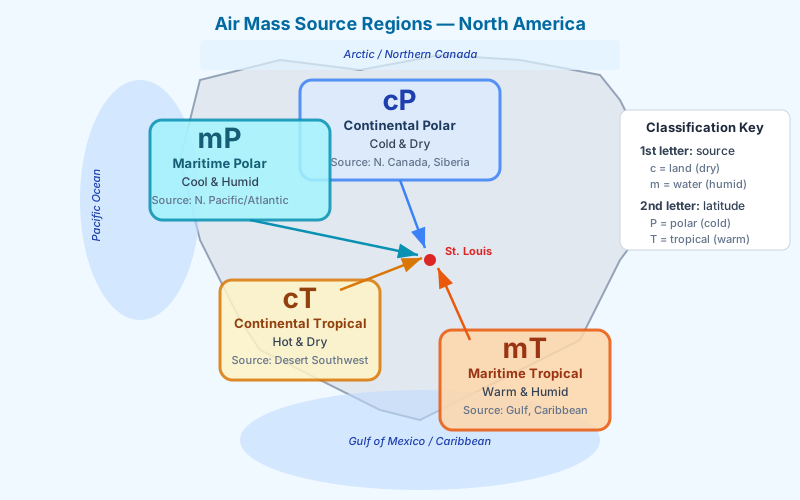
Air Mass Source Regions — Use this to identify where each air mass type forms
The Air Mass Classification System
| Type | Temperature | Humidity | Source Region |
|---|---|---|---|
| cP | Cold | Dry | Canada, Siberia |
| mP | Cold | Humid | North Pacific, North Atlantic |
| cT | Warm | Dry | Southwest deserts, Mexico |
| mT | Warm | Humid | Gulf of Mexico, Caribbean |
Worked Example and Simulation
WORKED EXAMPLE: Air Mass Classification Strategy
Learn by following an expert's thinking process. Week 1 shows ALL steps.
Scenario: An air mass is moving toward St. Louis from the Gulf of Mexico. It formed over warm ocean water near the equator.
Expert Thinking Process:
[CLAIM — Step 1] Identify the source region
"Where did it form? Gulf of Mexico = ocean water. I'll check the table for ocean sources."
Source: Gulf of Mexico (ocean/water)
[EVIDENCE — Step 2] Determine humidity
"Ocean = water surface. Air over water picks up moisture through evaporation. That means HUMID!"
Humidity: Humid (maritime) → First letter is m
[REASONING — Step 3] Determine temperature
"Near the equator = low latitude = warm! The table says Gulf of Mexico is a tropical source."
Temperature: Warm (tropical) → Second letter is T
[CLAIM — Step 4] Predict weather impact
"Humid + warm = lots of moisture + energy. This air mass can bring thunderstorms and heavy rain to St. Louis!"
Likely weather: Warm, humid conditions with potential for storms
ANSWER: mT (maritime Tropical) - humid and warm air mass from Gulf of Mexico
Simulation: Air Mass Collision
PREDICT (before running the sim)
Look at the simulation controls. Before changing any variables, predict what will happen when you adjust them. Write your prediction down.
OBSERVE (while using the sim)
Change one variable at a time. Record what happens after each change. Use the data journal to capture at least 3 trials.
EXPLAIN (after collecting data)
Compare your observations with your prediction. Use scientific vocabulary to explain the patterns you found. What surprised you? What confirmed your thinking?
COMPLETING THIS AT HOME?
Use this memory trick to classify air masses:
- First letter: m = maritime (water = humid) | c = continental (land = dry)
- Second letter: P = polar (cold) | T = tropical (warm)
- Example: mT = maritime Tropical = humid AND warm (Gulf of Mexico air)
Need extra support? Click here for hints and sentence starters
Key Concept Reminder:
- Air masses form over large areas with uniform surfaces (oceans or continents)
- They take on the properties of where they form
- Maritime = over water = humid | Continental = over land = dry
- Polar = cold (high latitude) | Tropical = warm (low latitude)
Sentence Starters:
- "This air mass is classified as ___ because it formed over..."
- "The temperature is ___ because it comes from a ___ latitude region..."
- "The humidity is ___ because it formed over ___ (land/water)..."
Word Bank:
maritime • continental • polar • tropical • humid • dry • warm • cold • source region • air mass
🆘 Stuck? Click here for step-by-step help
Try these steps in order:
- Look at WHERE the air mass formed (the source region)
- Was it over water (m) or land (c)?
- Was it near the poles (P) or near the equator (T)?
- Combine the two letters: first letter + second letter = air mass type
- Check your answer against the table above
- Watch: Search "Air Mass Classification Explained"
Station 2 – Frontal Boundary Modeling
20 Points | ~15 Minutes
Your Mission: Understand Frontal Boundaries
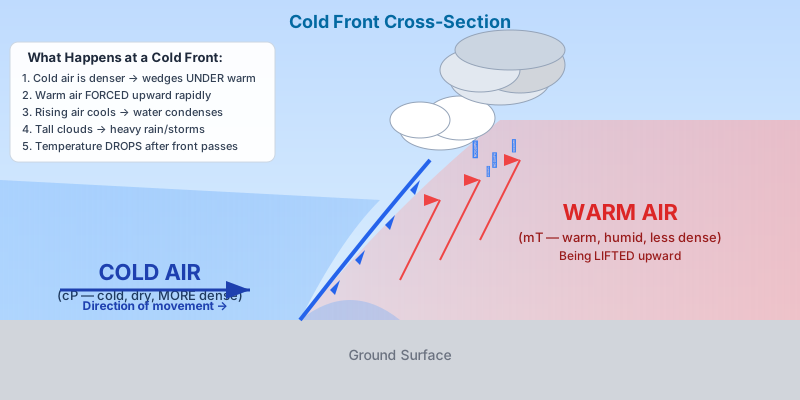
Cold Front Cross-Section
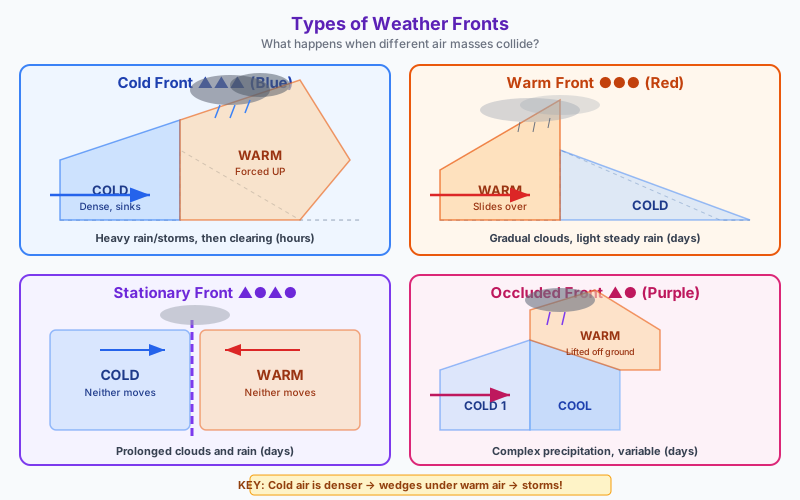
Types of Frontal Boundaries
What Happens When Air Masses Collide?
| Front Type | Symbol | Weather | Duration |
|---|---|---|---|
| Cold Front | ▲▲▲ (blue) | Heavy rain, thunderstorms, then clearing | Hours |
| Warm Front | ●●● (red) | Gradual clouds, light steady rain | Days |
| Stationary Front | ▲●▲● (alternating) | Prolonged clouds and rain | Days |
| Occluded Front | ▲● merged (purple) | Complex, variable precipitation | Variable |
KEY CONCEPT: Cold air is DENSER than warm air. When they meet, cold air "wedges" under warm air, forcing the warm air UP. Rising air cools → water vapor condenses → clouds and precipitation!
Need extra support? Click here for hints and sentence starters
Front Comparison Help:
- Cold front: Cold air is the "aggressor"—pushes under warm air steeply = violent but quick
- Warm front: Warm air is the "aggressor"—slides over cold air gently = gradual but long
- Remember: The front is named after the air that's ADVANCING
Sentence Starters:
- "When a cold front passes, you can expect..."
- "Cold fronts produce more violent weather because..."
- "The warm air is forced upward, which causes..."