🐋Week 2: Evidence of Evolution🧬
Grade 8 Science | Rosche | Kairos Academies
MS-LS4-2 & MS-LS4-4 Evidence of Evolution | 100 Points Total | ~75 Minutes
Grade 8 Science | Rosche | Kairos Academies
MS-LS4-2 & MS-LS4-4 Evidence of Evolution | 100 Points Total | ~75 Minutes
🔊 Learning Support
⚠️ COMMON MISTAKE ALERT: Lamarckian Thinking
WRONG: "Giraffes stretched their necks to reach
leaves, so their babies had longer necks."
RIGHT:
"Giraffes with longer neck genes survived better and had more
offspring. The population changed over generations."
KEY:
You cannot change your genes by trying! Populations evolve, not
individuals.
💻 100% Digital Lesson
This lesson uses interactive simulations and Google Forms for all activities. The only physical material is one worksheet to write your homologous vs. analogous definitions.
Chromebook Tips
MS-LS4-4 (Continuing from Week 1)
What it means: Construct an explanation based on evidence for how genetic variations increase survival probability.
In student language: I can use evidence to explain how organisms evolved from common ancestors.
MS-LS4-2 (New This Week)
What it means: Apply scientific ideas to construct an explanation for anatomical similarities among organisms.
Spiral Standards from Week 1
By the end of this week, you will be able to:
Target 1: Distinguish between homologous and analogous structures
Self-check: Can I identify whether similar structures came from common ancestry or evolved independently?
Target 2: Use anatomical evidence to infer evolutionary relationships
Self-check: Can I explain what shared bone patterns tell us about ancestry?
Target 3: Interpret fossil evidence including transitional forms
Self-check: Can I explain why Tiktaalik and Ambulocetus are important transitional fossils?
Target 4: Predict features of transitional organisms based on evidence
Self-check: Can I design what a transitional form would look like based on ancestor and descendant?
Look at an X-ray of a whale's flipper. Inside that smooth flipper, there are BONES:
But whales don't have hands. They swim. They don't grab things. So why would a whale have finger bones?
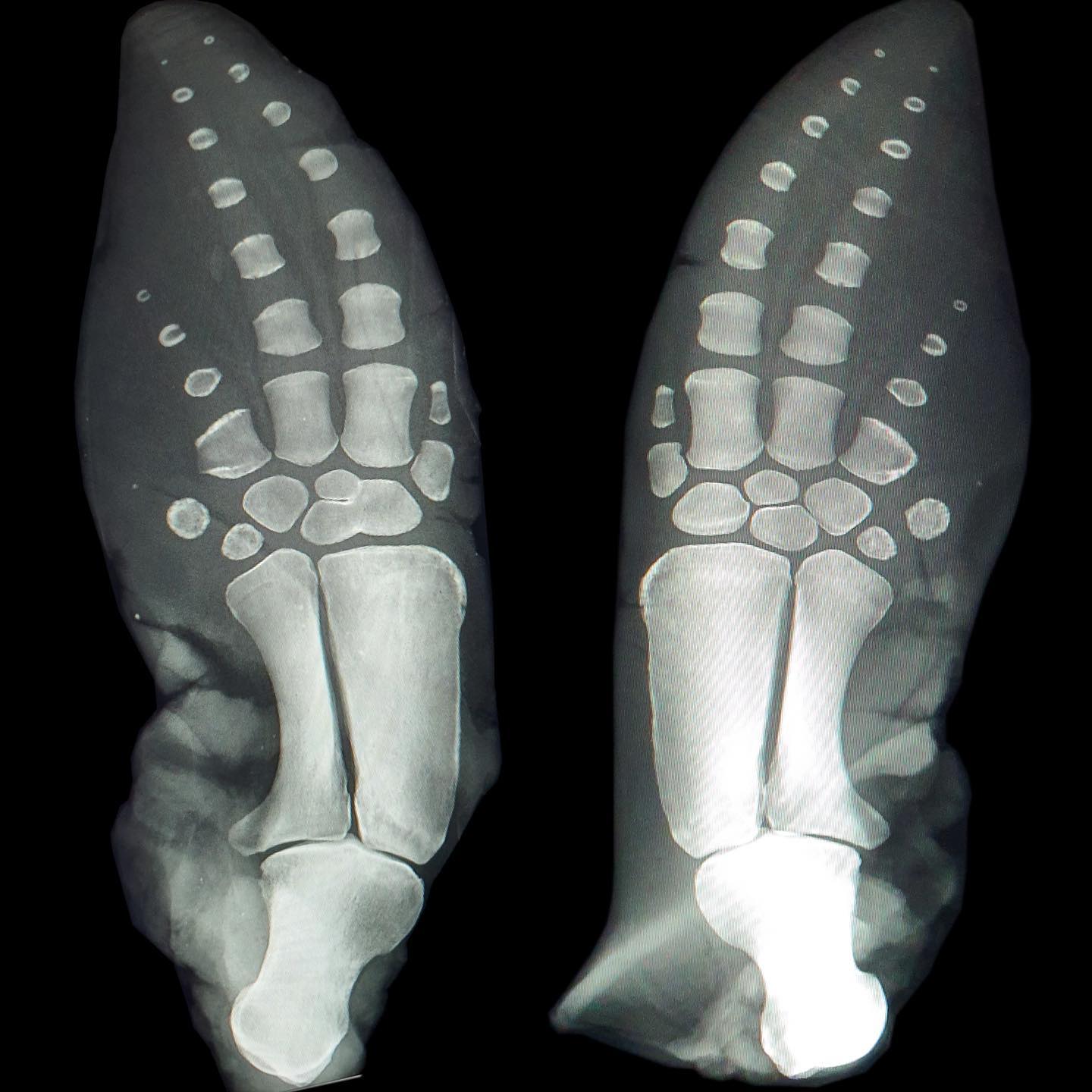
Real X-ray of whale flippers showing finger bones hidden inside! Count the five digits.
🤔 Driving Question: Why do whale flippers have finger bones? What does this tell us about whale ancestors?
🔗 Clickable Links: Text that is purple and underlined links to more information. ↗ = opens in new tab.
Key Vocabulary This Week
| Term | Definition |
|---|---|
| Homologous Structures | Same bone structure, different function (evidence of common ancestor) |
| Analogous Structures | Different structure, same function (NOT from common ancestor) |
| Transitional Fossil | Fossil with features of both ancestral and descendant groups |
| Vestigial Structure | Reduced or non-functional structure left over from ancestors |
| Common Ancestor | An ancestral species from which multiple species evolved |
🎯 Practice These Vocabulary Terms
12 Points | ~10 Minutes
What You'll Do (~10 minutes)
Same bones, different functions: Human, cat, whale, bat –
all share the same basic bone pattern!
Image: CK-12 Foundation (CC BY-NC)
Both fly, but different bone structure = evolved independently
(analogous as wings)
Image: CK-12 Foundation (CC BY-NC)
🦴 Bone Pattern to Look For:
Human arm, whale flipper, cat leg, bat wing all have:
This "1-2-many-5" pattern proves common ancestry!
📝 HOOK FORM
20 Points | ~18 Minutes
Homologous vs. Analogous – Know the Difference!
| Type | Structure | Function | Indicates |
|---|---|---|---|
| Homologous | SAME bones | Different | Common ancestor |
| Analogous | Different | SAME | Independent evolution |
Examples:
📺 Homologous Structures vs Analogous Structures | Key Differences
Click play to watch the video explaining the key differences!
🏠 COMPLETING THIS AT HOME? (No diagrams needed)
Use this reference data if you can't see the bone diagrams:
| Animal | Limb | Bone Pattern | Function |
|---|---|---|---|
| Human | Arm | 1→2→many→5 | Grab, throw |
| Whale | Flipper | 1→2→many→5 | Swim, steer |
| Bat | Wing | 1→2→many→5 | Fly |
| Dog | Front leg | 1→2→many→5 | Run, dig |
| Bird | Wing | Different | Fly |
| Butterfly | Wing | No bones | Fly |
KEY: Same bone pattern = HOMOLOGOUS (common ancestor). Different pattern, same function = ANALOGOUS (evolved separately)
How to use: Compare limb bones across 5 species (human, whale, bat, cat, bird). Click bones to highlight them across species and see how the same bones are modified for different functions.
HINT 1: "Homologous" = same origin. Same bones, different jobs.
HINT 2: "Analogous" = similar job. Different structures that do the same thing.
HINT 3: If mammals have the SAME bone pattern, they probably share a common ancestor!
SENTENCE STARTERS:
WORD BANK: homologous, analogous, common ancestor, bone pattern, natural selection, modified, inherited, function, structure
🆘 Stuck on Station 1? Try these in order:
📝 STATION 1 FORM
20 Points | ~15 Minutes
Whale Evolution Timeline
| Fossil | Age | Key Features |
|---|---|---|
| Pakicetus | 50 mya | 4 legs, lived on land near water |
| Ambulocetus | 49 mya | Could walk AND swim, webbed feet |
| Rodhocetus | 47 mya | Short legs, large tail, mostly aquatic |
| Basilosaurus | 40 mya | Tiny back legs, fully aquatic |
| Modern whales | Today | Flippers, no visible legs |
mya = million years ago
📺 What is the Evidence for Evolution?
Click play to watch the video about whale evolution evidence!
🏠 COMPLETING THIS AT HOME?
Use the diagram above and Berkeley's online resource:
KEY: Notice how legs get smaller over millions of years. Each fossil is a "snapshot" of evolution happening!
HINT 1: Transitional = "in-between." Has features of BOTH groups.
HINT 2: Older fossils are at the bottom. Look at the DATES (mya = million years ago).
HINT 3: Vestigial = "leftover." Doesn't work anymore but ancestors needed it.
SENTENCE STARTERS:
WORD BANK: transitional, vestigial, ancestor, descendant, gradual, million years, legs, flippers, aquatic, land-dwelling
🆘 Stuck on Station 2? Try these in order:
📝 STATION 2 FORM
25 Points | ~20 Minutes (Highest Value!)
Your Challenge: Design a Transitional Organism
ANCESTOR (100 mya): Fully land-dwelling mammal – 4 legs, fur, small ears
DESCENDANT (today): Fully aquatic mammal – flippers, smooth skin, no visible ears
YOUR DESIGN (60 mya): What would the in-between organism look like?
📝 WORKED EXAMPLE: How to Design a Transitional Form
Given: Fish ancestor (400 mya) → Tetrapod descendant (today)
Transitional (375 mya) – Tiktaalik:
Notice: EACH feature is "in-between" – not fully fish, not fully tetrapod!
How to use: Pick a transition scenario (fish→tetrapod, dinosaur→bird, or land mammal→whale). Design what you think the transitional form looked like, then compare your predictions to real fossils like Tiktaalik, Archaeopteryx, and Ambulocetus!
HINT 1: Your transitional form should be HALFWAY between ancestor and descendant.
HINT 2: Think about each body part separately: limbs, covering, behavior.
HINT 3: DON'T make the animal fully land or fully water – it needs features of BOTH!
SENTENCE STARTERS:
WORD BANK: intermediate, webbed feet, shortened legs, sparse fur, streamlined, selection pressure, survival advantage, offspring, population, generations
🆘 Stuck on Station 3? Try these in order:
📝 STATION 3 FORM
23 Points | ~15 Minutes
Question Types:
📝 EXIT TICKET
Homologous Structures: Same bones, different functions = common ancestor
Analogous Structures: Different structures, same function = independent evolution
Transitional Fossils: Show intermediate features between ancestral and descendant groups
Key Misconception: Individuals don't evolve – POPULATIONS change over generations!
🎉 Week 2 Complete!
Next Week: Synthesis & Assessment – Bringing it all together!