Week 3: Matter Cycling & Decomposition
Grade 8 Science | Rosche | Kairos Academies
The Phenomenon: The Disappearing Leaves Mystery
Anchoring Context & Focus Question
Before We Begin: Activate Your Prior Knowledge
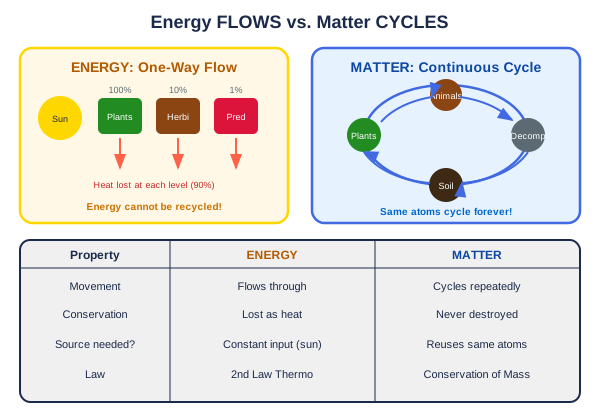
Think back to Week 1: The 10% rule showed you that energy flows ONE direction through trophic levels and is lost as heat at each step. Now ask yourself: If energy is "lost" at each level, what about matter? Do the atoms in dead leaves disappear, or does something else happen? Keep this question in mind as you examine the evidence below.

Scientists studying forest ecosystems discovered something puzzling:
- A forest produces about 5,000 kg of leaf litter per hectare each year
- After 100 years, that should be 500,000 kg piled up
- But the leaf layer on forest floors is only a few centimeters thick
- Where do all the leaves GO? They don't just "disappear"!
St. Louis Connection
Forest Park's 1,300 acres produce thousands of tonnes of leaf litter annually (Figure 1, top-left above), yet the forest floor stays thin. Bacteria, fungi, and invertebrates break down dead leaves, returning nutrients to soil. Without these decomposers, the park would be buried under decades of leaves! This continuous matter cycling supports 3,000+ tree species and provides ecosystem services worth millions: carbon storage, stormwater filtration, and urban cooling.
Why This Matters to YOU
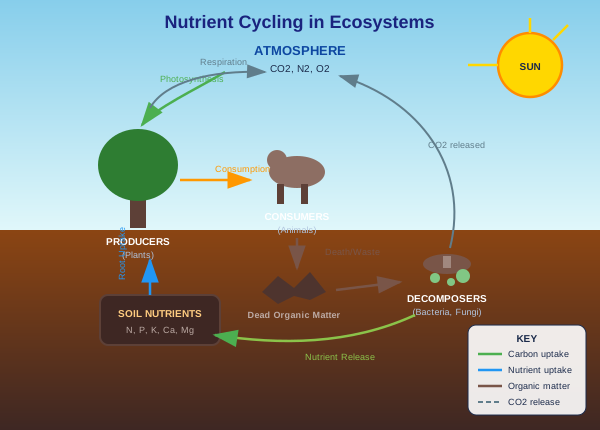
Forests drop 5,000 kg of leaves yearly but don't get buried (see Figure 3's cycling diagram). Understanding decomposition explains why forests recycle waste—and why composting reduces landfill trash! This knowledge powers careers in sustainability, waste management, and environmental science. Whether you become an ecologist, urban planner, or informed citizen, you'll need to understand how matter cycles through ecosystems.
Focus Question: Why don't dead leaves pile up forever in forests? Where does all the matter go?
By the end of this lesson, you will be able to:
- Explain how decomposers break down dead matter and return nutrients to the ecosystem
- Distinguish between energy flow (one direction, lost as heat) and matter cycling (continuous, conserved)
- Track atoms through decomposition to demonstrate conservation of mass
- Design a composting system that optimizes decomposition rate
NGSS 3D Standards
This Week's Standards
MS-LS2-3: Develop a model to describe the cycling of matter and flow of energy among living and nonliving parts of an ecosystem.
Vocabulary
Cognate Strategy: Many science words look similar in English and Spanish — use your Spanish to learn science!
| Term | Spanish | Definition |
|---|---|---|
| decomposition | descomposición | Breaking down dead organisms into simpler substances (CO₂, H₂O, nutrients) |
| decomposer | descomponedor | Organisms (bacteria, fungi) that break down dead matter |
| nutrient cycling | ciclo de nutrientes | How nutrients move from soil to organisms and back continuously |
| matter | materia | Physical substance made of atoms (conserved in reactions) |
| organic matter | materia orgánica | Dead plant and animal material in soil |
| bacteria | bacteria | Microscopic single-celled decomposers |
| fungi | hongos | Decomposers like mushrooms and mold |
Hook – The Disappearing Leaves
Mystery
12 Points | ~10 Minutes
Make predictions about where all the matter goes.

The Challenge
What You'll Do (~10 minutes)
- Observe the phenomenon: Forests produce 5,000 kg leaves/year but don't get buried (2 min)
- Apply conservation of mass: Where do the atoms in leaves go? (3 min)
- Connect to Week 1: How is matter cycling different from energy flow? (3 min)
- Answer diagnostic questions (2 min)
The Mystery Data
Scientists measuring leaf accumulation in forests found something strange:
- Annual leaf fall: ~5,000 kg per hectare per year
- Expected after 100 years: 500,000 kg piled up
- Actual leaf layer: Only 5 cm thick - the SAME as after 1 year!
- The mystery: Where did all that matter go? It can't just vanish!
Key Questions: What's breaking down these leaves? Where are the atoms going?
Leaf Accumulation Data
| Time Period | Expected Leaf Pile | Actual Leaf Layer |
|---|---|---|
| 1 year | 5,000 kg | ~5 cm |
| 10 years | 50,000 kg | ~5 cm |
| 100 years | 500,000 kg | ~5 cm |
| Conclusion | Should be buried! | Stays the SAME |
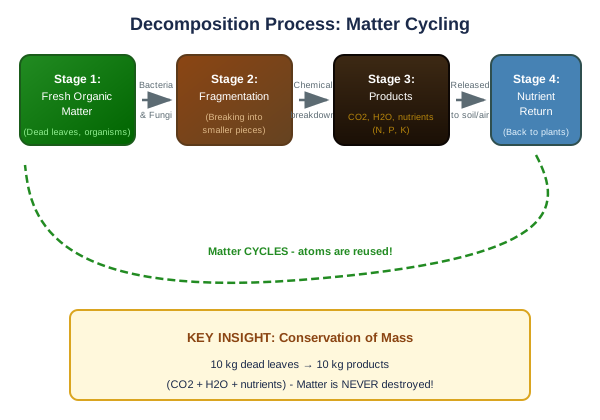
KEY: The leaf layer stays constant. Matter is being TRANSFORMED, not destroyed!
Worked Example and Simulation:
Tracking Matter Through Decomposition
Step-by-Step Problem Solving
[████░░░░] PARTIAL SUPPORT - Week 3
The Problem
A 10 kg fallen log decomposes over 5 years. At the end, only 2 kg of solid material remains. Using conservation of mass, explain where the other 8 kg went. How is this different from what happens to energy?
Step-by-Step Solution
Step 1: Identify what you know & what changed
"BEFORE: 10 kg log (solid
wood)
AFTER: 2 kg solid remains + ??? (where did 8 kg go?)
KEY LAW: Conservation of mass - atoms cannot be created or
destroyed"
Step 2: Identify decomposition products
"Decomposers (bacteria, fungi)
break down organic matter into:
- CO2 gas (carbon dioxide) - released to atmosphere
- H2O (water vapor) - evaporates or absorbed
- Mineral nutrients (N, P, K) - released to soil"
Step 3: Apply conservation of mass
"10 kg log = 2 kg solid + 8 kg
gases/vapor
The 8 kg 'missing' mass became CO2 and H2O that left as gases!
Total mass is CONSERVED: 10 kg in = 10 kg out (just in different
forms)"
Now YOU Complete Steps 4-5:
Step 4: Explain how this is DIFFERENT from energy. Does energy cycle back? (Hint: think about the 10% rule from Week 1)
Step 5: Where does the CO2 from decomposition eventually go? Can it become part of a living organism again? Explain the complete cycle.
Fading Support: Weeks 1-2 showed more steps. This week, steps 4-5 are YOUR turn. By Week 4, you'll do most steps independently! This builds your problem-solving stamina.
Station 1 – Decomposition
Investigation
20 Points | ~18 Minutes
Model how decomposers break down matter and track where atoms go.

Your Mission: Model How Decomposers Break Down Matter
Decomposition Process - What Really Happens
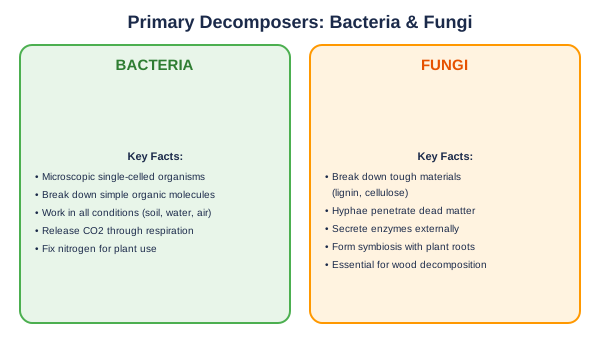
When organisms die, they don't just "rot away" - their matter is transformed by decomposers!
| Component | Decomposers | Products |
|---|---|---|
| Carbon (C) | Bacteria, fungi | CO2 gas → atmosphere |
| Hydrogen/Oxygen | Bacteria, fungi | H2O → evaporates |
| Nitrogen (N) | Bacteria | Nitrates → soil |
| Phosphorus (P) | Bacteria, fungi | Phosphates → soil |
Key Insight: Matter vs. Energy
This is THE key distinction in ecosystem science:
- ENERGY flows ONE direction (sun → producers → consumers → HEAT lost)
- MATTER cycles continuously (dead organisms → decomposers → soil → plants → new organisms)
- The 10% rule applies to ENERGY, not matter!
- The SAME atoms can cycle for millions of years!
Remember: Energy flows OUT. Matter cycles WITHIN.
COMPLETING THIS AT HOME? Use this activity:
At-Home Decomposition Model:
- Draw a dead leaf with arrows showing what happens to its atoms
- Label: Carbon atoms become CO2 gas (arrow to atmosphere)
- Label: Nitrogen atoms become soil nutrients (arrow to soil)
- Draw a plant absorbing CO2 and nutrients to complete the cycle
KEY: Show that the SAME atoms cycle back into living things!
Station 2 – Nutrient Cycle Analysis
20 Points | ~15 Minutes
Analyze how nutrients cycle through ecosystems and distinguish from
energy flow.

Your Mission: Analyze How Nutrients Cycle Through Ecosystems
Ecosystem Matter Budget (Forest Example)
| Component | Amount (kg/ha) | What Happens | Key Insight |
|---|---|---|---|
| Living biomass | 200,000 | Trees, plants, animals | Matter stored in living things |
| Dead organic matter | 150,000 | Being decomposed | Matter being transformed |
| Annual leaf fall | 5,000 | New dead matter added | INPUT to decomposition |
| Annual decomposition | ~5,000 | Dead matter broken down | OUTPUT = INPUT (balance!) |
KEY DISTINCTION: Matter vs. Energy
This table shows THE most important concept in ecosystem science:
| Property | ENERGY (Week 1) | MATTER (Week 3) |
|---|---|---|
| Movement | Flows ONE direction | CYCLES continuously |
| What happens | Lost as heat at each level | Conserved & recycled |
| % transferred | ~10% (10% rule) | ~100% (conservation of mass) |
| Can be reused? | NO (lost forever) | YES (atoms conserved) |
Enrichment & Extension
Optional deep dives into ecosystem science, scientist profiles, and
environmental justice.
Optional content if you finish early or want to go deeper.
Scientist Spotlight: Dr. Eugene Odum
Dr. Eugene Odum (1913-2002) is known as the "father of ecosystem ecology." He revolutionized how scientists understand energy flow and matter cycling in ecosystems. His groundbreaking 1953 textbook, Fundamentals of Ecology, established ecology as a rigorous science by showing that ecosystems follow thermodynamic laws: energy flows through food webs while matter cycles via decomposition. His framework—"energy flows, matter cycles"—is the foundation of modern ecosystem science and the key concept you're learning this week!
Environmental Justice: Industrial Pollution and Nutrient Cycling
Industrial pollution in North St. Louis doesn't just poison the air—it disrupts nutrient cycling in soil. Heavy metals (lead, arsenic, cadmium) from decades of manufacturing contaminate soil in predominantly Black neighborhoods. These pollutants interfere with decomposition processes by killing bacteria and fungi that break down organic matter and return nutrients to soil. Organizations like Gateway Greening and Urban Harvest STL work to remediate contaminated soil through composting and microbial restoration. They understand that environmental justice requires restoring natural nutrient cycles that industrial pollution destroyed.
Week 3 Complete!
Next Week: Food Web Complexity & Stability – Why can some ecosystems survive a drought but others collapse?