Week 2: Waves & Material Interactions
Grade 8 Science | Rosche | Kairos Academies
MS-PS4-3 Waves and Their Applications
The Phenomenon: The Signal Blocker Mystery
Anchoring Context & Focus Question
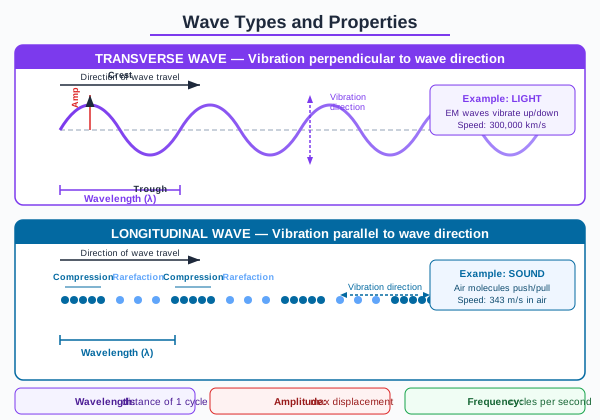
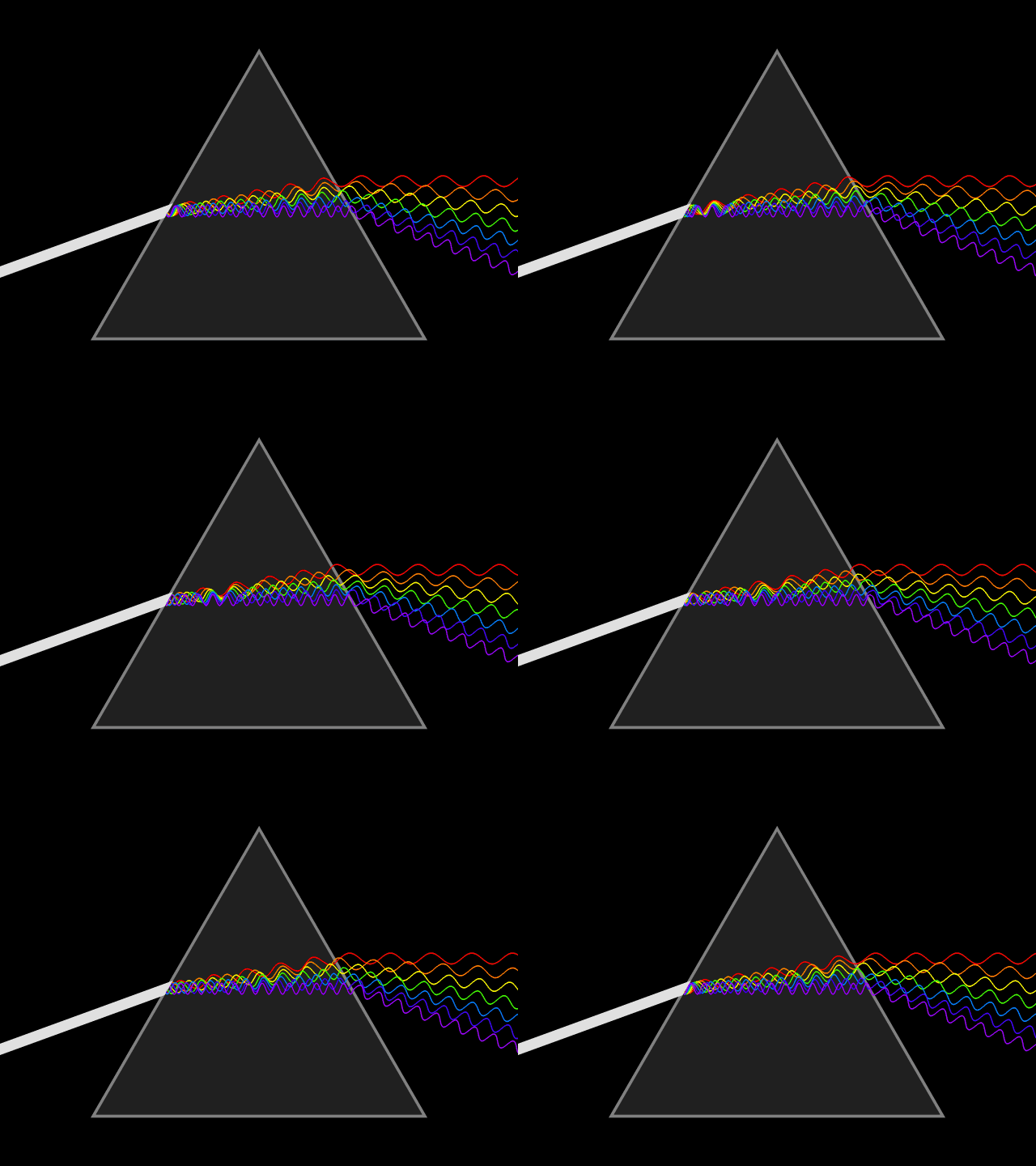
Before We Begin: Activate Your Prior Knowledge
Think back to Week 1: You learned about wavelength, frequency, and amplitude, and how waves transfer energy. Now ask yourself: Why does a metal tin block cell signals but a glass jar lets them through? How can the SAME material (like a tinted window) block visible light but transmit a radio wave? Keep this question in mind as you examine the evidence below.
Your friend claims they can “kill” any phone’s signal by putting it inside a metal cookie tin. You test it—and it works! But here’s what’s weird:
- The tin has no holes — it is completely sealed.
- You can still see the phone through a clear glass container, yet the signal passes through fine.
- Glass blocks visible light from the sun (like tinted windows) but lets cell signals through.
- Metal blocks cell signals but mirrors let you SEE (reflect visible light).
St. Louis Connection
St. Louis is a major hub for telecommunications because the Port of St. Louis and the Mississippi River corridor serve as a critical route for fiber optic cables. These cables carry digital internet traffic encoded as light waves through glass cables over thousands of miles with almost zero absorption. The precise interaction between those light waves and the engineered glass determines how fast your internet works!

Why This Matters to YOU
Knowing how waves interact with materials lets you ask informed questions: Why does my building block signals? Why is digital streaming (1s and 0s) so much clearer than an old analog radio? Understanding these wave behaviors is the foundation of the modern internet and helps power careers in engineering, telecommunications, and tech infrastructure.
Focus Question: Why do different materials treat different wavelengths so differently?
By the end of this lesson, you will be able to:
- Measure and explain transmission vs. absorption for different materials.
- Explain how a material’s atomic structure determines its wave interaction.
- Describe how waves encode and transmit information (Digital vs Analog).
- Design a communication system for a challenging environment using specific wave types.
NGSS 3D Standards
This Week's Standards
MS-PS4-2: Develop and use a model to describe that waves are reflected, absorbed, or transmitted through various materials.
MS-PS4-3: Integrate qualitative scientific and technical information to support the claim that digitized signals are a more reliable way to encode and transmit information.
Spiral Standards (Review)
- MS-LS2-3: Energy flow in ecosystems (Cycle 4)
- MS-LS4-4: Natural selection and adaptation (Cycle 3)
Vocabulary
Cognate Strategy: Many science words look similar in English and Spanish — use your Spanish to learn science!
| Term | Spanish | Definition |
|---|---|---|
| transmission | transmisión | Wave passes through a material (like light through glass) |
| absorption | absorción | Wave energy converted to heat in a material |
| modulation | modulación | Changing a wave's properties to encode information |
| digital signal | señal digital | Information encoded as discrete values (1s and 0s) |
| analog signal | señal analógica | Information encoded as continuous wave variations |
| binary code | código binario | Number system using only 1s and 0s to represent information |
| material | material | A substance that waves interact with |
| opaque | opaco | Blocks light from passing through |
| transparent | transparente | Allows light to pass through clearly |
| translucent | translúcido | Allows some light through, but scatters it |
Hook – The Signal Blocker Mystery
Make predictions about why materials block certain waves.
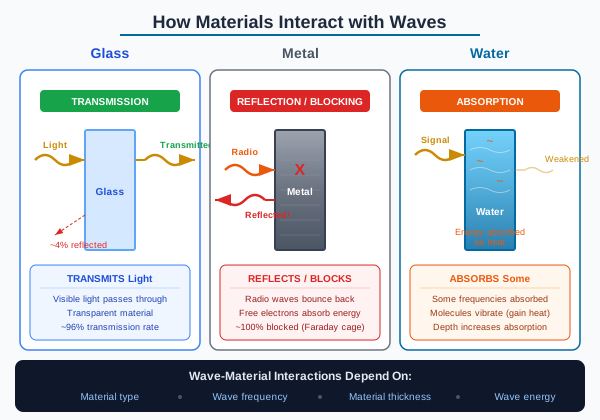
The Challenge
What You'll Do
- Watch the signal blocker demonstration
- Make predictions about WHY metal blocks signals
- Connect to Week 1: wavelength and wave behaviors
- Answer diagnostic questions
The Mystery Data
Consider the differences in how these materials behave:
| Material | Visible Light (Sight) | Radio Waves (Cell) |
|---|---|---|
| Clear Glass | Transmits | Transmits |
| Tinted Window | Blocks (Absorbs) | Transmits |
| Metal Tin | Blocks (Reflects) | Blocks |
Key Questions: What is happening to the wave energy when it is “blocked”? Why can you SEE through glass but cell signals also pass through?
Stop & Think
Before you open the form below, formulate your hypothesis: If radio waves can pass perfectly through solid glass, why do they bounce off extremely thin aluminum foil?
Worked Example and Simulation:
Classifying Materials
[████░░░░] PARTIAL SUPPORT
The Problem
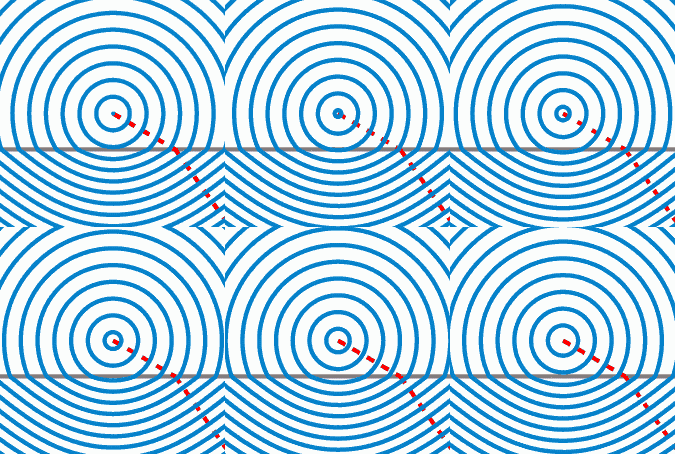
Scenario: You shine a flashlight at three materials: clear glass, wax paper, and aluminum foil. Record what happens to the light in each case and classify the material interaction.
Step-by-Step Solution
Step 1: Clear Glass
“Light passes through clearly — you can see the flashlight beam on the other side. Classification: TRANSPARENT”
Step 2: Wax Paper
“Some light passes through but is scattered — you see a glow but not a clear beam. Classification: TRANSLUCENT”
Step 3: Aluminum Foil
“No light passes through — the beam reflects off the surface. Classification: OPAQUE”
Now YOU Complete Steps 4-5:
Step 4: A frosted bathroom window lets in light but you cant see through it clearly. Is it transparent, translucent, or opaque? Explain using wave interactions.
Step 5: Why can WiFi signals (radio waves) pass through a wall that blocks visible light? Connect your answer to wavelength and material properties.
Fading Support: Step 4 and 5 are YOUR turn. This builds your problem-solving stamina.
Station 1 – Transmission-Absorption
Lab
Analyze transmission and absorption percentages of different waves.

Your Mission: Measure Wave-Material Interactions
What Happens When Waves Hit Materials?
| Outcome | What Happens | Energy Goes... |
|---|---|---|
| TRANSMISSION | Wave passes through | Through the material |
| ABSORPTION | Wave is absorbed | Into the material (becomes heat) |
| REFLECTION | Wave bounces back | Back the way it came |
Sample Data Table
| Material | Visible Light | Infrared | Radio (Cell) |
|---|---|---|---|
| Clear Glass | 85% trans. | 10% trans. | 90% trans. |
| Aluminum Foil | 0% trans. | 0% trans. | 0% trans. |
| Tinted Window | 30% trans. | 5% trans. | 85% trans. |
| Water (10 cm) | 95% trans. | 50% trans. | 5% trans. |
Phenomenon Check-In
Think back to the metal cookie tin from the beginning of class. Based on the data you just collected about aluminum foil (0% transmission), why did your phone instantly lose its signal when placed inside?
Station 2 – Information Encoding
Investigation
Analyze how waves encode information and compare analog vs digital
signals.
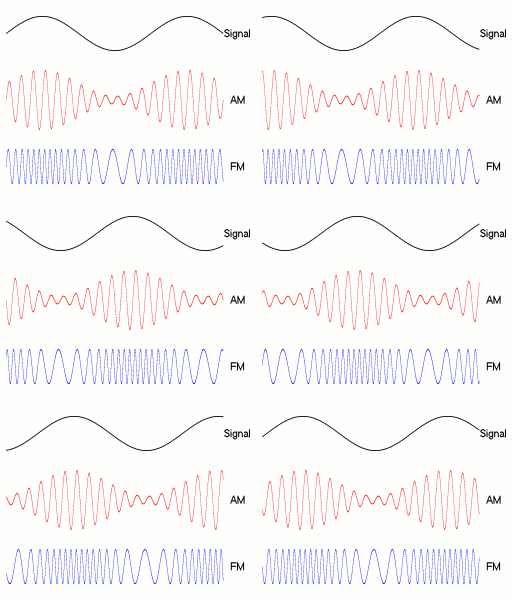
Your Mission: How Do Waves Carry Information?
Digital vs. Analog: Why Digital Wins
| Feature | Analog | Digital |
|---|---|---|
| Signal Type | Continuous (like dimmer) | Discrete (like light switch) |
| Noise Resistance | Poor—noise adds up | Excellent—1 is still 1 |
| Copying Quality | Degrades each copy | Perfect copies forever |
| Example | Vinyl record, AM radio | MP3, streaming, cell calls |
ASCII Reference (Common Letters):
| Letter | ASCII | Binary |
|---|---|---|
| H | 72 | 01001000 |
| E | 69 | 01000101 |
| L | 76 | 01001100 |
| O | 79 | 01001111 |
“HELLO” in binary: 01001000 01000101 01001100 01001100 01001111
Stop & Think
Look at the AM/FM animation above. If a little bit of “noise” distorted the top edge of those smooth, continuous curves, would the message be permanently changed? What if it was a digital 1 or 0 instead?
Station 3 – Design an Antarctic
Communication System
Engineer a system utilizing specific waves for specific environmental
obstacles.

Engineering Challenge: Antarctic Research Station
Communication Challenges in Antarctica
| Challenge | Problem | Wave Consideration |
|---|---|---|
| Distance to HQ | 12,000+ km | Need satellite or HF radio |
| Ice/Snow | Blocks many waves | Choose frequencies that penetrate |
| Underwater | Water absorbs radio | Use VLF or acoustic waves |
| Blizzards | Snow scatters some waves | Lower frequencies work better |
Wave Type Reference
| Wave Type | Through Ice? | Through Water? | Range |
|---|---|---|---|
| HF Radio | Yes | No | Global (bounces off ionosphere) |
| VHF/UHF | Yes | No | Line of sight (~50 km) |
| Satellite | Yes | No | Global (via space) |
| VLF Radio | Yes | Shallow | Long range but SLOW |
| Acoustic | Limited | Yes | Medium (10s of km) |
Stop & Think
Look at your design for the submarine communicating with the base. If VLF radio waves get absorbed quickly by water, how deep can the submarine actually go before it loses connection?
Exit Ticket – Material Interactions
Integration
Demonstrate mastery by integrating concepts from Waves & Material
Interactions.

Show What You Learned
Question Types:
- 2 NEW - Material interactions and information encoding (this week)
- 2 SPIRAL - Cycle 3 natural selection + Cycle 4 energy transfer review
- 1 INTEGRATION - Apply wave-material interactions to real-world scenario
- 1 SEP-6 - Design a solution using wave properties
Stop & Think
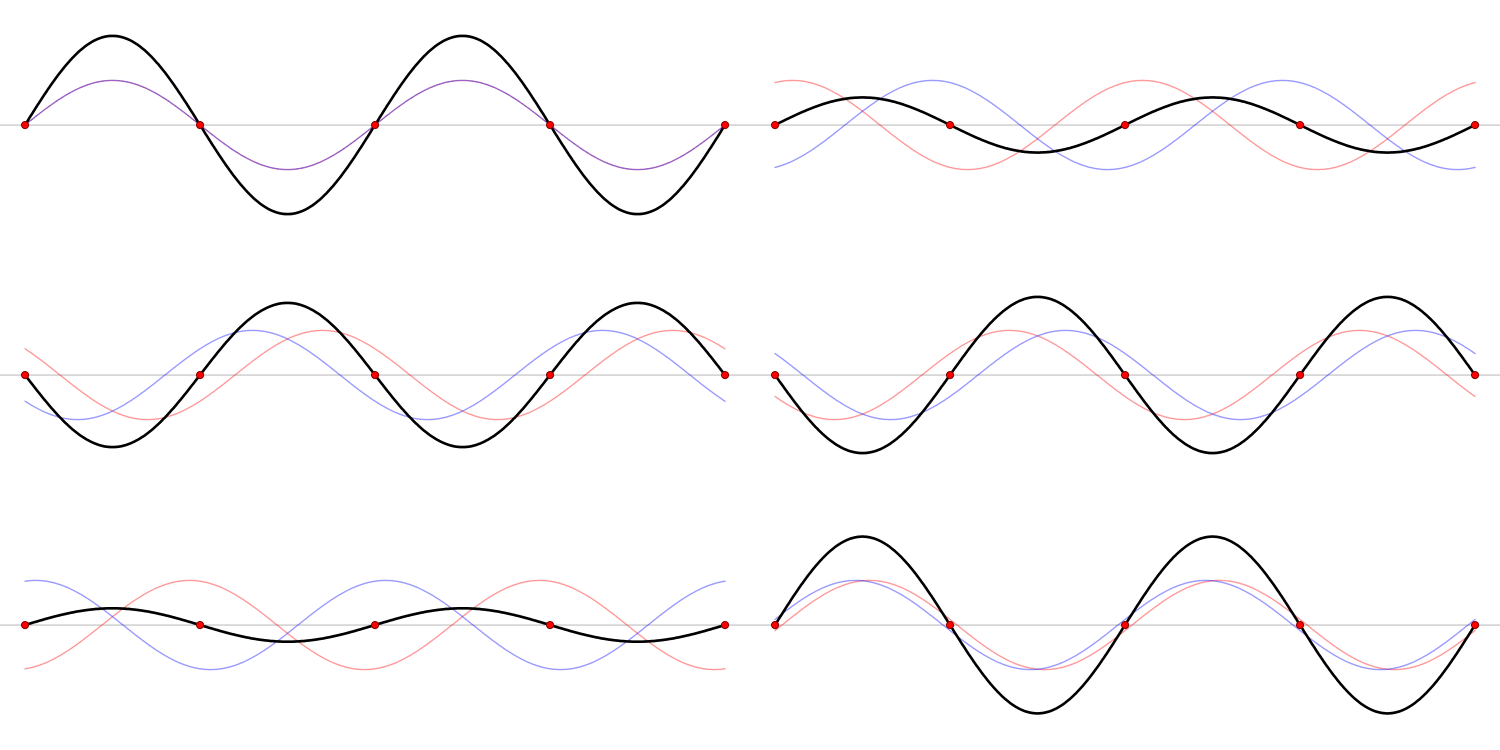
Look at the standing wave animation above. If the black line is your cell phone signal, what happens to that line when it hits a thick wall made of solid steel? Does it go through, or does it bounce back?
Enrichment & Extension
Optional deep dives into wave science, scientist profiles, and
environmental justice.
Optional content if you finish early or want to go deeper.

Scientist Spotlight: Claude Shannon
Claude Shannon (1916-2001) was an American mathematician and electrical engineer whose 1948 paper “A Mathematical Theory of Communication” revolutionized how we understand information transmission. Before his digital revolution, computing required manually punching holes into physical cards (like the one pictured left) to represent 1s and 0s. Shannon proved mathematically why digital signals are more reliable than analog signals, showing that by converting those physical 1s and 0s into continuous electronic waves, we can transmit digital information perfectly even through noisy, analog channels!
Environmental Justice: Cell Tower Placement
While you’re learning how electromagnetic waves interact with materials, communities across St. Louis face an environmental justice challenge: cell towers are disproportionately placed in low-income neighborhoods. The paradox: Communities need reliable service, but residents worry about constant electromagnetic radiation exposure. Understanding the science of how non-ionizing radiation interacts with materials helps you ask informed questions and use physics as a tool for environmental justice advocacy.

Week 2 Complete!
Next Week: Cycle 5 Synthesis & Assessment—bringing it all together!