Week 3: Synthesis & Assessment
Grade 8 Science | Rosche | Kairos Academies
MS-PS4-1, 2 & 3 Waves & Information Transfer
The Phenomenon: Waves & Information Transfer
Synthesis & Assessment — Weeks 1 & 2 Integration
Two Weeks of Learning — One Assessment
Week 1: You investigated wave properties — wavelength, frequency, amplitude — and how waves transfer energy through space and matter. Week 2: You explored how waves interact with different materials (transmission, absorption, reflection) and how waves encode information (analog vs. digital). Today: Demonstrate your integrated understanding of the entire wave unit.
The Big Picture: Every modern communication technology depends on wave-material interactions. WiFi, cell phones, fiber optic internet, medical imaging — they all rely on engineers precisely controlling how waves interact with engineered materials.
- Wave properties (wavelength, frequency, amplitude) determine what energy a wave carries
- Material interactions (transmission, absorption, reflection) determine how signals travel
- Digital encoding makes information transfer reliable — 1s and 0s survive noise that destroys analog signals
- The design challenge: Engineers must match wave type to material to build reliable communication systems
St. Louis Connection
The Port of St. Louis and the Mississippi River corridor carry fiber optic cables encoding internet traffic as light waves through engineered glass — transmitting because glass is transparent to that wavelength. Meanwhile, the metal infrastructure of bridges and buildings creates dead zones for cell signals (radio waves) by blocking transmission. The same physics you’ve been studying governs both!
Focus Question: How do the properties of waves and the structure of materials determine how we encode, transmit, and receive information?
This assessment checks your mastery of:
- Calculating and comparing wavelength, frequency, and amplitude (MS-PS4-1)
- Explaining why different materials transmit, absorb, or reflect specific wave types (MS-PS4-2)
- Designing and evaluating communication systems using appropriate waves (MS-PS4-2)
- Comparing analog vs. digital signal reliability with evidence (MS-PS4-3)
- Connecting wave interactions to real-world technology and engineering decisions
NGSS 3D Standards
This Week's Standards
MS-PS4-1: Use mathematical representations to describe a simple model for waves that includes how the amplitude of a wave is related to the energy in a wave.
MS-PS4-2: Develop and use a model to describe that waves are reflected, absorbed, or transmitted through various materials.
MS-PS4-3: Integrate qualitative scientific and technical information to support the claim that digitized signals are a more reliable way to encode and transmit information.
Spiral Standards (Review)
- MS-LS2-3: Energy flow in ecosystems — how energy transfer parallels wave energy transfer (Cycle 4)
- MS-LS4-4: Natural selection — how organisms have evolved structures that use wave interactions (Cycle 3)
Vocabulary
Cognate Strategy: Many science words look similar in English and Spanish — use your Spanish vocabulary to help you remember wave property definitions!
| Term | Spanish | Definition |
|---|---|---|
| wavelength | longitud de onda | Distance between two consecutive crests or troughs of a wave (measured in meters) |
| frequency | frecuencia | Number of complete waves passing a point per second; measured in Hertz (Hz) |
| amplitude | amplitud | Maximum displacement of a wave from its rest position; related to wave energy |
| transmission | transmisión | Wave passes through a material (e.g., light through glass, radio waves through walls) |
| absorption | absorción | Wave energy is converted to heat within a material instead of passing through |
| reflection | reflexión | Wave bounces back from a surface (e.g., metal reflects radio waves and light) |
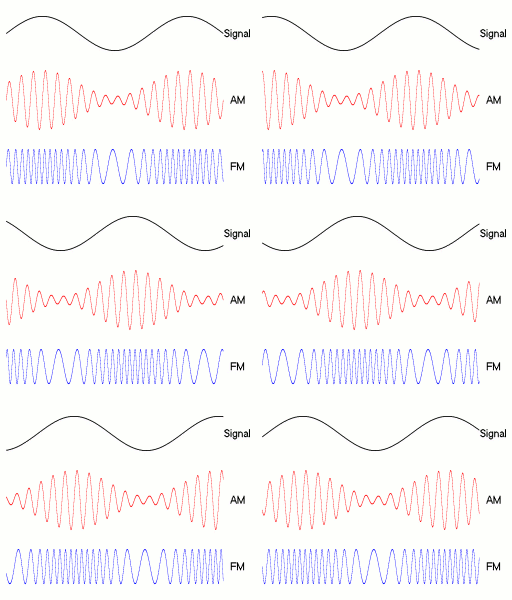
| modulation | modulación | Changing a wave's amplitude or frequency to encode information (AM/FM radio) |
| digital signal | señal digital | Information encoded as discrete values (1s and 0s); resistant to noise degradation |
| analog signal | señal analógica | Information encoded as continuous wave variations; degrades with noise over distance |
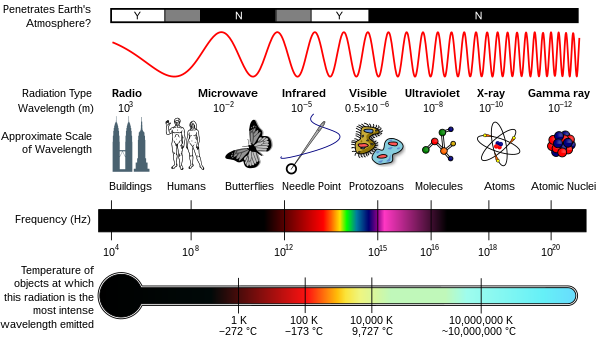
| electromagnetic spectrum | espectro electromagnético | Full range of electromagnetic waves: radio, microwave, infrared, visible, UV, X-ray, gamma |
Part 1 — Synthesis Review
Connect Weeks 1 & 2 concepts before the main assessment. (20 points,
~15 min)
Synthesis Review Challenge
Quick Review: Wave Properties
| Property | Symbol / Unit | What It Tells You | Relationship |
|---|---|---|---|
| Wavelength | λ (meters) | Crest-to-crest distance | Long λ = low frequency |
| Frequency | f (Hz) | Waves per second | High f = short wavelength |
| Amplitude | A (meters) | Height from rest position | High A = more energy |
Quick Review: Wave-Material Interactions
| Interaction | What Happens | Example |
|---|---|---|
| Transmission | Wave passes through | Light through glass; radio through walls |
| Absorption | Energy converted to heat | Infrared absorbed by dark surfaces |
| Reflection | Wave bounces back | Radio waves reflected by metal |
Pre-Assessment Simulation
Stop & Think Before the Form
A wave has a wavelength of 0.1 m and travels at 3 × 10⁸ m/s. Without a calculator — is this wave's frequency higher or lower than a wave with a wavelength of 1 m? Why?
Assessment Strategies & Common
Mistakes
Test-Taking Support
How to Succeed on This Assessment
For mathematical questions (Part A):
- Write the formula — f × λ = v (wave speed equation)
- Identify what's given — wavelength? frequency? speed?
- Solve step by step — show your work for partial credit
- Check your units — Hz × m = m/s
For model/design questions (Parts C/D):
- State your claim — what wave type or design do you recommend?
- Cite evidence — transmission %, material properties, wavelength data
- Explain your reasoning — why does this wave work for this situation?
Worked Assessment Example (Part A type):
Question: A wave has a frequency of 5 × 10⁹ Hz and travels at 3 × 10⁸ m/s. What is its wavelength? What type of wave is this?
Step 1: λ = v ÷
f = (3 × 10⁸ m/s) ÷ (5 × 10⁹ Hz) = 0.06 m = 6 cm
Step 2:
6 cm wavelength = microwave range on the EM spectrum
Step 3:
This is a microwave — the same frequency used by cell
phones and microwave ovens!
Cumulative Assessment — Sections A–E
Wave properties, material interactions, information transfer, models, and engineering synthesis. Complete all sections A–E in this one form. Includes Q12 DOK-4 engineering synthesis (required).
Part 2C/D: Information Transfer & System Design
This section (30 points) covers:
- Part C (15 pts): Analyze and compare analog vs. digital signal reliability with evidence from the ASCII encoding activity
- Part D (15 pts): Design a communication system for a challenging environment — justify your wave type, material, and encoding choices using scientific reasoning
Analog vs. Digital — Quick Reference:
| Feature | Analog | Digital |
|---|---|---|
| Signal Type | Continuous (infinite values) | Discrete (only 1s and 0s) |
| Noise Effect | Noise permanently corrupts signal | Noise can be corrected (still clearly 0 or 1) |
| Copying | Degrades each generation | Perfect copies indefinitely |
| Examples | Vinyl records, AM/FM radio | MP3, streaming, cell calls, WiFi |
Part D Design Challenge
You need to design a communication system for an emergency shelter in an underground parking garage. The system must send signals through concrete walls. Which wave type do you choose? What encoding method? Justify with evidence.
Part 3 — Misconception Final Check
Targeted check of the most common wave misconceptions. (20 points, ~20
min)
Misconception Final Check
What this section covers (20 points):
Four multiple-choice questions plus an extended response — each targeting a different wave misconception. These are the same ideas from your Week 1 pre-assessment. Show how much your scientific thinking has grown over Cycle 5!
The Wave Misconceptions Being Checked:
- “Waves carry matter from place to place” — Do they?
- “All waves behave the same with all materials” — Is that true?
- “Light travels instantly” — Does it?
- INTEGRATION + SEP-4: Analyze wave data to evaluate a claim about signal reliability
How to Approach These Questions
Each question presents a common wrong idea — your job is to explain WHY it's wrong using scientific evidence and vocabulary from Weeks 1 and 2. The more specific your evidence, the stronger your answer!
Enrichment & Extension
Optional deep dives into wave technology, engineer profiles, and
physics of communication.
Optional content if you finish early or want to go deeper.
Scientist Spotlight: Hedy Lamarr
Hedy Lamarr — famous as a Hollywood actress — was also a brilliant inventor who co-developed “frequency hopping spread spectrum” technology during World War II. Her invention of rapid signal frequency changes to prevent radio-controlled torpedo jamming became the foundation of modern WiFi, GPS, and Bluetooth technology — all of which rely on the wave-material interaction principles you studied in Cycle 5.
Her work shows: Understanding how waves can be modulated and transmitted through different environments (the core of MS-PS4-3) is revolutionary technology. Lamarr didn't wait to be recognized as a scientist — she just solved the problem with physics.
Environmental Justice: The Digital Divide & Wave Access
Not everyone has equal access to the wave-based communication systems you studied. In rural areas and low-income urban neighborhoods, buildings block cell signals (wave transmission) and infrastructure for fiber optic cables (light wave transmission) is limited or absent. The “digital divide” is literally a physics problem: certain communities don't have the engineered wave infrastructure to access digital information reliably.
In St. Louis: The city has significant variation in broadband access across zip codes. Communities with lower-income households often have fewer fiber optic connections, slower internet speeds, and greater dependence on radio-wave cellular data — which is more susceptible to signal blocking by building materials.
Cycle 5 Week 3 Complete — Outstanding work on Waves & Information Transfer!
Cycle 6 begins next week — get ready for a new phenomenon and new questions about our living world.