Week 1: Magnetic Forces & Fields
Grade 8 Science | Rosche | Kairos Academies
MS-PS2-3 Forces and Interactions
The Phenomenon: The Invisible Force Mystery
Anchoring Context & Focus Question

Before We Begin: Activate Your Prior Knowledge
Think back to Cycle 5: You learned how waves travel through materials — some pass through (transmission), some bounce back (reflection), some get absorbed. Now ask yourself: Magnetic forces also act through solid materials like wood and glass. Is a magnetic field a kind of wave? How can a force reach across empty space without anything touching? Keep this question in mind as you investigate today.
Hold a strong magnet above a wooden table. Slowly slide another magnet underneath. At some point, the top magnet jumps or spins — the force acts right through solid wood!
- A strong neodymium magnet can attract a paperclip through a thick textbook.
- A weak refrigerator magnet barely holds a single sheet of paper.
- Two magnets can repel so strongly they fly apart — or attract so strongly you can't pull them apart.
- Distance matters enormously — move just a centimeter away and the force drops dramatically.
St. Louis Connection
The Gateway Arch uses over 900 tons of steel — a magnetic material. During construction, workers had to account for Earth's magnetic field when using compass-based surveying instruments near all that steel. St. Louis is also home to Sigma-Aldrich, a major supplier of rare-earth magnetic materials used in MRI machines, electric vehicles, and wind turbines worldwide.
Why This Matters to YOU
Every electric motor — in your phone's vibration, your fan, your car — works because of magnetic forces. Understanding how distance and pole orientation affect force strength is the foundation of electrical engineering, one of the highest-paying career paths in STEM.
Focus Question: Why do some magnets attract through tables while others don't — and why does distance matter so much?
By the end of this lesson, you will be able to:
- Describe magnetic fields and how they extend through space.
- Explain how distance affects magnetic force strength (inverse relationship).
- Identify factors that influence magnetic field strength.
- Design an investigation to test magnetic force relationships.
NGSS 3D Standards
This Week's Standards
MS-PS2-3: Ask questions about data to determine the factors that affect the strength of electric and magnetic forces.
Spiral Standards (Review)
- MS-PS4-2: Wave behavior through materials (Cycle 5)
- MS-LS2-3: Energy flow in ecosystems (Cycle 4)
Vocabulary
Cognate Strategy: Many science words look similar in English and Spanish — use your Spanish to learn science!
| Term | Spanish | Definition |
|---|---|---|
| magnetic field | campo magnético | Region around a magnet where magnetic force acts |
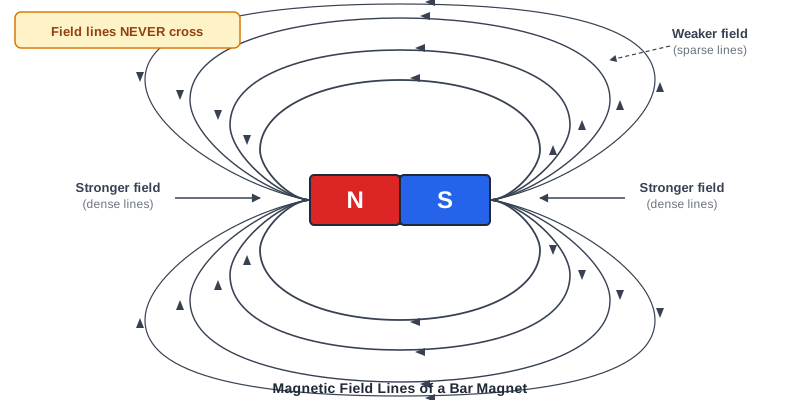
| field lines | líneas de campo | Imaginary lines showing field direction and strength |
| poles | polos | The north and south ends of a magnet where the field is strongest |
| repulsion | repulsión | Force that pushes objects apart (like poles repel) |
| attraction | atracción | Force that pulls objects together (opposite poles attract) |
| inverse relationship | relación inversa | When one value increases, another decreases (force vs. distance) |
| levitation | levitación | Object hovering in the air — magnetic forces push back against (counteract) gravity |
Hook – The Invisible Force Mystery
Observe magnetic field effects through various materials.
The Challenge
What You'll Do
- Explore data from a magnet-through-materials experiment
- Make predictions about WHY distance affects magnetic force
- Connect to Cycle 5: Do magnetic fields behave like waves?
- Answer diagnostic questions about field concepts
The Mystery Data
Here's data from an experiment where different magnets were held above various materials to attract a paperclip placed underneath:
| Magnet Type | Attracts Through Paper? | Through Textbook? | Through Table? |
|---|---|---|---|
| Weak fridge magnet | Barely | No | No |
| Small neodymium | Yes | Yes | No |
| Large neodymium | Yes | Yes | Yes! |
Key Question: The table is the same thickness for all three magnets. Why can the large neodymium attract through it but the fridge magnet can't even get through paper?
Stop & Think
Before you open the form below, formulate your hypothesis: If distance weakens all magnetic forces, what must be DIFFERENT about a strong magnet's field compared to a weak one?
Worked Example and Simulation – Mapping Magnetic
Field Lines
The Problem
Scenario: You place a compass near a bar magnet. The compass needle always points toward the magnet's south pole. You move the compass to different positions around the magnet and record which way the needle points at each location. Use your observations to map the magnetic field.

Step-by-Step Solution
Step 1: Place compass near the North pole
"The compass needle points AWAY from the N pole. This means the field direction at this point goes outward from North."
Step 2: Place compass near the South pole
"The compass needle points TOWARD the S pole. The field lines enter the magnet at South. So the pattern is: exit N → curve through space → enter S."
Step 3: Move the compass far from the magnet
"Far away, the compass barely responds — the field is very weak here. The field lines are spread out (low density = weak force)."
Now YOU Complete Steps 4-5:
Step 4: What happens when you place the compass between two magnets with N-N facing each other (repelling)? How do the field lines between them differ from N-S (attracting)?
Step 5: If field lines NEVER cross, what does this tell us about the direction of force at any point in space?
Fading Support: Steps 4 and 5 are YOUR turn. This builds your field-mapping skills before Station 1.
Simulation: Magnetic Field
PREDICT (before running the sim)
Look at the simulation controls. Before changing any variables, predict what will happen when you adjust them. Write your prediction down.
OBSERVE (while using the sim)
Change one variable at a time. Record what happens after each change. Use the data journal to capture at least 3 trials.
EXPLAIN (after collecting data)
Compare your observations with your prediction. Use scientific vocabulary to explain the patterns you found. What surprised you? What confirmed your thinking?
Station 1 – Magnetic Field Mapping
Visualize fields using iron filings and compass arrays.

Your Mission: Visualize the Invisible
What to Observe with Iron Filings & Compass
| Configuration | Field Pattern | Where Densest? |
|---|---|---|
| Single bar magnet | Lines curve from N → S | Near the poles |
| Two attracting (N-S) | Lines connect between poles | Between the magnets |
| Two repelling (N-N) | Lines push apart, compress | Sides of gap |
Phenomenon Check-In
Think back to the magnet data you analyzed in the Hook. Now that you've mapped field lines, use your evidence to explain: why does a strong neodymium magnet attract through a thick table while a fridge magnet can't even get through paper?
Station 2 – Force-Distance
Investigation
Quantify inverse relationship and graph data.
Your Mission: Measure the Invisible Force
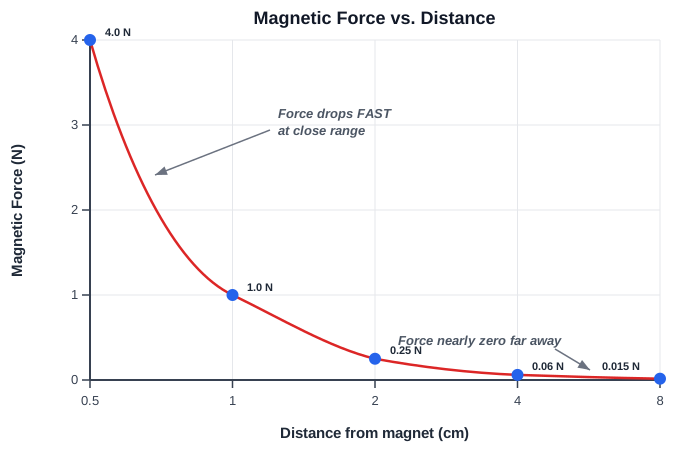
Force vs. Distance Data (Spring Scale Measurements)
| Distance (cm) | Force (N) | What Happened? |
|---|---|---|
| 0.5 cm | 4.0 N | Very strong — hard to separate |
| 1.0 cm | 1.0 N | Doubled distance → force ÷ 4 |
| 2.0 cm | 0.25 N | Doubled again → force ÷ 4 again |
| 4.0 cm | 0.06 N | Barely detectable |
| 8.0 cm | 0.015 N | Nearly zero |
Stop & Think
Why do you think refrigerator magnets only work when touching the fridge? Use the data table to support your answer.
Station 3 – Design a Magnetic
Levitation Device
Apply force understanding to engineering challenge.
Engineering Challenge: Magnetic Levitation Display
Design Requirements & Constraints
| Requirement | Details | Physics Connection |
|---|---|---|
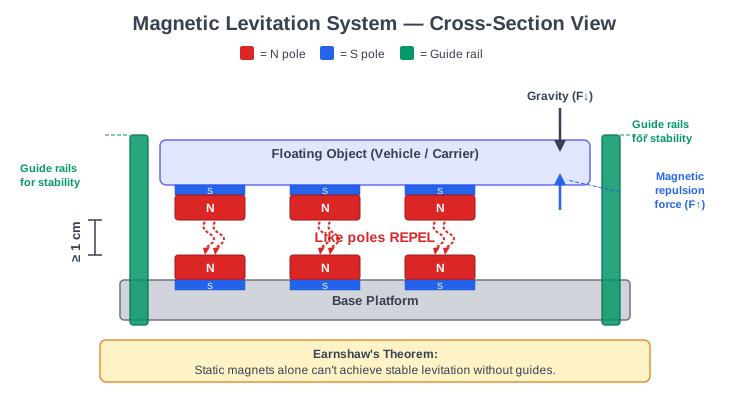
| Levitation height | ≥ 1 cm above base | Force-distance: need enough repulsion at 1 cm |
| Stability | Object doesn't flip or fall | Earnshaw's Theorem: need guides |
| Mechanism | Magnetic repulsion only | Like poles (N-N or S-S) facing |
| Object mass | ~50 grams | Repulsion force must exceed gravity |
The Stability Problem (Earnshaw's Theorem)
In 1842, Samuel Earnshaw proved mathematically that static magnets alone cannot achieve stable levitation. The floating magnet will always want to flip or slide sideways. Real solutions: (1) physical guide rails or walls, (2) spinning the magnet (gyroscopic stability), or (3) electromagnets with feedback sensors (how real maglev trains work!).
Stop & Think
Real maglev trains in Shanghai travel at 430 km/h. Why can't they use permanent magnets like your design? What advantage do electromagnets provide?
Exit Ticket – Magnetic Force
Integration
Synthesize understanding of magnetic forces and field behavior.
Show What You Learned
Question Types:
- 2 NEW — Magnetic fields and force-distance relationship (this week)
- 2 SPIRAL — Cycle 5 wave-material interactions + Cycle 4 energy flow review
- 1 INTEGRATION + SEP-1 — Ask a testable question connecting magnetic forces to a real-world scenario
Stop & Think
Before starting the exit ticket, review: What is the relationship between field line density and force strength? What happens to force when distance doubles?
Enrichment & Extension
Optional content if you finish early or want to go deeper.

Scientist Spotlight: Nikola Tesla
Nikola Tesla (1856–1943) was a Serbian-American inventor who revolutionized our understanding of magnetic fields and electromagnetic forces. He invented the alternating current (AC) motor by discovering how rotating magnetic fields could spin a metal rotor — the exact force-distance principles you explored today. The unit of magnetic field strength (the Tesla, T) is named after him. Every electric motor in your home uses his invention.
Environmental Justice: Rare Earth Mining
The neodymium magnets you used today contain rare earth elements mined primarily in China and the Democratic Republic of Congo. Mining these materials causes significant environmental damage — toxic waste ponds, deforestation, and water contamination that disproportionately affects Indigenous communities and low-income populations near mine sites. As demand grows for electric vehicles and wind turbines (which rely on powerful magnets), understanding the physics helps us design motors that use LESS rare earth material, reducing the human and environmental cost.
Week 1 Complete!
Next Week: Electromagnetism & Energy Transfer — how can spinning a magnet create electricity?