Week 1: Wave Properties & Behavior
Grade 8 Science | Rosche | Kairos Academies
NGSS Standards Covered This Week
MS-PS4-2 (NEW this cycle)
What it means: Develop and use a model to describe that waves are reflected, absorbed, or transmitted through various materials depending on the wave type and material.
In student language: I can explain why WiFi passes through walls but visible light doesn't, using wavelength and material properties.
Spiral Standards from Cycles 3 & 4
- MS-LS2-3: Energy flow in ecosystems (Cycle 4)
- MS-LS4-4: Natural selection and adaptation (Cycle 3)
How These Connect (3-Dimensional Learning)
| Dimension | What You'll Practice |
|---|---|
| SEP-2 Developing Models | Model wave behaviors (reflection, refraction, diffraction, transmission) |
| SEP-3 Planning Investigations | Design experiments to test wave-material interactions |
| DCI PS4.A/B Wave Properties | Understand how wavelength affects material interactions |
| CCC-1/2/6 Patterns, Cause & Effect, Structure & Function | Connect wavelength to predictable interaction patterns |
The Phenomenon: The WiFi vs Flashlight Mystery
Learning Targets
By the end of this week, you will be able to:
Success Criteria – How You'll Know You've Got It
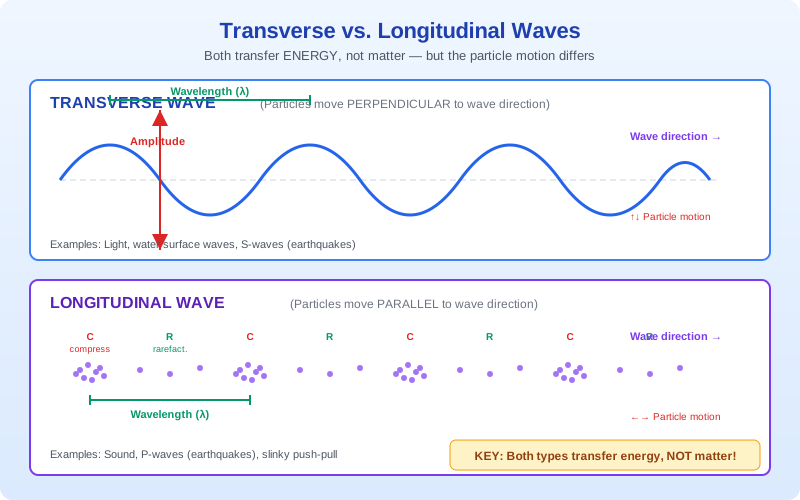
Target 1: Explain that waves transfer energy without transferring matter
Self-check: Can I explain why a cork bobs but doesn't travel when a wave passes?
Target 2: Describe how wavelength affects wave-material interactions
Self-check: Can I explain why WiFi passes through walls but light doesn't?
Target 3: Model reflection, refraction, absorption, and transmission
Self-check: Can I identify which wave behavior is happening in different scenarios?
Target 4: Design investigations to test wave behavior with different materials
Self-check: Can I design a barrier that blocks some waves while allowing others?
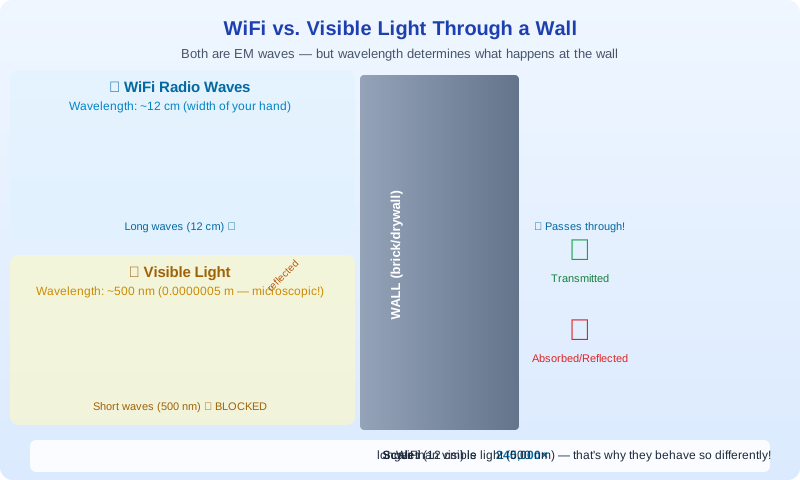

Your home WiFi signal passes through walls, floors, and furniture to reach your devices in any room. But if you try to shine a flashlight through those same walls, no light gets through.
Here's the weird part: BOTH WiFi and visible light are electromagnetic waves!
- WiFi wavelength: ~12 cm (about the width of your hand)
- Visible light wavelength: ~500 nm (0.0000005 meters—microscopic!)
- WiFi waves are 240,000× LONGER than visible light waves!
Focus Question: How can we "see through walls" with WiFi but not with flashlights?
Vocabulary
Cognate Strategy: Many science words look similar in English and Spanish — use your Spanish to learn science!
| Term | Spanish | Definition |
|---|---|---|
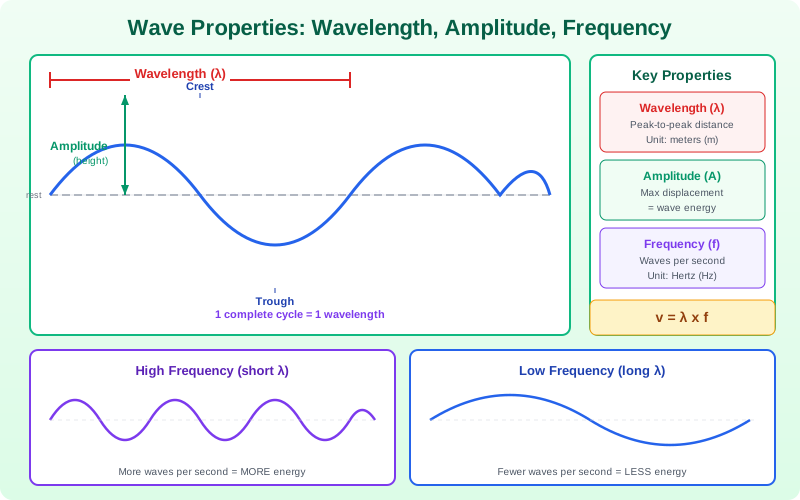
| Wavelength | Longitud de onda | Distancia de un pico de onda al siguiente / Distance from one wave peak to the next |
| Reflection | Reflexión | Onda rebota de una superficie (ángulo de entrada = ángulo de salida) / Wave bounces off a surface |
| Refraction | Refracción | Onda se dobla al cambiar de velocidad entre materiales / Wave bends when changing speed between materials |
| Diffraction | Difracción | Onda se dispersa alrededor de obstáculos o a través de espacios / Wave spreads around obstacles or through gaps |
| Absorption | Absorción | Energía de onda se convierte en calor en un material / Wave energy is converted to heat in a material |
| EM Spectrum | Espectro EM | Todos los tipos de ondas electromagnéticas, desde radio hasta rayos gamma / All types of electromagnetic waves |
| Frequency | Frecuencia | Número de ondas que pasan por un punto por segundo / Number of waves passing a point per second |
Hook – The WiFi vs Flashlight Mystery
12 Points | ~10 Minutes
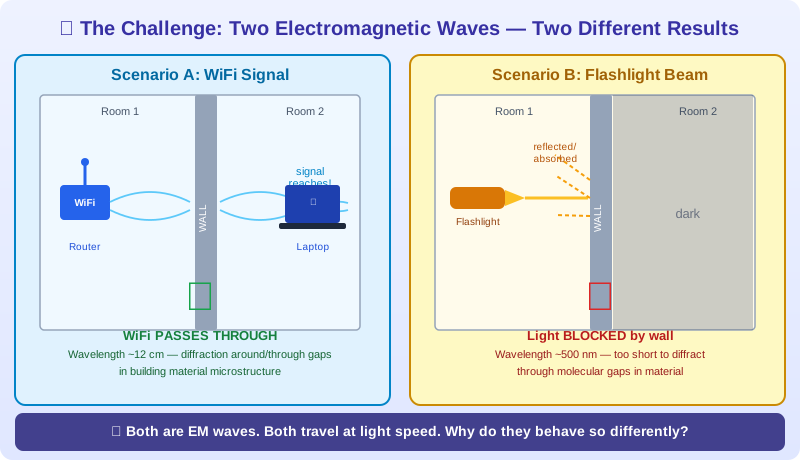
The Challenge
What You'll Do (~10 minutes)
- Observe the phenomenon: WiFi signal strength vs flashlight (2 min)
- Make predictions about why they behave differently (3 min)
- Connect to Cycle 4: energy transfer concepts (3 min)
- Answer diagnostic questions (2 min)
Think About This:
- Both WiFi and light are electromagnetic waves—why are they so different?
- What do waves transfer? (Hint: NOT matter!)
- When a wave hits a wall, where does its energy go?
Worked Example
Step-by-Step Problem Solving
Problem Scenario
Review the problem scenario and work through each step below.
Station 1 – Wave Tank Investigation
20 Points | ~18 Minutes
Your Mission: Discover Wave Behaviors


The Four Wave Behaviors
| Behavior | What Happens | Example |
|---|---|---|
| REFLECTION | Wave bounces off barrier | Echo, mirror |
| REFRACTION | Wave bends when changing medium | Straw looks bent in water |
| DIFFRACTION | Wave spreads around obstacles | Hearing around corners |
| TRANSMISSION | Wave passes through material | Light through glass |
POE Protocol for Simulations (Predict-Observe-Explain)
PREDICT (Before you start):
What do you think will happen when you change the wavelength? When you add a barrier? Write your predictions in the form BEFORE running the simulation.
OBSERVE (While using simulation):
Run the simulation and record what you SEE in the data table. How do different wavelengths behave? What happens at barriers and gaps?
EXPLAIN (After investigation):
Compare your predictions to observations. What patterns did you find? How does wavelength affect reflection, diffraction, and transmission? Connect to wave physics!
COMPLETING THIS AT HOME? Use the PhET Simulation:
PhET Wave Interference Simulation
- Select "Water" tab to see wave behaviors
- Add barriers and observe reflection
- Create gaps and observe diffraction
- Record observations in the form
Interactive: PhET Wave Interference Simulation (Click to expand)
How to use: Create waves, add barriers, and observe how waves reflect, refract, and diffract!
Interactive Simulation
Open Wave Behavior SimulatorNeed extra support? Click here for hints and sentence starters
Key Concept Reminder:
- Waves transfer ENERGY, not matter
- Angle in = angle out for reflection
- Longer wavelengths diffract more around obstacles
Sentence Starters:
- "Sound waves can bend around corners because..."
- "The straw looks bent because light waves..."
- "Energy is conserved when a wave is absorbed because..."
Word Bank:
wavelength • frequency • reflection • refraction • diffraction • transmission • absorption • amplitude • medium • oscillate
🆘 Stuck? Click here for step-by-step help
Try these steps in order:
- Review the 4 wave behaviors table above
- For each scenario, ask: "Does the wave bounce, bend, spread, or pass through?"
- Watch: Search "Wave Behaviors Explained"
- Still stuck? Email Mr. Rosche with your specific question
Station 2 – Electromagnetic Spectrum
Exploration
20 Points | ~15 Minutes
Your Mission: Explore the EM Spectrum
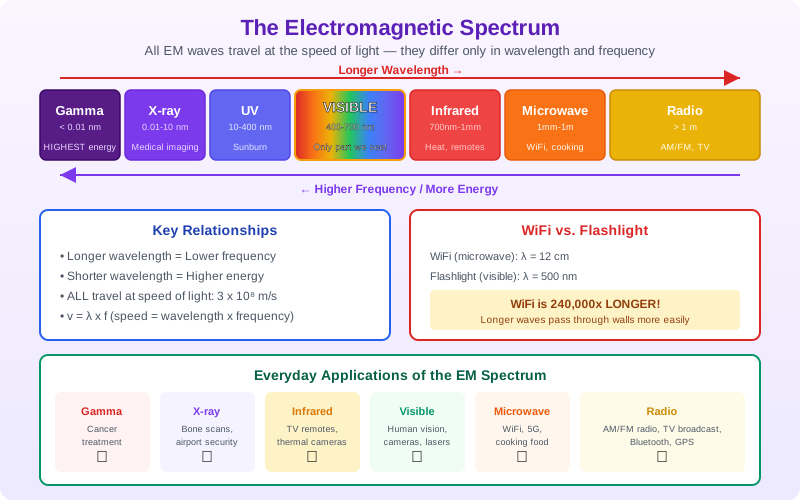
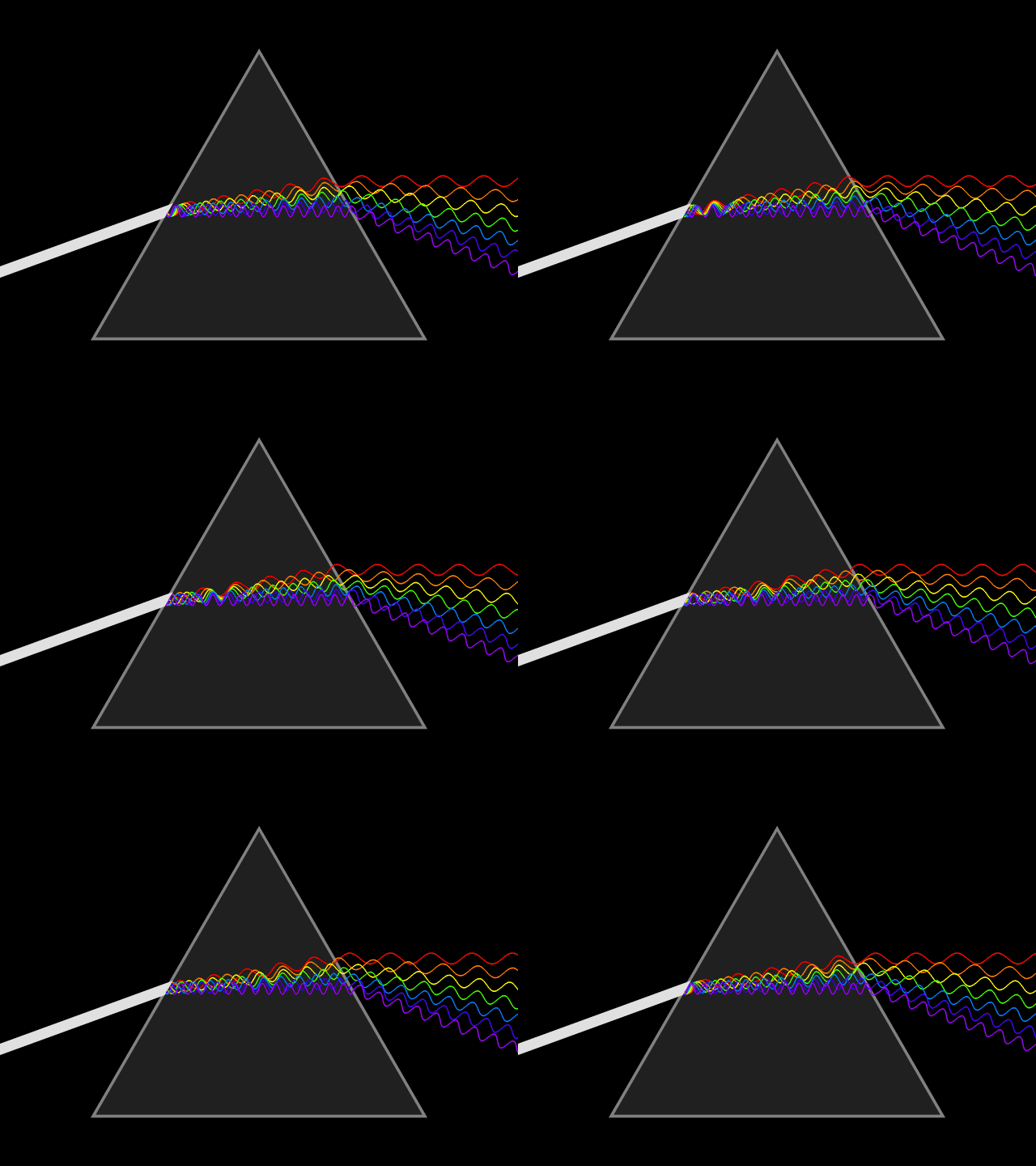

The Electromagnetic Spectrum
| Wave Type | Wavelength | Energy | Common Use |
|---|---|---|---|
| Radio | 1 km - 1 m | LOW | AM/FM, WiFi |
| Microwave | 1 m - 1 mm | ↓ | Cell phones, cooking |
| Infrared | 1 mm - 700 nm | ↓ | Remote controls, heat |
| VISIBLE | 700 - 400 nm | ↓ | Human eyes can see! |
| Ultraviolet | 400 - 10 nm | ↓ | Sunburn, sterilization |
| X-ray | 10 - 0.01 nm | ↓ | Medical imaging |
| Gamma | < 0.01 nm | HIGH | Cancer treatment |
KEY: Longer wavelength = Lower energy = More likely to pass through materials
WORKED EXAMPLE: Analyzing Wavelength-Material Interactions
Learn by following an expert's thinking process. Week 1 shows ALL steps.
PROBLEM:
A concrete wall (20 cm thick) blocks your cell phone signal (microwave, λ = 12 cm) but radio waves (λ = 3 m) from an AM station pass through easily. Why?
STEP 1: Identify wavelengths and compare to material
Expert thinks: "First, I need to organize what I know about the waves:"
- Cell phone microwave: λ = 12 cm = 0.12 m
- AM radio wave: λ = 3 m
- Wall thickness: 20 cm = 0.2 m
- "The radio wave is 25× LONGER than the microwave!"
STEP 2: Apply wave-material interaction principles
Expert thinks: "Concrete is a composite with small gaps and pores (typically 1-5 cm)."
- Microwave (12 cm) is LARGER than most gaps → gets absorbed/reflected
- Radio wave (3 m = 300 cm) is MUCH LARGER than gaps → diffracts around obstacles within the material
- "Long waves bend around small obstacles; short waves get blocked!"
STEP 3: Consider energy absorption
Expert thinks: "Concrete contains water molecules and metal reinforcement."
- Microwaves (higher frequency) excite water molecules → energy absorbed as heat
- Radio waves (lower frequency) have less energy per photon → less absorption
- "The microwave's energy matches concrete's absorption bands!"
STEP 4: Construct complete explanation
Expert writes:
"Radio waves pass through concrete while microwaves are blocked because: (1) Radio wavelength (3 m) is much longer than concrete's internal structure, allowing diffraction around obstacles, while microwave wavelength (12 cm) matches the size of gaps and gets blocked; (2) Microwaves have higher frequency and thus more energy to excite water molecules in concrete, causing absorption, while radio waves have insufficient energy for significant absorption."
SELF-EXPLANATION PROMPT:
Why can you hear your neighbor's bass music through a wall more easily than their high-pitched vocals? Use wavelength principles from this worked example to explain. (Hint: Bass = longer wavelength sound waves, vocals = shorter wavelength sound waves.)
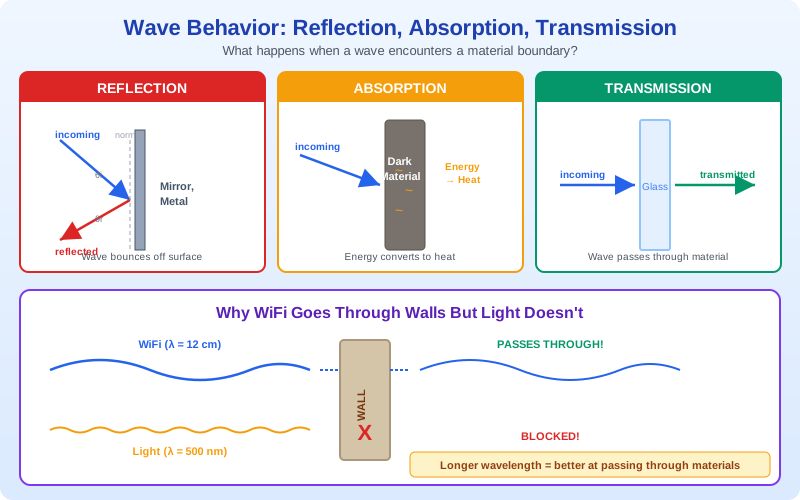
Why WiFi Goes Through Walls But Light Doesn't:
- WiFi wavelength: ~12 cm (120,000,000 nm)
- Light wavelength: ~500 nm
- WiFi is 240,000× LONGER
- Longer waves diffract through gaps in wall materials that block shorter waves!
Engineering Waves in St. Louis: Gateway Arch Integrity Testing
The Gateway Arch uses X-ray testing to check structural steel integrity—exactly the wavelength/transmission properties you're studying. Dr. Katharine M. Flores, a materials scientist at Washington University in St. Louis, studies how different wavelengths penetrate different materials. Engineers use gamma rays for thick steel (short wavelength = high penetration), X-rays for thinner sections, and infrared for surface temperature monitoring. The Arch's stainless steel skin requires constant monitoring because thermal expansion (summer heat vs winter cold) creates stress points. Diverse engineering teams—including structural engineers ($75k-$120k), materials scientists ($80k-$110k), and NDT (non-destructive testing) technicians ($45k-$75k)—use wave physics to protect the millions of visitors each year. Your understanding of how wavelength affects material interaction is foundational to infrastructure safety.
Need extra support? Click here for spectrum hints
Memory Trick:
"Randy Moves Into Very Unusual X-treme Games" = Radio, Microwave, Infrared, Visible, UV, X-ray, Gamma (longest to shortest wavelength)
Sentence Starters:
- "X-rays pass through skin but not bone because..."
- "Radio waves have lower energy than gamma rays because..."
- "WiFi passes through walls because its wavelength is..."
Week 1 Summary: What You Learned
Energy Transfer: Waves transfer ENERGY, not matter—a cork bobs but doesn't travel
Wave Behaviors: Reflection, refraction, diffraction, and transmission
EM Spectrum: Longer wavelength = lower energy = more likely to pass through materials
WiFi vs Light: WiFi has 240,000× longer wavelength, so it diffracts through wall gaps
Enrichment & Extension
Optional deep dives into wave physics, scientist profiles, and
environmental justice.
Scientist Spotlight: Dr. Shirley Ann Jackson — wave physics
Dr. Shirley Ann Jackson (b. 1946) is a theoretical physicist and the first African American woman to earn a Ph.D. from MIT. Her research on the electronic and optical properties of materials at Bell Laboratories led to breakthroughs enabling fiber optic cables, touch-tone telephones, and caller ID.
Connection to this week: Just as you are learning how waves interact with materials, Dr. Jackson's research on how different wavelengths of light interact with silicon and other materials made modern telecommunications possible.
Environmental Justice: St. Louis's Digital Divide
The digital divide in North St. Louis neighborhoods reveals how wave technology access is an equity issue. Up to 40% of households in some neighborhoods lack broadband internet, while affluent areas have near-universal connectivity. Building materials in older homes can also degrade WiFi signals.
Week 1 Complete!
Next Week: How do waves carry and transmit information?