Week 3: Radiometric Dating & Absolute Age
Grade 7 Science | Rosche
MS-ESS1-4 Construct a scientific explanation based on evidence from rock strata for how the geologic time scale is used to organize Earth's 4.6-billion-year-old history.
The Phenomenon: Radiometric Dating & Absolute Age
Anchoring Context & Focus Question
How can scientists determine the age of a dinosaur bone?
Cognate Strategy: Many science words look similar in English and Spanish — use your Spanish to learn science!
| Term | Spanish | Definition |
|---|---|---|
| intrusive igneous | ignea intrusiva | Rock formed from slow cooling underground with large crystals |
| extrusive igneous | ignea extrusiva | Rock formed from fast cooling at surface with small crystals |
| trace fossil | fosil de traza | Evidence of organism activity like footprints or burrows |
| body fossil | fósil corporal | Actual organism remains like bones, shells, and teeth |
| radiometric dating | datacion radiometrica | Dating rocks using radioactive decay rates |
| half-life | vida media | Time for half of radioactive isotope to decay |
| parent isotope | isotopo progenitor | Original radioactive element before decay |
| daughter isotope | isotopo producto | Product of radioactive decay |
| absolute dating | datacion absoluta | Determining actual age in years using radiometric methods |
| geologic time scale | escala de tiempo geologico | Division of Earth history into eons, eras, periods, epochs |
Hook – Radiometric Dating & Absolute Age
Engage with the phenomenon for Radiometric Dating & Absolute Age.
How Old Is That Bone?
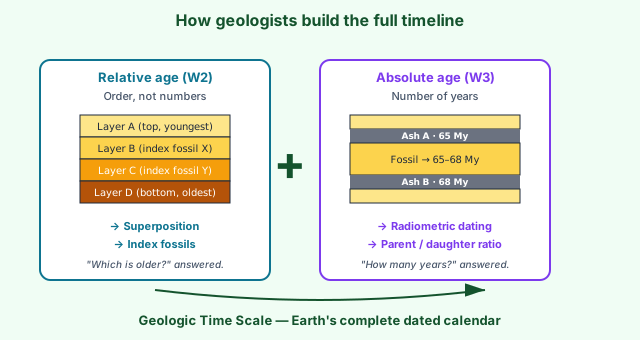
In 1991, hikers in the Alps discovered a frozen human body later named "Ötzi the Iceman." Scientists used radiometric dating — measuring how much carbon-14 remained in his body — to determine he died approximately 5,300 years ago. For a dinosaur bone, which is far too old for carbon-14, scientists use uranium-238 instead, whose half-life is 4.5 billion years. These techniques give scientists the precise, absolute ages that the Law of Superposition alone cannot provide.
Week 2 Connection
What You'll Do
- Learn how radioactive decay works through a half-life simulation
- Calculate ages of rock and bone samples using decay equations
- Choose the correct isotope for different age ranges (carbon-14 vs. uranium-238)
- Connect absolute dates back to the geologic time scale from Week 2
- Evaluate real radiometric dating data from a Missouri fossil site
Worked Example – Calculating Absolute Age with Half-Life
Worked Example: Calculating Absolute Age with Half-Life
Problem: A geologist tests a piece of wood from an archaeological site in Missouri. The sample originally contained 100% carbon-14. Today it contains only 12.5% of its original carbon-14. Carbon-14 has a half-life of 5,730 years. How old is this wood?
Step 1: Count the Half-Lives
Start: 100% → after 1 half-life: 50% → after 2 half-lives: 25% → after 3 half-lives: 12.5%
The sample has gone through 3 half-lives to reach 12.5%.
Step 2: Multiply to Get Years
This wood is approximately 17,190 years old — from the last Ice Age, when mastodons still roamed Missouri.
Step 3: Choose the Right Isotope
Station 1 – Half-Life Simulation
Model radioactive decay using a half-life simulation and calculate sample ages.
Station 1 — Half-Life Simulation
Use the interactive half-life simulation to model radioactive decay. You will adjust the starting amount of a parent isotope and observe how the parent (original radioactive element) decreases while the daughter isotope (decay product) increases over time. This simulates exactly what happens inside a rock or fossil after it forms — the isotope clock starts ticking the moment the rock solidifies.
Data Collection — Record in the Form
- Run the simulation for 5 half-lives and record the % parent remaining after each half-life in the data table
- Describe the pattern you observe: is decay linear or curved?
- Given a sample with 25% parent isotope remaining and a half-life of 10,000 years — calculate its age using the worked example method
- Explain in your own words: why does the percentage of parent isotope never actually reach 0%?
Station 2 – Isotope Selection & Age Calculation
Choose the correct isotope for different fossil ages and calculate absolute dates.
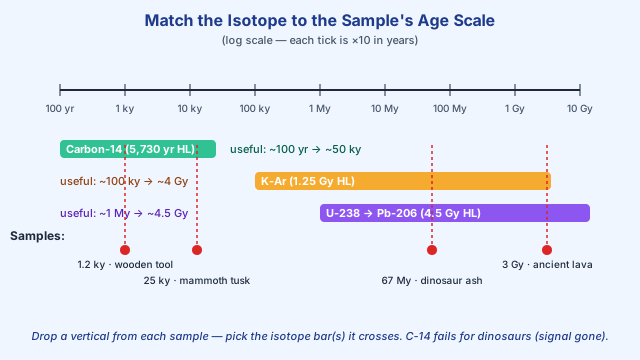
Station 2 — Isotope Selection & Age Calculation
You are given a set of five samples from Missouri field sites — ranging from a campfire charcoal to a granite boulder from the Ozarks. For each sample, you must select the correct radiometric dating isotope and calculate an estimated age from the given decay data. Then you will place each sample on the geologic time scale to connect absolute dates to the eras and periods you mapped in Week 2.
Isotope Reference Card
- Carbon-14 / Carbono-14: Half-life 5,730 years — use for organic materials up to ~50,000 years old
- Potassium-40: Half-life 1.25 billion years — use for volcanic rocks 100,000 to 4 billion years old
- Uranium-238 / Uranio-238: Half-life 4.5 billion years — use for very ancient rocks and zircon crystals
For each sample: (a) state which isotope you would use and why, (b) calculate the absolute age from the given % remaining, (c) name the geologic era when this sample formed.
Station 3 – Constructing Earth's Timeline
Combine relative and absolute dating to build a complete Earth history timeline.
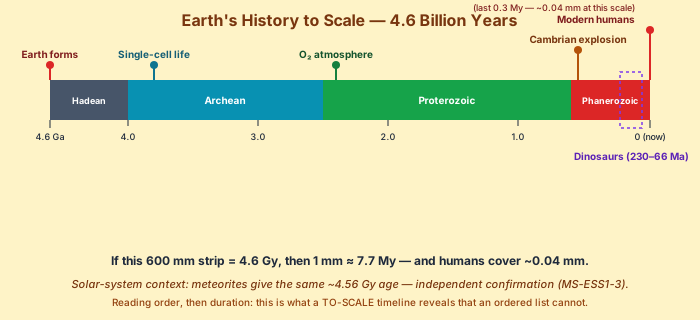
Station 3 — Constructing Earth's Complete Timeline
Now you have both tools — relative dating from Week 2 and absolute dating from this week. Your challenge: take a set of Missouri rock and fossil evidence cards and arrange them on a complete geologic timeline that shows both the order of events (relative) and their actual ages in years (absolute). You will create a geologic history of Missouri from 1.5 billion years ago to the present.
Missouri Evidence to Place
- Taum Sauk rhyolite — uranium-238 data indicates ~1.47 billion years ago (Proterozoic)
- St. Louis limestone with brachiopod fossils — 300–340 million years ago (Mississippian Period)
- Dinosaur trackway near Glen Allen — 100–120 million years ago (Cretaceous, Mesozoic)
- Mastodon teeth from Kimmswick site — carbon-14 data indicates ~11,000–13,000 years ago (Pleistocene, Cenozoic)
CER: Defending an Age Claim
Exit Ticket – Radiometric Dating Integration
Synthesize learning about radiometric dating and absolute age.
Exit Ticket — Absolute Dating Mastery
Demonstrate your understanding of radiometric dating through 2 new-content questions about half-life calculations and isotope selection, 2 spiral questions that connect back to Week 2 relative dating and the geologic time scale, and 1 integration question that combines radiometric data with the SEP practice of using mathematics and computational thinking to determine the absolute age of a Missouri fossil sample.
Enrichment & Extension
Optional content if you finish early or want to go deeper.
Scientist Spotlight: Willard Libby
Willard Libby (1908–1980) was an American chemist who invented radiocarbon dating (carbon-14 dating) in 1949. While a professor at the University of Chicago, Libby realized that living organisms continuously absorb carbon-14 from the atmosphere — and that the moment an organism dies, the clock starts: carbon-14 begins decaying at a known, constant rate. By measuring how much carbon-14 remains in organic material, scientists can calculate when the organism died. Libby won the Nobel Prize in Chemistry in 1960 for this discovery, which transformed archaeology, geology, and paleontology overnight. His technique directly answered the question of this week: how old is that bone? Libby's method has since been used to date mummies, ancient wood beams, cave paintings, and even the Shroud of Turin. Like all good science, carbon-14 dating was tested, calibrated, and improved by thousands of scientists who came after him.
Environmental Justice: Radioactive Waste and Deep Time
Uranium-238 has a half-life of 4.5 billion years — roughly the age of Earth itself. When nuclear power plants and weapons programs produce radioactive waste, scientists must think in geologic time to answer a frightening question: how do we store something dangerous for longer than human civilization has existed? The proposed Yucca Mountain nuclear waste repository in Nevada is designed to contain waste for 10,000 years. But some waste products, like plutonium-239 (half-life 24,000 years), remain hazardous far longer. Communities near nuclear waste sites — like the communities along Coldwater Creek and near West Lake Landfill in St. Louis — bear a disproportionate share of this risk. Understanding half-lives and decay rates is not just a classroom exercise: it is fundamental to knowing how long contamination persists and how urgently cleanup must occur. This is why geologists, not just politicians, must be part of environmental justice decisions.
Week 3 Complete!
Next Week: Synthesis & Assessment — bring together everything from the rock cycle, geologic time, and radiometric dating.