Week 2: Evidence of Evolution
Grade 8 Science | Rosche
🐋Week 2: Evidence of Evolution🧬
Grade 8 Science | Rosche
MS-LS4-2 & MS-LS4-4 Evidence of Evolution | 100 Points Total | ~75 Minutes
🔊 Learning Support
- Text-to-speech: Right-click → "Read aloud"
- At home: Use 🏠 HOME ALTERNATIVE boxes
- Support: 📗 Green buttons | 🆘 Red "Stuck?" boxes
💻 100% Digital Lesson
This lesson uses interactive simulations and Google Forms for all activities. The only physical material is one worksheet to write your homologous vs. analogous definitions.
Chromebook Tips
- Auto-save: Forms save when you click outside text boxes
- Order: Hook → Stations 1-3 → Exit
- Builds on Week 1: Natural selection explains evidence
- Key: Same structure = common ancestry; Different = independent evolution
🦎 NGSS Standards Covered This Week
MS-LS4-4 (Continuing from Week 1)
What it means: Construct an explanation based on evidence for how genetic variations increase survival probability.
In student language: I can use evidence to explain how organisms evolved from common ancestors.
MS-LS4-2 (New This Week)
What it means: Apply scientific ideas to construct an explanation for anatomical similarities among organisms.
Spiral Standards from Week 1
- Natural Selection Mechanism: Variation → Selection → Survival → Reproduction
- Population Evolution: Individuals don't evolve; populations change over generations
🎯 Learning Targets
By the end of this week, you will be able to:
Success Criteria – How You'll Know You've Got It
Target 1: Distinguish between homologous and analogous structures
Self-check: Can I identify whether similar structures came from common ancestry or evolved independently?
Target 2: Use anatomical evidence to infer evolutionary relationships
Self-check: Can I explain what shared bone patterns tell us about ancestry?
Target 3: Interpret fossil evidence including transitional forms
Self-check: Can I explain why Tiktaalik and Ambulocetus are important transitional fossils?
Target 4: Predict features of transitional organisms based on evidence
Self-check: Can I design what a transitional form would look like based on ancestor and descendant?
🐋 The Phenomenon: The Whale Finger Mystery
Look at an X-ray of a whale's flipper. Inside that smooth flipper, there are BONES:
- Upper arm bone (humerus)
- Two forearm bones (radius and ulna)
- Wrist bones (carpals)
- FIVE FINGERS with knuckles!
But whales don't have hands. They swim. They don't grab things. So why would a whale have finger bones?
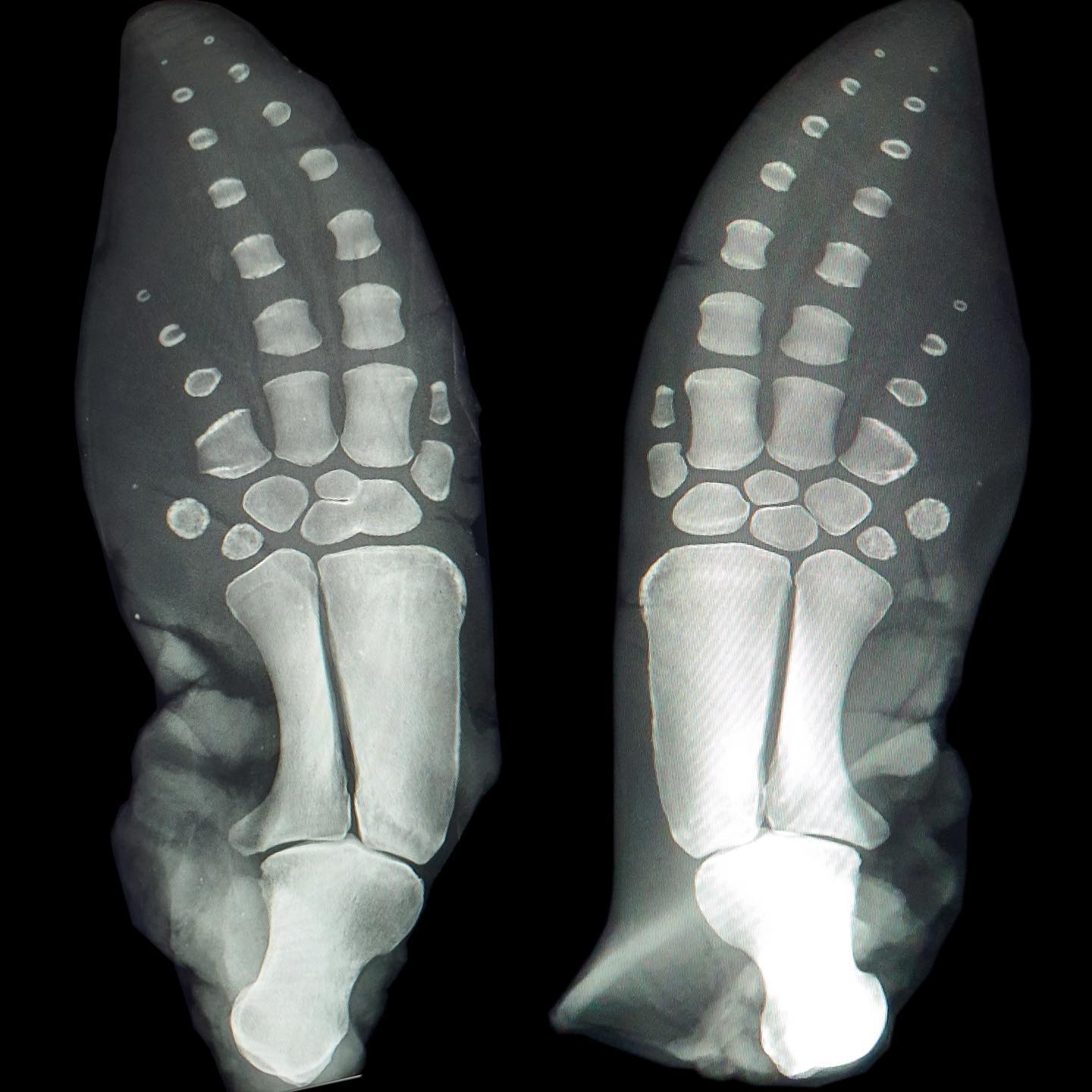
Real X-ray of whale flippers showing finger bones hidden inside! Count the five digits.
🤔 Driving Question: Why do whale flippers have finger bones? What does this tell us about whale ancestors?
🔗 Clickable Links: Text that is purple and underlined links to more information. ↗ = opens in new tab.
Key Vocabulary This Week
| Term | Definition |
|---|---|
| Homologous Structures | Same bone structure, different function (evidence of common ancestor) |
| Analogous Structures | Different structure, same function (NOT from common ancestor) |
| Transitional Fossil | Fossil with features of both ancestral and descendant groups |
| Vestigial Structure | Reduced or non-functional structure left over from ancestors |
| Common Ancestor | An ancestral species from which multiple species evolved |
🎯 Practice These Vocabulary Terms
🎯 Hook – The Whale Finger Mystery
12 Points | ~10 Minutes
What You'll Do (~10 minutes)
- Observe the whale flipper bone structure (2 min)
- Compare to human arm bones (2 min)
- Identify which other animals share this pattern (3 min)
- Connect to natural selection from Week 1 (3 min)
🌿 Click to reveal: Homologous Structures Comparison
Same bones, different functions: Human, cat, whale, bat –
all share the same basic bone pattern!
Image: CK-12 Foundation (CC BY-NC)
🦇 Click to reveal: Bat vs Bird Wings (Analogous vs Homologous)
Both fly, but different bone structure = evolved independently
(analogous as wings)
Image: CK-12 Foundation (CC BY-NC)
🦴 Bone Pattern to Look For:
Human arm, whale flipper, cat leg, bat wing all have:
- Humerus – 1 upper arm/shoulder bone
- Radius & Ulna – 2 forearm bones
- Carpals – Multiple small wrist bones
- Metacarpals & Phalanges – Hand/finger bones
This "1-2-many-5" pattern proves common ancestry!
📝 HOOK FORM
Simulation: Bone Homology Explorer
PREDICT (before running the sim)
Look at the simulation controls. Before changing any variables, predict what will happen when you adjust them. Write your prediction down.
OBSERVE (while using the sim)
Change one variable at a time. Record what happens after each change. Use the data journal to capture at least 3 trials.
EXPLAIN (after collecting data)
Compare your observations with your prediction. Use scientific vocabulary to explain the patterns you found. What surprised you? What confirmed your thinking?
🦴 Station 1 – Comparative Anatomy Analysis
20 Points | ~18 Minutes
Homologous vs. Analogous – Know the Difference!
| Type | Structure | Function | Indicates |
|---|---|---|---|
| Homologous | SAME bones | Different | Common ancestor |
| Analogous | Different | SAME | Independent evolution |
Examples:
- Homologous: Whale flipper + bat wing + human arm (same bones!)
- Analogous: Bird wing + butterfly wing (both fly, different structure)
📺 Homologous Structures vs Analogous Structures | Key Differences
Click play to watch the video explaining the key differences!
📗 Need extra support? Click here for hints and sentence starters
HINT 1: "Homologous" = same origin. Same bones, different jobs.
HINT 2: "Analogous" = similar job. Different structures that do the same thing.
HINT 3: If mammals have the SAME bone pattern, they probably share a common ancestor!
SENTENCE STARTERS:
- "These structures are homologous because they have the same _____ but different _____."
- "The common bone pattern suggests that these animals share a _____."
- "Natural selection modified the ancestor's limb into different shapes because _____."
WORD BANK: homologous, analogous, common ancestor, bone pattern, natural selection, modified, inherited, function, structure
🆘 Stuck on Station 1? Try these in order:
- Re-read the Homologous vs. Analogous table above
- Check your Week 1 notes on natural selection
- Study the diagram above carefully
- Ask a neighbor: "Is this same structure or same function?"
- Raise your hand for Mr. Rosche
📝 STATION 1 FORM
🦕 Station 2 – Fossil Record Investigation
20 Points | ~15 Minutes
Whale Evolution Timeline
| Fossil | Age | Key Features |
|---|---|---|
| Pakicetus | 50 mya | 4 legs, lived on land near water |
| Ambulocetus | 49 mya | Could walk AND swim, webbed feet |
| Rodhocetus | 47 mya | Short legs, large tail, mostly aquatic |
| Basilosaurus | 40 mya | Tiny back legs, fully aquatic |
| Modern whales | Today | Flippers, no visible legs |
mya = million years ago
📺 What is the Evidence for Evolution?
Click play to watch the video about whale evolution evidence!
📗 Need extra support? Click here for hints and sentence starters
HINT 1: Transitional = "in-between." Has features of BOTH groups.
HINT 2: Older fossils are at the bottom. Look at the DATES (mya = million years ago).
HINT 3: Vestigial = "leftover." Doesn't work anymore but ancestors needed it.
SENTENCE STARTERS:
- "This fossil is transitional because it has _____ like the ancestor AND _____ like the descendant."
- "The fossil sequence shows evolution because over time, the organisms' _____ changed from _____ to _____."
- "Vestigial hip bones in whales suggest that their ancestors _____."
WORD BANK: transitional, vestigial, ancestor, descendant, gradual, million years, legs, flippers, aquatic, land-dwelling
🆘 Stuck on Station 2? Try these in order:
- Re-read the Whale Evolution Timeline table above
- Look at the dates – oldest (50 mya) to newest (today)
- Study the evolution diagram above
- Ask yourself: "What changed between each fossil?"
- Raise your hand for Mr. Rosche
📝 STATION 2 FORM
🔧 Station 3 – Design a Transitional Form
25 Points | ~20 Minutes (Highest Value!)
Your Challenge: Design a Transitional Organism
ANCESTOR (100 mya): Fully land-dwelling mammal – 4 legs, fur, small ears
DESCENDANT (today): Fully aquatic mammal – flippers, smooth skin, no visible ears
YOUR DESIGN (60 mya): What would the in-between organism look like?
📝 WORKED EXAMPLE: How to Design a Transitional Form
Given: Fish ancestor (400 mya) → Tetrapod descendant (today)
Transitional (375 mya) – Tiktaalik:
- Limbs: Fins with WRIST BONES (in-between fins and legs)
- Body: Fish scales + flat head like tetrapods
- Habitat: Shallow water, could prop itself up on "elbows"
Notice: EACH feature is "in-between" – not fully fish, not fully tetrapod!
🔧 Interactive: Transitional Form Designer (Click to expand)
How to use: Pick a transition scenario (fish→tetrapod, dinosaur→bird, or land mammal→whale). Design what you think the transitional form looked like, then compare your predictions to real fossils like Tiktaalik, Archaeopteryx, and Ambulocetus!
📗 Need extra support? Click here for hints and sentence starters
HINT 1: Your transitional form should be HALFWAY between ancestor and descendant.
HINT 2: Think about each body part separately: limbs, covering, behavior.
HINT 3: DON'T make the animal fully land or fully water – it needs features of BOTH!
SENTENCE STARTERS:
- "The limbs would be _____ because the ancestor had _____ and the descendant has _____."
- "The body covering would be _____ because this is intermediate between _____ and _____."
- "Natural selection would favor _____ individuals because _____."
- "Over generations, the population changed because individuals with _____ survived better and had more _____."
WORD BANK: intermediate, webbed feet, shortened legs, sparse fur, streamlined, selection pressure, survival advantage, offspring, population, generations
🆘 Stuck on Station 3? Try these in order:
- Look at the Worked Example above (Tiktaalik)
- Make a T-chart: Ancestor features | Descendant features
- Pick the MIDDLE option for each feature
- Review your Week 1 notes on natural selection
- Raise your hand for Mr. Rosche
📝 STATION 3 FORM
🎓 Exit Ticket – Evidence Integration
23 Points | ~15 Minutes
Question Types:
- 2 NEW – Week 2 evolutionary evidence
- 2 SPIRAL – Week 1 natural selection
- 1 INTEGRATION – Connect Week 1 & Week 2
- 1 SEP-6 – Construct a scientific explanation
📝 EXIT TICKET
Week 2 Summary: What You Learned
Homologous Structures: Same bones, different functions = common ancestor
Analogous Structures: Different structures, same function = independent evolution
Transitional Fossils: Show intermediate features between ancestral and descendant groups
Key Misconception: Individuals don't evolve – POPULATIONS change over generations!
🎉 Week 2 Complete!
Next Week: Synthesis & Assessment – Bringing it all together!
👇 🌟 Enrichment & Extension 👇
Optional deep dives for early finishers.
Optional content if you finish early or want to go deeper.
👨🌿 Scientist Spotlight
Research a scientist who contributed to this week's topic area and describe their key findings.
⚖️ Environmental Justice Connection
Explore how this week's science concepts connect to environmental justice issues in our community.