🙋Need Support?: Look for green and red "Hint" and "Walkthrough" boxes!
🌊NGSS Standards Covered This Week
MS-PS4-2 (NEW this cycle)
What it means: Develop and use a model to describe that
waves are reflected, absorbed, or transmitted through various materials
depending on the wave type and material.
In student language: I can explain why WiFi passes
through walls but visible light doesn't, using wavelength and material
properties.
Spiral Standards from Cycles 3 & 4
MS-LS2-3: Energy flow in ecosystems (Cycle 4)
MS-LS4-4: Natural selection and adaptation (Cycle 3)
How These Connect (3-Dimensional Learning)
Dimension
What You'll Practice
SEP-2 Developing Models
Model wave behaviors (reflection, refraction, diffraction,
transmission)
SEP-3 Planning Investigations
Design experiments to test wave-material interactions
DCI PS4.A/B Wave Properties
Understand how wavelength affects material interactions
CCC-1/2/6 Patterns, Cause & Effect, Structure &
Function
Connect wavelength to predictable interaction patterns
📡The Phenomenon: The WiFi vs Flashlight Mystery
🎯Learning Targets
By the end of this week, you will be able to:
Success Criteria – How You'll Know You've Got It
Target 1: Explain that waves transfer energy without
transferring matter
Self-check: Can I explain why a cork bobs but doesn't travel
when a wave passes?
Target 2: Describe how wavelength affects
wave-material interactions
Self-check: Can I explain why WiFi passes through walls but
light doesn't?
Target 3: Model reflection, refraction, absorption,
and transmission
Self-check: Can I identify which wave behavior is happening
in different scenarios?
Target 4: Design investigations to test wave behavior
with different materials
Self-check: Can I design a barrier that blocks some waves
while allowing others?
>
A home WiFi router broadcasting ~12 cm radio waves through walls.
Visible light is 240,000× shorter — that's why it can't do the same.
Wikimedia Commons / CC BY-SA
Your home WiFi signal passes through walls, floors, and furniture to
reach your devices in any room. But if you try to shine a flashlight
through those same walls, no light gets through.
Here's the weird part:
BOTH WiFi and visible light are electromagnetic waves!
WiFi wavelength: ~12 cm (about the width of your
hand)
WiFi waves are 240,000× LONGER than visible light
waves!
🤔 Focus Question: How can we "see
through walls" with WiFi but not with flashlights?
👇🏙️ St. Louis Connection & Why This
Matters 👇
🏙️ St. Louis Connection
Boeing St. Louis uses wave technology extensively — radar systems,
electromagnetic testing, and signal processing all rely on the wave
properties and behaviors you are studying this week.
Step-by-Step Problem Solving
Animation unavailable.
🎬Watch: Coupled oscillators transfer energy in waves — the basis of mechanical wave propagation. | Wikimedia Commons
👇✍️COMPLETE THE HOOK FORM👇
Complete the hook form below.
👇🌊 Station 1 – Wave Tank Investigation
👇
20 Points | ~18 Minutes
🌊 Your Mission: Discover Wave
Behaviors
Ocean waves: a real transverse wave. Water moves up-down; the wave
pattern moves sideways. Photo: Roger McLassus / Wikimedia Commons
/ CC BY-SA 3.0
Coupled oscillations in a physics demonstration — the same math
that describes all waves. Wikimedia Commons / CC BY-SA
The Four Wave Behaviors
Behavior
What Happens
Example
REFLECTION
Wave bounces off barrier
Echo, mirror
REFRACTION
Wave bends when changing medium
Straw looks bent in water
DIFFRACTION
Wave spreads around obstacles
Hearing around corners
TRANSMISSION
Wave passes through material
Light through glass
📊 POE Protocol for Simulations
(Predict-Observe-Explain)
📝 PREDICT (Before you start):
What do you think will happen when you change the wavelength?
When you add a barrier? Write your predictions in the form
BEFORE running the simulation.
👀 OBSERVE (While using
simulation):
Run the simulation and record what you SEE in the data table.
How do different wavelengths behave? What happens at barriers
and gaps?
💭 EXPLAIN (After
investigation):
Compare your predictions to observations. What patterns did you
find? How does wavelength affect reflection, diffraction, and
transmission? Connect to wave physics!
🌊 Interactive: PhET Wave
Interference Simulation (Click to expand)
How to use: Create waves, add barriers, and
observe how waves reflect, refract, and diffract!
👇🌈 Station 2 – Electromagnetic Spectrum
Exploration 👇
20 Points | ~15 Minutes
🌈 Your Mission: Explore the EM
Spectrum
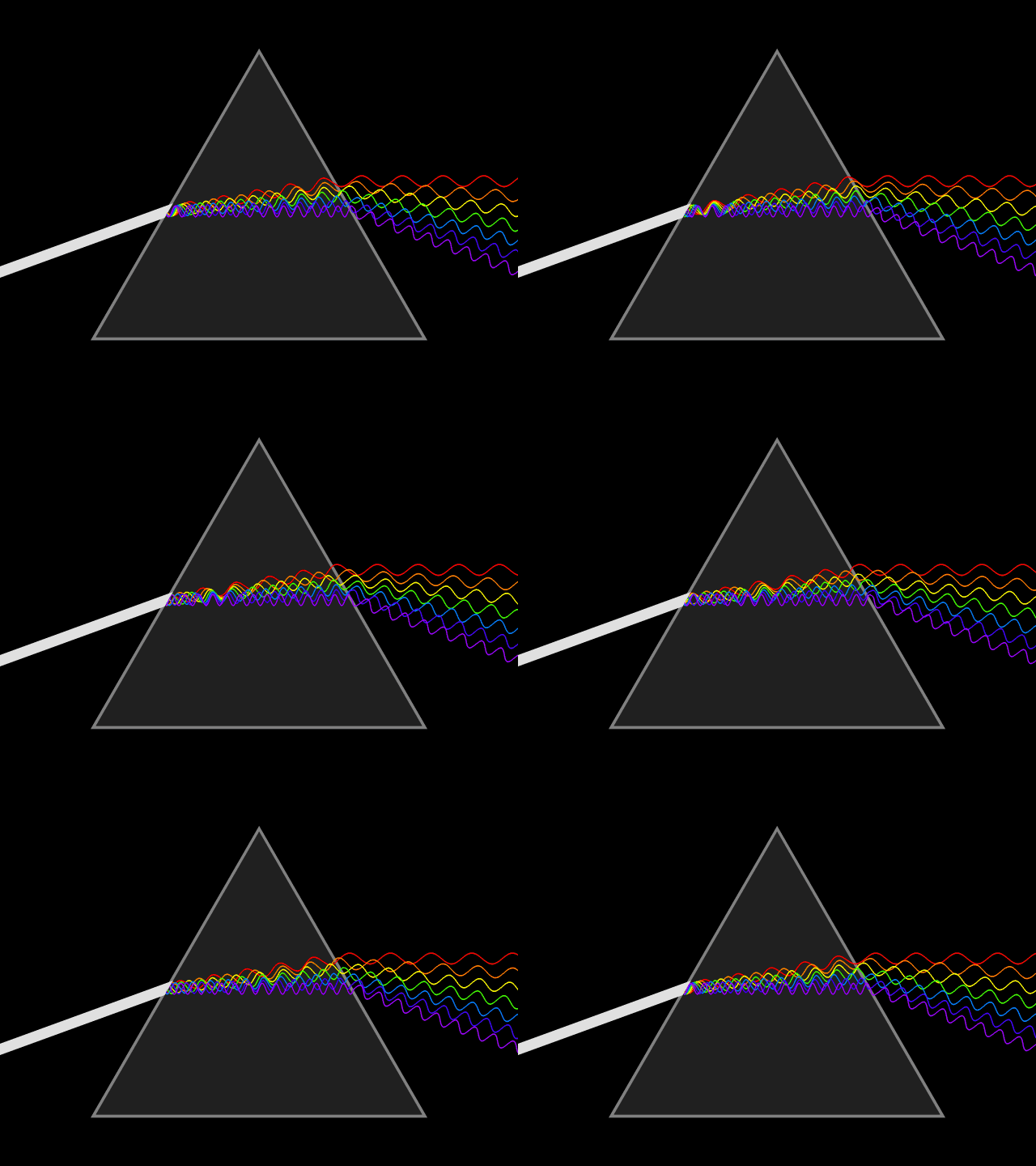
A prism splits white light into the visible spectrum — the tiny
slice of the EM spectrum human eyes can detect. Wikimedia Commons
/ CC BY-SA
X-rays (short EM waves) transmit through soft tissue but are
absorbed by dense bone — a real-world example of wave-material
interaction. Wikimedia Commons / public domain
The Electromagnetic Spectrum
Wave Type
Wavelength
Energy
Common Use
Radio
1 km - 1 m
LOW
AM/FM, WiFi
Microwave
1 m - 1 mm
↓
Cell phones, cooking
Infrared
1 mm - 700 nm
↓
Remote controls, heat
VISIBLE
700 - 400 nm
↓
Human eyes can see!
Ultraviolet
400 - 10 nm
↓
Sunburn, sterilization
X-ray
10 - 0.01 nm
↓
Medical imaging
Gamma
< 0.01 nm
HIGH
Cancer treatment
KEY: Longer wavelength = Lower energy = More likely
to pass through materials
🔍 WORKED EXAMPLE: Analyzing
Wavelength-Material Interactions
Learn by following an expert's thinking process. Week 1 shows ALL
steps.
🎯 PROBLEM:
A concrete wall (20 cm thick) blocks your cell phone signal
(microwave, λ = 12 cm) but radio waves (λ = 3 m) from an AM
station pass through easily. Why?
STEP 1: Identify wavelengths and compare to material
💭Expert thinks: "First, I need to organize what
I know about the waves:"
Cell phone microwave: λ = 12 cm = 0.12 m
AM radio wave: λ = 3 m
Wall thickness: 20 cm = 0.2 m
"The radio wave is 25× LONGER than the microwave!"
💭Expert thinks: "Concrete is a composite with
small gaps and pores (typically 1-5 cm)."
Microwave (12 cm) is LARGER than most gaps → gets
absorbed/reflected
Radio wave (3 m = 300 cm) is MUCH LARGER than gaps → diffracts
around obstacles within the material
"Long waves bend around small obstacles; short waves get
blocked!"
STEP 3: Consider energy absorption
💭Expert thinks: "Concrete contains water
molecules and metal reinforcement."
Microwaves (higher frequency) excite water molecules → energy
absorbed as heat
Radio waves (lower frequency) have less energy per photon →
less absorption
"The microwave's energy matches concrete's absorption bands!"
STEP 4: Construct complete explanation
💭Expert writes:
"Radio waves pass through concrete while microwaves are blocked
because: (1) Radio wavelength (3 m) is much longer than
concrete's internal structure, allowing diffraction around
obstacles, while microwave wavelength (12 cm) matches the size
of gaps and gets blocked; (2) Microwaves have higher frequency
and thus more energy to excite water molecules in concrete,
causing absorption, while radio waves have insufficient energy
for significant absorption."
🤔 SELF-EXPLANATION PROMPT:
Why can you hear your neighbor's bass music through a wall more
easily than their high-pitched vocals? Use wavelength principles
from this worked example to explain. (Hint: Bass = longer
wavelength sound waves, vocals = shorter wavelength sound waves.)
Why WiFi Goes Through Walls But Light Doesn't:
WiFi wavelength: ~12 cm (120,000,000 nm)
Light wavelength: ~500 nm
WiFi is 240,000× LONGER
Longer waves diffract through gaps in wall materials that block
shorter waves!
💡Engineering Waves in St. Louis: Gateway Arch Integrity
Testing
The Gateway Arch uses X-ray testing to check structural steel
integrity—exactly the wavelength/transmission properties you're
studying. Dr. Katharine M. Flores, a materials
scientist at Washington University in St. Louis, studies how
different wavelengths penetrate different materials. Engineers use
gamma rays for thick steel (short wavelength = high penetration),
X-rays for thinner sections, and infrared for surface temperature
monitoring. The Arch's stainless steel skin requires constant
monitoring because thermal expansion (summer heat vs winter cold)
creates stress points. Diverse engineering teams—including
structural engineers ($75k-$120k), materials scientists
($80k-$110k), and NDT (non-destructive testing) technicians
($45k-$75k)—use wave physics to protect the millions of visitors
each year. Your understanding of how wavelength affects material
interaction is foundational to infrastructure safety.
📗 Need extra support? Click here
for spectrum hints
Memory Trick:
"Randy Moves
Into Very
Unusual X-treme
Games" = Radio, Microwave, Infrared, Visible, UV,
X-ray, Gamma (longest to shortest wavelength)
Sentence Starters:
"X-rays pass through skin but not bone because..."
"Radio waves have lower energy than gamma rays because..."
"WiFi passes through walls because its wavelength is..."
👇✍️COMPLETE THE STATION 2 FORM👇
Explore the EM spectrum and explain wavelength-material
interactions.
⏳ Station 2 Form — Form pending deployment
This form is authored but has not yet been published to Google Forms. Your teacher will share the link once it is live. No action needed from students until then.
👇✍️ Complete Your Worksheet
👇
Complete the "Station 2" box in the "STATION 1 & 2 NOTES"
section:
EM spectrum pattern: longer wavelength = lower
energy = more likely to pass through
Why WiFi passes through walls but light does not
Key insight: (one sentence summary)
👇✍️COMPLETE THE STATION 2 FORM👇
Complete the form below for Station 2.
👇✍️ Complete Your Worksheet
👇
Complete the "Station 3 — Engineering Design" section:
Materials tested and wave behaviors:
(reflect/absorb/transmit)
Design choice and justification
Key insight: (one sentence summary)
👇✍️COMPLETE THE STATION 2 FORM👇
Complete the form below for Station 2.
👇✍️ Complete Your Worksheet
👇
Complete the "DAY 2 EXIT TICKET" and "SCIENCE CIRCLE" sections:
Check your answers match your reasoning from the stations