Week 4: Electric Motors & Mechanical Advantage
Grade 8 Science | Rosche
The Phenomenon: The Tiny Motor Mystery
Anchoring Context & Focus Question
How can a tiny electric motor lift a car?
Before We Begin: Activate Your Prior Knowledge
Think back to Week 3: You learned how electric circuits transfer energy — voltage pushes current through resistance, and power measures how fast energy is delivered (P = V x I). You calculated that a hairdryer draws 1500W from a 120V circuit. Now ask yourself: If a motor draws power from a circuit, where does that energy go? Can a motor produce more mechanical energy than the electrical energy it receives? And how can a motor that fits in your palm generate enough force to lift a 1,500 kg car? Today we connect circuits to real mechanical work.
A typical car weighs about 1,500 kg — that's 14,700 Newtons of gravitational force. Yet a portable electric car jack, powered by a motor smaller than your fist, can lift that entire car off the ground in about 30 seconds.
- The motor runs on just 12 volts from the car battery, drawing about 15 amps — that's only 180 watts of power (about the same as two light bulbs).
- The secret isn't that the motor is impossibly strong — it's that gears and screws multiply the motor's small force into a much larger one.
- The trade-off: You get more force, but the car lifts very slowly. Force goes up, speed goes down — energy is conserved.
- From W3: You already know P = V x I. Today you'll see how that electrical power becomes mechanical work: W = F x d.
St. Louis Connection
The Gateway Arch tram system uses electric motors and a complex gear train to carry visitors 630 feet to the observation deck. Each barrel-shaped capsule must stay level as it travels along the curved track inside the Arch's legs. The motors are relatively small, but the gear system provides enough mechanical advantage to move loaded capsules weighing over 2,000 kg — at a safe, controlled speed. Engineers at the Arch balanced motor power, gear ratios, and safety margins, using the exact same physics you'll explore today.
Why This Matters to YOU
Every power tool, electric vehicle, elevator, and robot uses a motor paired with gears or pulleys. Understanding efficiency and mechanical advantage is how mechanical engineers design machines that are powerful, safe, and energy-efficient. Mechanical engineering is one of the broadest STEM fields, with careers in automotive, aerospace, robotics, and renewable energy — and a median salary over $95,000.
Focus Question: How can a tiny electric motor lift a car?
By the end of this lesson, you will be able to:
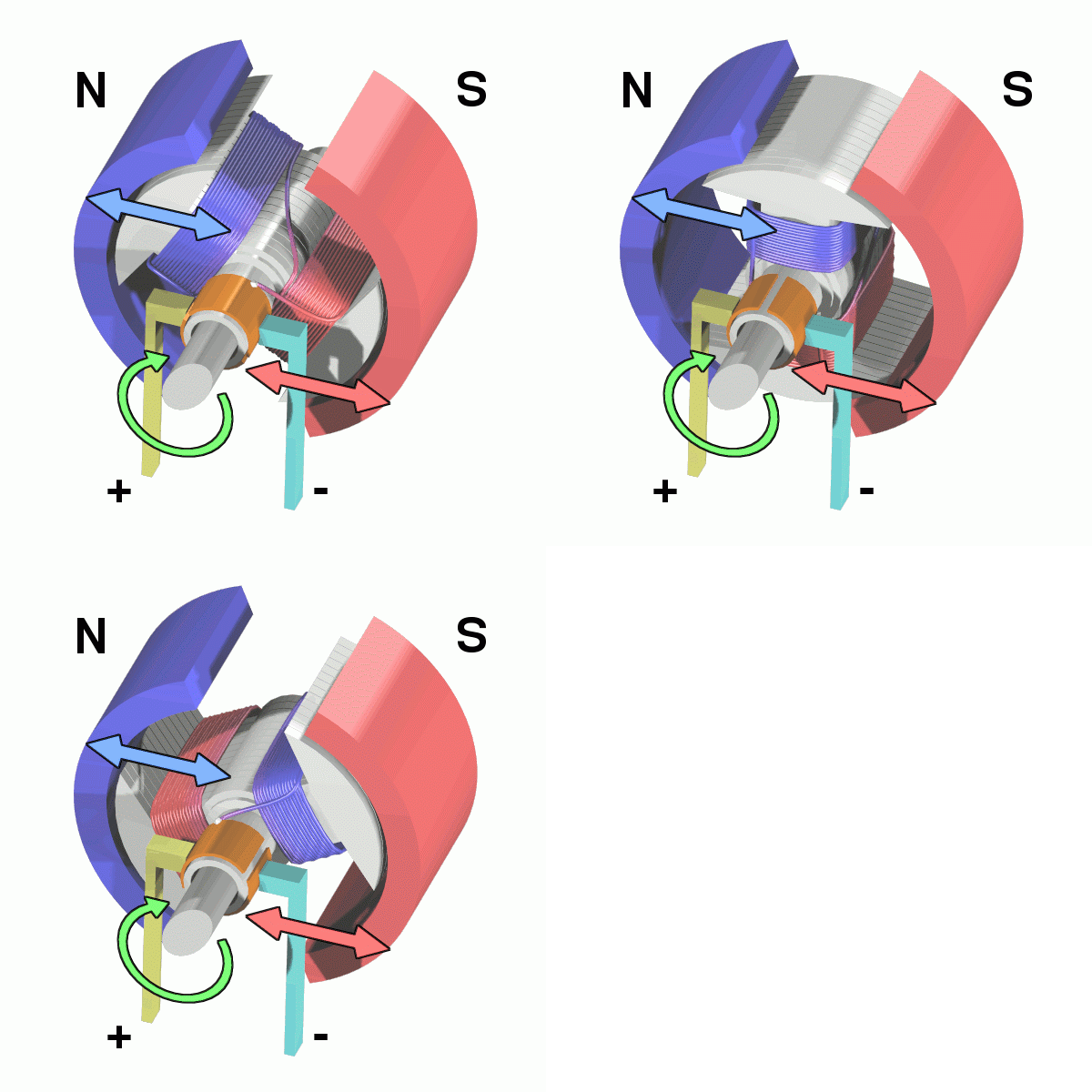
- Explain how electric motors convert electrical energy to mechanical energy.
- Calculate motor efficiency using input and output power (Efficiency = P_out / P_in x 100%).
- Apply mechanical advantage principles to analyze force multiplication in gears and pulleys.
- Design a motor-and-gear system to meet specific lifting requirements.
NGSS 3D Standards
This Week's Standards
MS-PS3-2: Develop a model to describe that when the arrangement of objects interacting at a distance changes, different amounts of potential energy are stored in the system.
MS-PS2-3: Ask questions about data to determine the factors that affect the strength of electric and magnetic forces.
Spiral Standards (Review)
- MS-PS2-3: Electric and magnetic forces — circuit power (Week 3)
- MS-PS3-5: Energy transfer in fields — electromagnetic induction (Week 2)
Cognate Strategy: Many science words look similar in English and Spanish — use your Spanish to learn science!
| Term | Spanish | Definition |
|---|---|---|
| mechanical advantage | ventaja mecánica | Factor by which a machine multiplies force (MA = Output Force / Input Force) |
| gear ratio | relación de engranajes | Ratio of teeth on driven gear to driving gear; determines speed/torque trade-off |
| torque | torque | Rotational force — the twisting power of a motor (measured in Newton-meters) |
| work | trabajo | Force times distance (W = F × d); measured in Joules |
| efficiency | eficiencia | Useful energy output divided by total energy input (always less than 100%) |
| pulley system | sistema de poleas | Wheels and ropes that change the direction or magnitude of force |
| energy | energía | Capacity to do work; can be transferred but not created or destroyed |
Hook – The Tiny Motor Mystery
Compare motor size to car weight.
The Challenge
What You'll Do
- Examine how a small electric car jack lifts a 1,500 kg car
- Predict: Does the motor output more force than it receives as electrical power?
- Connect to Week 3: How does P = V x I relate to the power a motor receives?
- Answer diagnostic questions about energy transfer and force multiplication
The Mystery Data
A student tests an electric car jack lifting a 1,500 kg car (14,700 N of weight):
| Measurement | Value |
|---|---|
| Motor voltage | 12 V |
| Motor current | 15 A |
| Electrical power input | 180 W |
| Force needed to lift car | 14,700 N |
| Motor's own force output | ~50 N |
| Time to lift car 20 cm | ~45 seconds |
Key Question: The motor only produces 50 N of force, but the car weighs 14,700 N. That's a 294x difference! Where does the extra force come from? Is energy being created?
Stop & Think
Before you open the form below, consider: From Week 3, you know P = V x I. The motor receives 180W of electrical power. If it lifts the car slowly instead of quickly, what does that tell you about the trade-off between force and speed?
Worked Example and Simulation – Calculating Mechanical Advantage in a Gear System
The Problem
Scenario: An engineer is designing a motor-powered winch to lift equipment at a construction site. The motor runs on 24V and draws 10A of current. She measures that the motor's shaft produces 180W of mechanical power. Meanwhile, the winch needs to lift a 900 N load. The engineer uses a gear system with a mechanical advantage of 6. Calculate the motor's efficiency, the output force after the gear system, and whether the system can lift the load.
Step-by-Step Solution
Step 1: Calculate electrical power input using P = V x I
"P_in = 24V x 10A = 240W. The motor receives 240 watts of electrical power from the circuit."
Step 2: Calculate motor efficiency (Efficiency = P_out / P_in x 100%)
"Efficiency = 180W / 240W x 100% = 75%. So 75% of electrical energy becomes useful mechanical energy. The other 25% is lost as heat due to friction and electrical resistance in the motor windings."
Step 3: Calculate the motor's base lifting force
"If the motor lifts at 1.2 m/s without gears: Force = Power / speed = 180W / 1.2 m/s = 150 N. That's the motor's base force — not enough for 900 N!"
Now YOU Complete Steps 4-5:
Step 4: Apply the gear system's mechanical advantage (MA = 6). Multiply the motor's base force by MA. What is the output force? Is it enough to lift 900 N?
Step 5: With MA = 6, the speed is reduced by the same factor. What is the new lifting speed? How long does it take to lift the load 2 meters?
Fading Support: Steps 4 and 5 are YOUR turn. Use MA = Output Force / Input Force and remember that speed decreases by the same factor that force increases. This prepares you for Station 1's motor efficiency investigation.
Simulation: Motor Efficiency
PREDICT (before running the sim)
Look at the simulation controls. Before changing any variables, predict what will happen when you adjust them. Write your prediction down.
OBSERVE (while using the sim)
Change one variable at a time. Record what happens after each change. Use the data journal to capture at least 3 trials.
EXPLAIN (after collecting data)
Compare your observations with your prediction. Use scientific vocabulary to explain the patterns you found. What surprised you? What confirmed your thinking?
Station 1 – Motor Efficiency Investigation
Analyze energy transfer in electric motors.
Your Mission: Investigate Motor Efficiency
Motor Simulation Data: Input Power vs. Output Power
Three motors are tested at different voltages. For each, electrical power input (P_in = V x I) and useful mechanical power output (P_out) are measured.
| Motor | Voltage (V) | Current (A) | P_in (W) | P_out (W) | Efficiency (%) |
|---|---|---|---|---|---|
| Small DC motor | 6 V | 0.5 A | 3 W | 1.5 W | 50% |
| Car jack motor | 12 V | 15 A | 180 W | 135 W | 75% |
| Industrial motor | 240 V | 8 A | 1920 W | 1728 W | 90% |
| Tesla EV motor | 400 V | 250 A | 100,000 W | 95,000 W | 95% |
Phenomenon Check-In
Think back to the tiny motor mystery. The car jack motor is 75% efficient at 180W input. That means only 135W of useful mechanical power is available. Is 135W enough to lift a 1,500 kg car? (Hint: think about how gears help in Station 2!)
Station 2 – Mechanical Advantage Analysis
Calculate mechanical advantage in motor systems.
Your Mission: Analyze Mechanical Advantage
Gear Ratio Data: Trading Speed for Force
A motor produces a base force of 50 N at a speed of 600 RPM. Different gear systems are attached to multiply force:
| System | Driving Gear (teeth) | Driven Gear (teeth) | Gear Ratio (MA) | Output Force (N) | Output Speed (RPM) |
|---|---|---|---|---|---|
| No gears | — | — | 1:1 | 50 N | 600 RPM |
| 2-gear set | 10 | 30 | 3:1 | 150 N | 200 RPM |
| 3-gear train | 10 | 60 | 6:1 | 300 N | 100 RPM |
| Worm gear | 1 (worm) | 40 | 40:1 | 2,000 N | 15 RPM |
| Car jack screw | — | — | ~300:1 | 15,000 N | 2 RPM |
Pulley Systems Comparison
Pulleys work the same way — more rope means less force needed, but you pull more rope:
| Pulley Type | Number of Support Ropes | MA | Force to Lift 600 N | Rope Pulled per 1 m Lift |
|---|---|---|---|---|
| Fixed (1 pulley) | 1 | 1 | 600 N | 1 m |
| Movable (1 pulley) | 2 | 2 | 300 N | 2 m |
| Block & tackle (4 pulleys) | 4 | 4 | 150 N | 4 m |
| 6-pulley system | 6 | 6 | 100 N | 6 m |
Phenomenon Check-In
Now you can answer the focus question! The car jack motor produces only 50N, but the screw mechanism has MA of ~300, multiplying the force to ~15,000N — enough to lift a 1,500 kg car (14,700 N). The trade-off? The car lifts only a few millimeters per motor revolution. Energy is conserved: small force x large distance = large force x small distance.

Station 3 – Design a Lifting System
Apply electromagnetism and mechanical advantage to engineering.
Your Mission: Design a Lifting System
The Engineering Challenge
A community center in North St. Louis needs a motorized system to raise and lower a heavy projector screen (weighing 200 N) from the ceiling. Your team must design a motor-and-gear or motor-and-pulley system that meets ALL of the following constraints:
Design Constraints
| Constraint | Requirement | Why It Matters |
|---|---|---|
| Load weight | 200 N (about 20 kg) | The screen plus mounting hardware |
| Lifting distance | 3 meters | Floor to ceiling height |
| Time limit | Under 30 seconds | Audience doesn't want to wait |
| Available motor | 12V, 2A, 80% efficient | Standard motor from supplier |
| Budget | Simplest gear/pulley system | Community center has limited funds |
| Safety | Output force > 1.5x load weight | Safety margin prevents drops |
Your Design Process (complete in the form below)
- Calculate available power: P_in = V x I = ? Then P_out = P_in x efficiency = ?
- Calculate minimum MA needed: Safety force = 200N x 1.5 = 300N. Motor's base force at reasonable speed = P_out / speed. What MA gets you to 300N?
- Choose your system: Gears or pulleys? How many? What are the trade-offs?
- Check the time: With your MA, what's the lifting speed? Can you lift 3m in under 30 seconds?
- Write a CER paragraph defending your design (Claim-Evidence-Reasoning)
CER Scaffold for Your Design Defense
CLAIM: State your design choice (e.g., "A 4-pulley block-and-tackle system with MA = 4 is the best solution because...")
EVIDENCE: Show your calculations — P_in, P_out, base force, output force with MA, lifting speed, time to lift 3m. Use specific numbers from the constraints table.
REASONING: Explain WHY your design meets all constraints. Connect to energy conservation: Why can't you just use a higher MA to make it faster AND stronger? Reference the force-speed trade-off from Station 2.

Exit Ticket – Motor Systems Integration
Synthesize understanding of motors and mechanical advantage.
Exit Ticket Overview
This exit ticket checks your understanding of electric motors, efficiency, and mechanical advantage. It includes questions from this week's new content as well as spiral review from previous weeks.
Question Distribution (23 points total):
- 2 NEW questions — Motor efficiency and mechanical advantage (this week)
- 2 SPIRAL questions — MAP Achievement Season: Energy transfer PS3.B.1 + design solutions ETS1.B.1 (MAP RETEACH standards)
- 1 INTEGRATION + SEP-4 question — Analyzing data from a motor-gear system to explain how a small motor can do large-scale work (Analyzing and Interpreting Data)
Reminders: Show your work on calculation questions. Use complete sentences for CER responses. Reference specific data or equations as evidence.

Enrichment & Extension
Optional content if you finish early or want to go deeper.
Scientist Spotlight: Granville T. Woods (1856–1910)
Granville T. Woods was an African American inventor and electrical engineer who held more than 60 patents. Known as "Black Edison," Woods invented the multiplex telegraph, which allowed moving trains to communicate with stations and with each other — preventing deadly collisions. His most impactful work involved electric railway systems, including motors, controllers, and power distribution systems for streetcars.
Woods was largely self-taught. He worked as a railroad engineer, steamship engineer, and in a machine shop — gaining hands-on experience with motors, electrical systems, and mechanical advantage long before he became an inventor. He fought — and won — patent disputes against Thomas Edison himself.
Connection to today's lesson: Woods' electric railway motors used the same principles you explored — converting electrical energy to mechanical motion, using gear systems to control speed and torque, and managing efficiency to move heavy train cars with relatively small motors.
Environmental Justice: E-Waste from Motors & Electronics
Every motor, phone, and electronic device you use contains copper windings, rare earth magnets, and circuit boards. When these devices are discarded, they become electronic waste (e-waste). Globally, over 50 million tons of e-waste are produced each year — and less than 20% is properly recycled.
Much of this e-waste is shipped to low-income communities in West Africa and Southeast Asia, where workers — including children — disassemble electronics by hand, burning plastic casings and exposing themselves to lead, mercury, and cadmium. In the U.S., e-waste processing facilities are disproportionately located near communities of color.
Think about it: The copper in a motor can be recycled indefinitely with no loss of quality. Why isn't more e-waste recycled? What policies could ensure that the benefits of electronics (like the motors we studied) don't come at the cost of environmental health for vulnerable communities?
Week 4 Complete!
Next Week: Synthesis & Assessment — bringing electricity and magnetism together!