Week 1: Evidence of Chemical Reactions
Grade 8 Science | Rosche
MS-PS1-2 Matter and Its Interactions
The Phenomenon: The Fading Glow Mystery
Anchoring Context & Focus Question
Why do glow sticks eventually stop glowing?
Cognate Strategy: Many science words look similar in English and Spanish — use your Spanish to learn science!
| Term | Spanish | Definition |
|---|---|---|
| chemical reaction | reacción química | Process where substances transform into new substances |
| reactant | reactivo | Starting substance in a chemical reaction |
| product | producto | New substance formed in a chemical reaction |
| conservation of mass | conservación de masa | Mass is neither created nor destroyed in reactions |
| precipitate | precipitado | Solid formed when two solutions are mixed |
| indicator | indicador | Substance that changes color to show chemical change |
| exothermic | exotérmico | Reaction that releases heat energy |
Hook – The Fading Glow Mystery
Observe how glow sticks produce and lose their light over time.
The Disappearing Nail Mystery
A shiny steel nail is dropped into a clear liquid. Twenty minutes later the liquid is green, bubbles are forming, the nail is pitted and coated in orange flakes, and the beaker is warm to the touch. Something has changed — but what, exactly? Is this a chemical reaction, or just mixing?
Cycle 6 Connection
What You'll Do
- Watch four short demo videos of real reactions (safely virtualized)
- Identify every piece of observable evidence you can
- Decide: chemical change, physical change, or unsure? Defend your reasoning
- Submit your predictions — you'll revise them after Station 1
Worked Example and Simulation – Identifying Evidence of Chemical Reactions
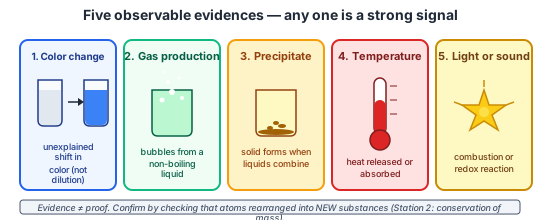
Worked Example: The Five Evidences of a Chemical Reaction
Problem: How do you tell a chemical change (new substance) from a physical change (same substance, different form)? Chemists use five observable evidences — any ONE is a strong signal a reaction may have occurred.
The Five Evidences
- Color change not explained by dilution or mixing
- Gas production (bubbles from a non-boiling liquid)
- Precipitate (solid forms when two liquids combine)
- Temperature change with no external heat source
- Light or sound emission (combustion, some redox reactions)
Important Caveat
Station 1 – Reaction Evidence Lab
Identify signs of chemical reactions through observable evidence.
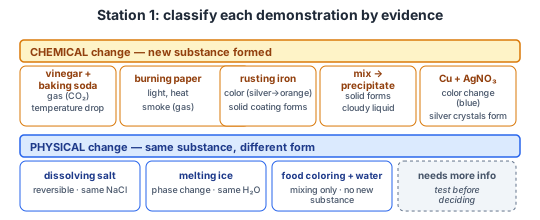
Station 1 — Classifying Reactions by Evidence
Your mission: examine 8 short demonstrations (vinegar + baking soda, dissolving salt, burning paper, rusting iron, mixing two colored solutions that produce a solid, melting ice, copper + silver nitrate, food coloring + water). For each, identify all evidence types present and decide: chemical, physical, or needs more info.
Data Table
Station 2 – Mass Conservation Investigation
Measure mass before and after reactions to test conservation of mass.
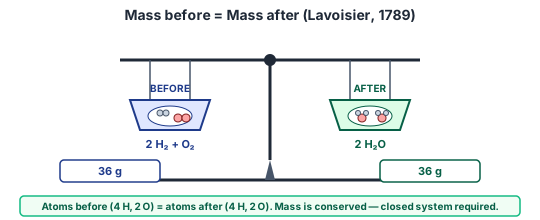
Station 2 — Atoms Rearrange, Mass Conserves
Reactions don't create or destroy atoms — they rearrange them. In the Worked Example above you ran the simulator and observed this directly. Now apply that understanding: balance the equations below by tracking the mass before and mass after each reaction. The Law of Conservation of Mass (Lavoisier, 1789) is your anchor.
Reactions to Balance
- H₂ + O₂ → H₂O (combustion of hydrogen)
- CH₄ + O₂ → CO₂ + H₂O (burning methane)
- Fe + O₂ → Fe₂O₃ (rusting)
- NaHCO₃ + CH₃COOH → CO₂ + H₂O + CH₃COONa (baking soda + vinegar)
Station 3 – Design a Reaction Detector
Apply understanding of reaction evidence to design a detection method.
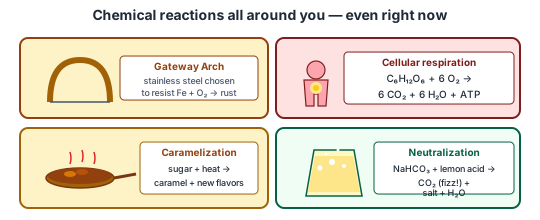
Station 3 — Chemical Reactions Around You
Your mission: identify the chemical reactions you encounter every day and classify them by evidence type. From cellular respiration in your own body, to the rusting of the Gateway Arch, to the caramelizing of onions on the stove — reactions surround you.
Real-World Reactions to Analyze
- Iron + oxygen → rust (slow oxidation) — Gateway Arch stainless-steel choice
- Glucose + O₂ → CO₂ + H₂O + ATP (cellular respiration in your cells, right now)
- Sugar + heat → caramel (pyrolysis + Maillard reactions)
- Baking soda + lemon juice → CO₂ (a neutralization + decomposition reaction)
Argument from Evidence
Exit Ticket – Reaction Evidence Integration
Synthesize understanding of chemical reaction evidence and conservation of mass. Spiral questions target MAP Achievement Season standards (PS3.B.1 energy transfer, PS1.A.1 matter structures).
Exit Ticket — Reaction Evidence Mastery
Demonstrate your understanding through 2 new-content questions on chemical-reaction evidence, 2 spiral questions from Cycle 6 (forces and motion — what doesn't change at the atomic level during physical change?), and 1 integration question on the SEP practice of analyzing and interpreting data.
Enrichment & Extension
Optional content if you finish early or want to go deeper.
Scientist Spotlight: Dr. Mario J. Molina
Dr. Mario J. Molina (1943–2020) was a Mexican chemist who won the 1995 Nobel Prize in Chemistry for discovering how chlorofluorocarbons (CFCs) — gases used in refrigerators and aerosol cans — destroy the ozone layer. Molina showed that sunlight triggers a chemical reaction: CFCs release chlorine atoms, and each chlorine atom can then break apart 100,000 ozone molecules in a chain reaction. His work led to the 1987 Montreal Protocol, the most successful environmental treaty in history, which phased out CFCs worldwide. The ozone hole is now shrinking. Molina's story shows two things this week's phenomenon makes visible: (1) reactions you can't see with your eyes can transform matter at planet scale, and (2) the evidence of a reaction — a fading glow, a missing mass, a color change — can reveal problems we would otherwise miss until it's too late.
Environmental Justice: Sauget & East St. Louis
Just across the Mississippi from downtown, the village of Sauget, Illinois and parts of East St. Louis hosted chemical plants — Monsanto (later Solutia) and others — that for decades ran industrial-scale chemical reactions producing PCBs, herbicides, and dyes. The reactants went in; the products shipped out; but the byproducts — chemical waste — were dumped into unlined lagoons and the American Bottom floodplain. The surrounding community is roughly 98% Black, and residents show elevated rates of cancer, asthma, and birth defects traced to chemical exposure. Conservation of mass from this week's lesson explains why this matters: the atoms in those byproducts didn't disappear when the plants closed. They stayed in the soil, the groundwater, and the bodies of neighbors. Today, chemists, epidemiologists, and community organizers are using the same detection methods you practice in Station 1 — color-change indicators, precipitate tests, mass balance — to map contamination and demand cleanup.
Week 1 Complete!
Next Week: Reaction Types & Conservation — how can mixing two clear liquids make a solid appear?