Week 2: Reaction Types & Conservation
Grade 8 Science | Rosche
MS-PS1-3 Matter and Its Interactions
The Phenomenon: The Disappearing Solid Mystery
Anchoring Context & Focus Question
How can mixing two clear liquids make something solid appear?
Cognate Strategy: Many science words look similar in English and Spanish — use your Spanish to learn science!
| Term | Spanish | Definition |
|---|---|---|
| synthesis | síntesis | Reaction combining two substances into one |
| decomposition | descomposición | Reaction breaking one substance into two or more |
| single replacement | sustitución simple | One element replaces another in a compound |
| double replacement | sustitución doble | Two compounds exchange elements |
| balanced equation | ecuación balanceada | Same number of atoms on both sides |
| coefficient | coeficiente | Number in front of a formula in an equation |
| combustion | combustión | Reaction where a substance burns in oxygen, producing carbon dioxide and water |
| endothermic | endotérmico | Reaction that absorbs heat energy |
Hook – The Disappearing Solid Mystery
Observe how mixing two clear liquids produces a visible solid.
Focus Question: How can mixing two clear liquids make something solid appear?
Imagine pouring two perfectly clear liquids together. The instant they touch, a white solid appears and sinks to the bottom. Neither liquid contained a visible solid by itself.
What changed? The atoms did not disappear or get created. Ions from both liquids rearranged in a double replacement reaction, producing a new solid compound that does not dissolve well in water.
Worked Example – Classifying Reaction Types
Worked Example: Classifying Reaction Types
Problem: A chemistry student drops a strip of magnesium ribbon into a test tube of hydrochloric acid. They observe rapid bubbling, the ribbon disappearing within seconds, the tube warming to the touch, and a colorless gas collecting at the top. The balanced equation is Mg(s) + 2 HCl(aq) → MgCl₂(aq) + H₂(g). What type of reaction is this, and how do we know mass is conserved?
Step 1: Compare reactants to products
A + BC → AC + B matches a single replacement reaction. Mg took H's spot in the chloride compound, and H came out as a free element.Step 2: Check that the equation is balanced
Step 3: Confirm conservation with mass
Conclusion: This is a single replacement reaction. We classify by pattern (one element swaps with one element of a compound), confirm balance (atom counts match), and confirm conservation (total mass before = total mass after, when nothing escapes). The same three checks work for any of the four reaction types.
Station 1 – Reaction Type Classification
Classify chemical reactions by type using observable evidence and equations.
Focus: Classify chemical reactions by comparing the reactant pattern to the product pattern.
Five Types of Chemical Reactions
| Type | Pattern | Example | Everyday Connection |
|---|---|---|---|
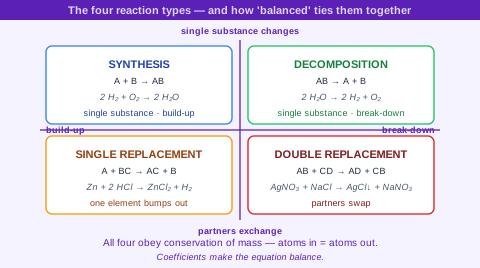
| Synthesis | A + B → AB | 2H2 + O2 → 2H2O | Making water from hydrogen and oxygen |
| Decomposition | AB → A + B | 2H2O → 2H2 + O2 | Electrolysis splits water |
| Single Replacement | A + BC → AC + B | Zn + CuSO4 → ZnSO4 + Cu | Coating objects with copper |
| Double Replacement | AB + CD → AD + CB | NaCl + AgNO3 → NaNO3 + AgCl | Precipitate reactions |
| Combustion | Fuel + O2 → CO2 + H2O | CH4 + 2O2 → CO2 + 2H2O | Burning natural gas for heat |
Memory move: classify by what changes partners.
- Synthesis puts pieces together.
- Decomposition breaks one substance apart.
- Replacement reactions swap partners.
- Combustion burns fuel with oxygen and releases energy.
Station 2 – Balancing Equations Lab
Practice balancing chemical equations to show conservation of atoms.
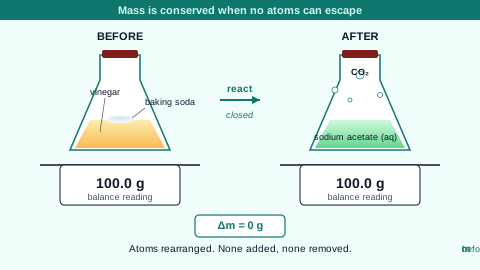
The Golden Rule: same atoms in = same atoms out. Balancing proves conservation of mass at the atomic level.
Coefficients vs. Subscripts
| Term | Symbol | What It Means | Can You Change It? |
|---|---|---|---|
| Coefficient | 2H2O | How many molecules | YES - this is how you balance |
| Subscript | H2O | Atoms per molecule | NO - this changes the substance |
Common misconception: "Change subscripts to balance equations."
Correction: changing subscripts creates a different substance. Use coefficients only.
Balancing steps:
- Count atoms on each side.
- Adjust coefficients only.
- Re-count to verify equal atoms.
- Reduce to the smallest whole numbers.
Station 3 – Design a Chemical Process
Apply understanding of reaction types to design a useful chemical process.
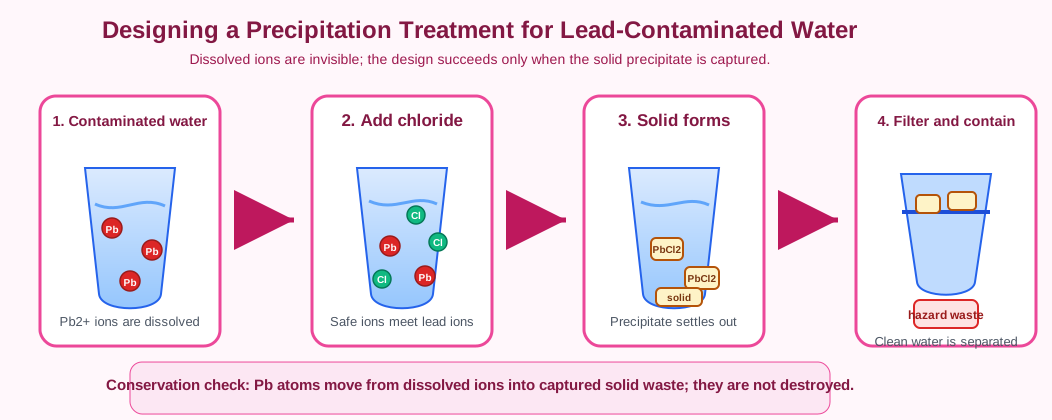
Design Challenge: remove dissolved lead from contaminated water using a precipitation reaction.
The Problem
Lead ions (Pb2+) in drinking water can harm the nervous system, especially in children. A chemical treatment can make dissolved lead form a solid so it can be filtered out.
Chemical Process
- Add a safe source of chloride ions to react with dissolved lead.
- Lead ions combine with chloride ions: Pb2+ + 2Cl- → PbCl2(s).
- The precipitate forms solid particles that can be filtered out.
- Dispose of the filter waste carefully because the solid still contains lead atoms.
Real-world connection: water treatment plants use controlled precipitation and filtration to remove some dissolved metals. The chemistry helps only when the waste is captured and handled safely.
Design constraints:
- Remove at least 95% of dissolved lead ions.
- Use affordable treatment chemicals.
- Work at room temperature.
- Capture and dispose of the precipitate safely.
Exit Ticket – Reaction Patterns Integration
Synthesize understanding of reaction types and conservation of mass.
Question Structure
| Type | Count | Focus |
|---|---|---|
| NEW | 2 | Reaction types and balancing equations |
| SPIRAL | 2 | MS-PS2-3 magnetic forces and fields |
| INTEGRATION | 1 | Connect reaction patterns to conservation of mass |
| SEP-6 | 1 | Construct a scientific explanation |
Before you submit:
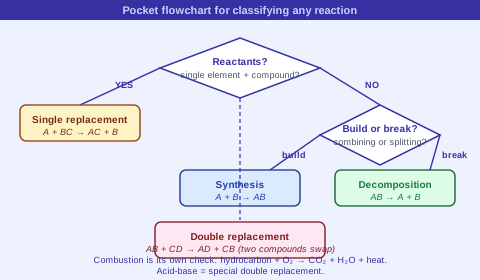
- Classify the reaction from its pattern.
- Check whether atoms are balanced on both sides.
- Use evidence from the model or equation to justify conservation of mass.
Enrichment & Extension
Optional content if you finish early or want to go deeper.
Scientist Spotlight: Stephanie Kwolek
Stephanie Kwolek (1923–2014) was a Polish-American chemist at DuPont who invented Kevlar in 1965 — the incredibly strong polymer now used in bulletproof vests, cut-resistant gloves, and fiber-optic cables. She discovered it through a synthesis reaction: combining two monomers (small molecules) under specific conditions caused them to link into long polymer chains — a macromolecular synthesis reaction. Kwolek noticed that the resulting solution looked unusual and cloudy rather than clear, and instead of discarding it (as lab protocol suggested), she convinced a colleague to test it anyway. The fibers were five times stronger than steel by weight. Her willingness to question a result that didn't match expectations is exactly the scientific practice of analyzing and interpreting data — this week's Station 1 skill. Kwolek's synthesis reaction has saved an estimated 3,000 lives per year among law enforcement officers alone. DuPont's Kevlar plant is located in Richmond, Virginia, but the company has deep roots in the St. Louis chemical industry corridor.
Environmental Justice: Chemical Precipitation & the Meramec River
This week's precipitate reaction — two clear liquids forming a solid — is the same chemistry behind one of Missouri's most persistent water-quality problems. For decades, industrial plants along the Meramec River near Fenton and Valley Park discharged wastewater containing dissolved heavy metals: lead, cadmium, zinc, and chromium. When these metal ions reached the river and mixed with naturally occurring sulfate and carbonate ions, double-replacement precipitation reactions deposited the metals as insoluble solids in river sediment. The sediment looked clean — no color, no obvious contamination — but the metals were locked in solid form along the riverbed. During floods (the Meramec floods dramatically — 1993, 2015, 2016), those sediments resuspend and spread. Communities downstream — predominantly Latino and low-income — face fish consumption advisories and well-water contamination. Chemists use the same precipitation reactions in reverse to clean water: adding a precipitating agent pulls dissolved lead back out of drinking water as a harmless solid that can be filtered out. This is the double-replacement reaction from Station 3's design challenge — applied at city scale.
Week 2 Complete!
Next Week: Reaction Rates & Factors — why does food cook faster on a hot day?