Week 3: Reaction Rates & Factors
Grade 8 Science | Rosche
MS-PS1-2 Analyze and interpret data on the properties of substances before and after the substances interact to determine if a chemical reaction has occurred.
The Phenomenon: Reaction Rates & Factors
Anchoring Context & Focus Question
Why does food cook faster on a hot day than a cold day?
Cognate Strategy: Many science words look similar in English and Spanish — use your Spanish to learn science!
| Term | Spanish | Definition |
|---|---|---|
| reaction rate | velocidad de reaccion | Speed at which a chemical reaction proceeds |
| catalyst | catalizador | Substance that speeds up a reaction without being consumed |
| collision theory | teoria de colisiones | Reactions occur when particles collide with enough energy |
| activation energy | energía de activacion | Minimum energy needed to start a chemical reaction |
| concentration | concentracion | Amount of substance dissolved in a given volume |
| surface area | area superficial | Total exposed area of reactant affecting reaction speed |
Hook – Reaction Rates & Factors
Engage with the phenomenon for Reaction Rates & Factors.
Why Does Food Cook Faster in Summer?
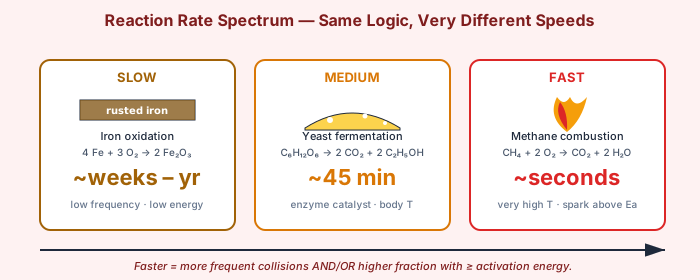
You know that leaving food out on a hot day spoils it faster than on a cold day. Cooking reactions speed up with heat — but why, exactly? The answer is molecular: at higher temperatures, particles move faster, collide more frequently, and have enough energy to break and form new chemical bonds. Temperature doesn't just warm things up — it changes how fast atoms rearrange.
Connection to Weeks 1 & 2
What You'll Do
- Learn collision theory through the worked example
- Station 1: measure reaction time at three different temperatures
- Station 2: analyze datasets for surface area, concentration, and catalyst effects
- Station 3: design an optimal reaction for a real-world engineering challenge
- Exit ticket: demonstrate mastery of rate factors and collision theory
Worked Example – Reaction Rates & Factors
Worked Example: Collision Theory in Action
Problem: A student dissolves an antacid tablet in water at 10°C and measures that it takes 45 seconds to stop fizzing. When the same tablet is dissolved at 40°C, it stops fizzing in only 12 seconds. Why does higher temperature speed up this reaction?
Step 1: Apply Collision Theory
- Higher temperature → faster-moving molecules: at 40°C, water molecules have more kinetic energy and move more rapidly through the solution
- Faster molecules → more frequent collisions: molecules crash into the antacid particles more often per second
- More collisions → faster reaction: each collision that meets the activation energy threshold produces products (CO₂ gas = the fizzing)
- Result: the reaction is roughly 3.75× faster at 40°C than at 10°C
Data Table: Temperature vs. Reaction Time
| Temperature (°C) | Reaction Time (s) | Relative Rate |
|---|---|---|
| 10 | 45 | 1× (baseline) |
| 25 | 24 | 1.9× faster |
| 40 | 12 | 3.75× faster |
Notice: doubling the temperature difference does NOT simply double the rate — the relationship is more complex (Arrhenius equation, which you'll explore in high school chemistry).
Check Your Thinking
Station 1 – Reaction Rates & Factors
Station 1 activity for Reaction Rates & Factors.
Station 1 — Temperature & Reaction Rate Investigation
Your mission: measure and compare the reaction time of a standard chemical system at three different temperatures (cold, room temperature, warm). Using a virtual lab simulation, you will record how long the reaction takes to complete and graph your results. Your data will let you quantify just how much temperature affects reaction speed.
Evidence Checklist
Station 2 – Reaction Rates & Factors
Station 2 activity for Reaction Rates & Factors.
Station 2 — Factors Affecting Rates Analysis
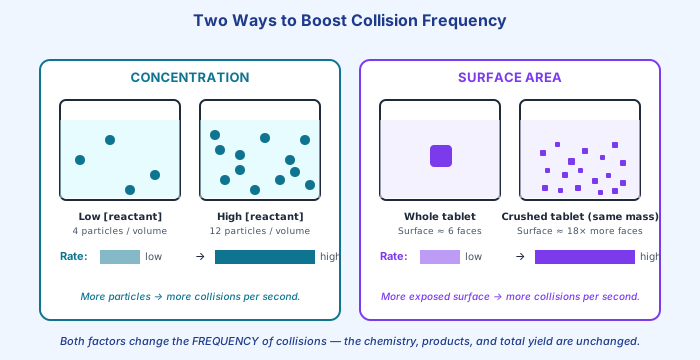
Temperature is only one factor. In this station you will analyze three pre-collected datasets showing how surface area, concentration, and the presence of a catalyst each affect reaction rate. Your goal is to compare the magnitude of each effect and answer: which factor produces the greatest change in reaction speed?
Factors to Analyze
- Surface area: whole marble chip vs. crushed marble chips — more exposed area means more particles available for collisions
- Concentration: dilute acid vs. concentrated acid — more reactant molecules per liter means more frequent collisions
- Catalyst: hydrogen peroxide with and without manganese dioxide — catalyst lowers activation energy so more collisions are successful
Key question: Which single factor, at a reasonable real-world level, has the greatest effect on reaction rate? Use evidence from all three datasets to defend your answer.
Station 3 – Reaction Rates & Factors
Station 3 activity for Reaction Rates & Factors.
Station 3 — Design an Optimal Reaction: Hand Warmer Challenge
You are an engineer designing a hand warmer for use in cold climates (think: a Missouri winter at 0°C). The warmer uses an exothermic chemical reaction that needs to produce heat within 30 seconds of activation and sustain it for at least 20 minutes. Your challenge: use everything you know about reaction rate factors to specify the best design.
Design Specifications to Address
- Reactant choice: iron oxidation (slow, long-lasting) or calcium chloride + water (fast, short burst) — explain the trade-off
- Temperature strategy: the warmer starts cold; how does this affect your initial rate, and what design feature compensates?
- Concentration: should you use dilute or concentrated reactants? What is the safety trade-off?
- Surface area: powdered iron vs. iron pellets — which releases heat faster, and why?
CER Prompt
Exit Ticket – Reaction Rates & Factors Integration
Synthesize learning about Reaction Rates & Factors.
Exit Ticket — Reaction Rates & Factors
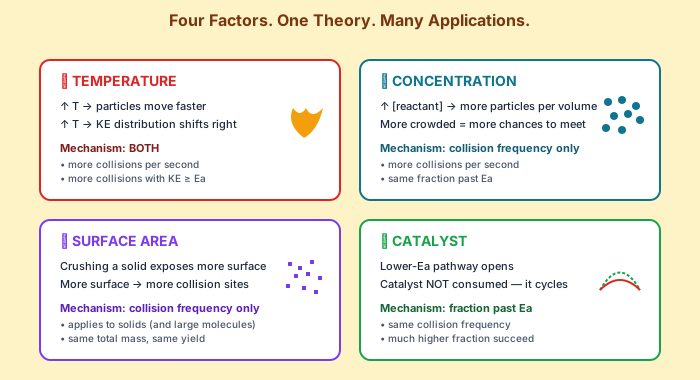
Demonstrate your understanding through 5 carefully structured questions: 2 new questions on today's content (collision theory and temperature's effect on molecular motion; factors affecting reaction rates), 2 spiral questions from earlier in the cycle (reaction types from Week 2; conservation of mass from Week 1), and 1 integration question [INTEGRATION + SEP-3] connecting reaction rate design to the science-and-engineering practice of Planning and Carrying Out Investigations.
Enrichment & Extension
Optional content if you finish early or want to go deeper.
Scientist Spotlight: Svante Arrhenius
Svante Arrhenius (1859–1927) was a Swedish chemist who won the Nobel Prize in Chemistry in 1903 for his work on electrolytes — but his most enduring contribution may be the Arrhenius equation, which mathematically describes exactly what you explored this week: the relationship between temperature and reaction rate. Arrhenius showed that as temperature increases, exponentially more molecules have enough energy to overcome the activation energy barrier, which is why even a small temperature increase can dramatically speed up a reaction. The equation is used today in everything from designing pharmaceutical manufacturing processes to predicting how fast adhesives cure. What is less often mentioned is that Arrhenius also published one of the earliest quantitative analyses of the greenhouse effect in 1896, predicting that doubling atmospheric CO₂ would raise global temperatures by 5–6°C. He was the first scientist to link industrial coal burning to potential planetary warming — making him not only a founder of chemical kinetics but also a pioneer of climate science, more than a century before the issue became urgent.
Environmental Justice: Reaction Rates and Pesticide Runoff in Missouri
The same collision theory you explored today explains a real environmental problem unfolding in Missouri every summer. Many pesticides used on Missouri's corn and soybean farms are volatile organic compounds — molecules that evaporate and react with air much faster at higher temperatures. During hot summer days, these chemicals react more rapidly in soil and water, increasing their volatility and their rate of runoff into drainage ditches that feed the Missouri and Mississippi Rivers. Communities along the lower Mississippi River — many of them low-income communities of color who depend on the river for fishing and drinking water — experience elevated pesticide concentrations precisely during the hottest months, when reaction rates are highest. Environmental chemists and advocacy groups like the Missouri Coalition for the Environment are using the same rate-factor analysis you practiced in Station 2 to model how climate change (increasing average temperatures) will accelerate this contamination problem in the coming decades, disproportionately affecting those with the least political power to demand change.
Week 3 Complete!