Week 4: Energy in Chemical Reactions: Exo- and Endothermic
Grade 8 Science | Rosche
MS-PS1-6 Undertake a design project to construct, test, and modify a device that either releases or absorbs thermal energy by chemical processes.
The Phenomenon: Energy in Chemical Reactions: Exo- and Endothermic
Anchoring Context & Focus Question
Where does the energy go when chemicals react?
Cognate Strategy: Many science words look similar in English and Spanish — use your Spanish to learn science!
| Term | Spanish | Definition |
|---|---|---|
| exothermic | exotérmico | Reaction that releases thermal energy to the surroundings; products store less chemical potential energy than reactants |
| endothermic | endotérmico | Reaction that absorbs thermal energy from the surroundings; products store more chemical potential energy than reactants |
| activation energy | energía de activación | Minimum energy a collision needs to break old bonds and start a reaction |
| bond energy | energía de enlace | Energy stored in a chemical bond; released when a bond forms, absorbed when a bond breaks |
| chemical potential energy | energía potencial química | Energy stored in the arrangement of atoms in molecules |
| thermal energy | energía térmica | Energy of random particle motion — what we feel as 'heat' |
| conservation of energy | conservación de la energía | Energy cannot be created or destroyed — only transferred or transformed between forms |
| reactants | reactivos | Starting substances on the left side of a chemical equation |
| products | productos | Substances formed on the right side of a chemical equation |
Hook – Why Glow Sticks Cool Down
Where does the energy come from — and where does it go?
Same atoms in, same atoms out — but different temperature
In Cycle 7 Week 1 you watched a glow stick fade. In Week 2 you proved that mass is conserved when chemicals react — atoms aren't created or destroyed. In Week 3 you learned what controls the SPEED of a reaction. This week we ask the next question: where does the energy go when chemicals react? A burning match heats your hand. A cold-pack chills your knee. Same chemistry rule (atoms are conserved) — but the energy story is very different. By the end of this week, you'll be able to explain both — and design a device that releases or absorbs energy on purpose.
Two Demonstrations — Notice & Wonder
- Hand-warmer: open a commercial hand-warmer (iron filings + air). Temperature climbs from room temperature to ~50 °C. Hand feels hot. Reaction: 4 Fe + 3 O₂ → 2 Fe₂O₃.
- Cold pack: burst an instant cold-pack (ammonium nitrate dissolving in water). Temperature drops to ~2 °C. Hand feels cold. Reaction: NH₄NO₃(s) + H₂O → NH₄⁺(aq) + NO₃⁻(aq).
Both follow conservation laws. So why does one warm and one cool? The Hook form (5 questions, 12 pts) starts you on the answer.
Worked Example – Reading an Energy Diagram
How to Read a Reaction Energy Diagram
Every reaction you'll meet this week can be drawn the same way — energy on the y-axis, reaction progress on the x-axis. Three landmarks tell the whole story: where the reactants start, how tall the activation-energy peak is, and where the products end up. Compare reactant height to product height and you instantly know exothermic vs endothermic.
Step 1: Find the Reactants and the Products
Step 2: Measure Activation Energy (E_a)
Step 3: Decide Exothermic vs Endothermic (ΔE)
Step 4: Connect to Energy Conservation (CCC-5)
Station 1 – Hot vs Cold Reactions
Distinguish exothermic from endothermic reactions using temperature evidence.
Station 1 — Hot vs Cold Reactions (20 points)
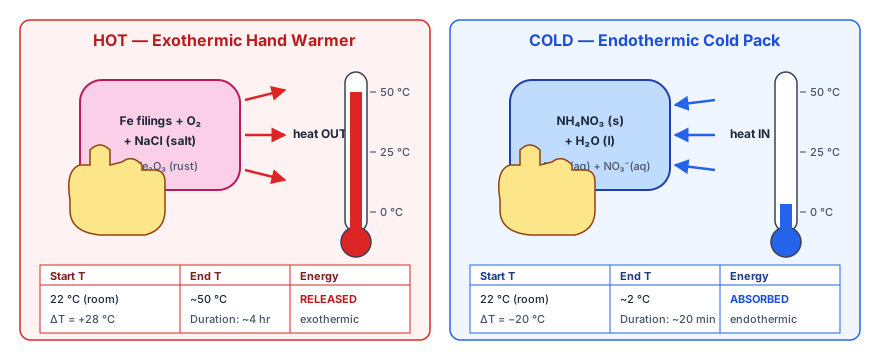
Two demo reactions, two thermometers. You'll collect (or analyze sample data for) temperature-over-time for an exothermic reaction (iron oxidation in a hand-warmer) and an endothermic reaction (ammonium nitrate dissolving in a cold-pack). Same starting temperature (~22 °C). Very different endings. Use the data to classify each reaction by what the THERMOMETER tells you.
Data Recap
- Hand-warmer (Fe + O₂ → Fe₂O₃): 22 °C → ~50 °C over 4 hours. Temperature rose → energy left the reaction and warmed the surroundings → EXOTHERMIC.
- Cold-pack (NH₄NO₃ + H₂O): 22 °C → ~2 °C over 20 minutes. Temperature dropped → energy entered the reaction from the surroundings → ENDOTHERMIC.
Connect to Earlier Weeks
Temperature change was already on your W1 evidence-of-reaction list. This week you go deeper: a temperature change is not just evidence that a reaction happened — it's also a measurement of how much energy moved into or out of the reaction. The rate of that temperature change connects to W3 (faster reaction → faster ΔT).
Station 2 – Where the Energy Hides: Bonds
Explain energy release/absorption in terms of bonds breaking and forming.
Station 2 — Where the Energy Hides: Bonds (20 points)
Zoom in on what's happening at the bond level. Energy stored in chemical bonds — chemical potential energy — is the bank account of a chemical reaction. Breaking bonds COSTS energy (you have to pay in to pull atoms apart). Forming bonds RELEASES energy (atoms 'fall together' into a more stable state). The net of those two movements is what your thermometer measured at Station 1.
The Net-Energy Rule
Net energy = ΔE_in (break bonds) − ΔE_out (form bonds)
- If forming bonds releases MORE energy than breaking bonds costs → energy flows OUT → EXOTHERMIC (reaction feels hot).
- If breaking bonds costs MORE energy than forming bonds releases → energy must be pulled IN → ENDOTHERMIC (reaction feels cold).
Combustion of methane (CH₄ + 2 O₂ → CO₂ + 2 H₂O) is exothermic because the new C=O and O–H bonds in CO₂ and H₂O are much stronger than the C–H and O=O bonds you started with. The difference comes out as heat and light.
Energy Is Always Conserved
Station 3 – Design a Hand-Warmer or Cold-Pack
Engineer a device that releases or absorbs thermal energy via chemical process.
Station 3 — Engineering Design Brief (25 points)
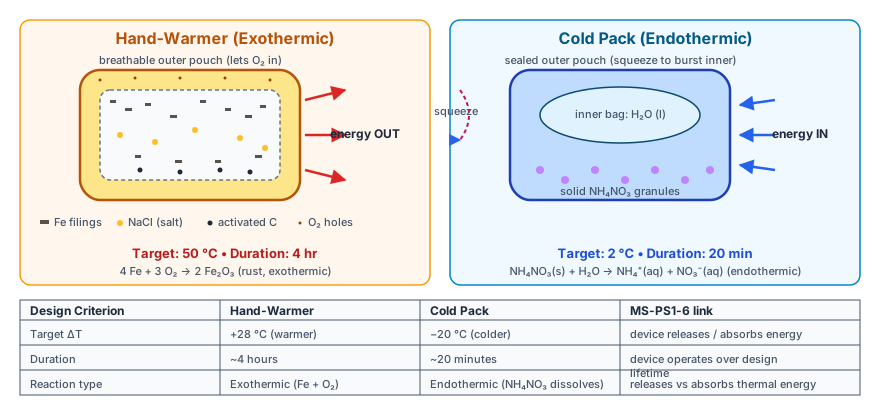
This is the MS-PS1-6 performance task for the cycle. You will design a chemical device that EITHER releases thermal energy (hand-warmer) OR absorbs thermal energy (cold-pack), then justify your choice of reactants using everything you've learned this week.
Your Design Must Specify
- Goal: warm or cool (and the target ΔT — e.g., +25 °C or −15 °C).
- Reactants you'd choose and WHY (which bonds break, which form, expected net energy direction).
- Container/delivery: how the user starts the reaction (squeeze a bag, open to air, mix). How is it safe?
- Duration target: how long should the temperature stay on-target? (Hand-warmer: hours. Instant cold-pack: minutes.)
- Test plan: what would you MEASURE to confirm the design works? (Thermometer, time, dose of reactant.)
Bridge to Cycle 8
Exit Ticket – Energy in Reactions Integration
Synthesize the week's energy-in-reactions story; spiral on conservation (W2) and rate (W3).
Exit Ticket — Energy in Reactions Integration (23 points)
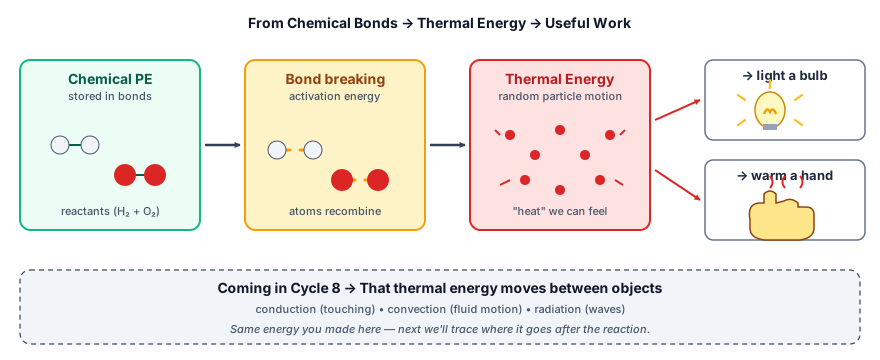
Six questions, 23 points: 2 NEW (energy-diagram reading; exo/endo classification), 2 SPIRAL (W2 mass conservation; W3 reaction rate with a catalyst), and 1 INTEGRATION + SEP-6 question that asks you to construct an explanation about a real device using bond-energy reasoning. Energy is conserved; atoms are conserved. The chemistry hasn't changed — your model of it has just gotten one layer richer.
Enrichment & Extension
Optional content if you finish early or want to go deeper.
Scientist Spotlight: Marie Maynard Daly
Marie Maynard Daly (1921–2003) was the first Black woman in the United States to earn a Ph.D. in chemistry (Columbia, 1947). Her doctoral work focused on the chemistry of digestion — specifically the enzymes (biological catalysts) that release energy from the food you eat. Every meal you've ever digested is a series of carefully-controlled chemical reactions, most of them exothermic, and the energy released is what powers your body's thermal regulation, your muscles, and your brain. Daly went on to study cholesterol and high-blood-pressure chemistry at Albert Einstein College of Medicine. Her work links directly to this week's content: living organisms are walking exothermic reactors — we run on the same bond-energy bookkeeping you saw at Station 2, just at higher precision. Daly established a scholarship at Queens College for Black students in science, honoring her father who had to abandon his own science studies for lack of funds.
Environmental Justice: Combustion Heat Islands
The exothermic combustion reactions you studied this week — methane in stoves, gasoline in engines, diesel in trucks, natural gas in power plants — release thermal energy into urban air. In dense, low-income neighborhoods of St. Louis, Memphis, and across the Mississippi River corridor, the combustion is concentrated: more trucks, more power-plant exhaust, more fossil-fuel heating, and less tree canopy to absorb the heat. The local air is measurably hotter than wealthier neighborhoods just miles away — sometimes by 7–10 °F on summer afternoons. This is called the urban heat island effect, and it has real health consequences: higher heat-related ER visits, higher cooling costs, more childhood asthma. The chemistry is the same chemistry you learned this week — exothermic reactions transferring energy to the surroundings. The injustice is in who gets to breathe the cleanest air and stand under the most shade. Next cycle (C8W3 Urban Heat Island) you'll measure heat transfer at the surface level and design surface-treatment interventions.
Week 4 Complete!
Next: Cycle 8 begins — thermal energy and heat transfer. You'll trace the energy your reactions released into surfaces, fluids, and waves.